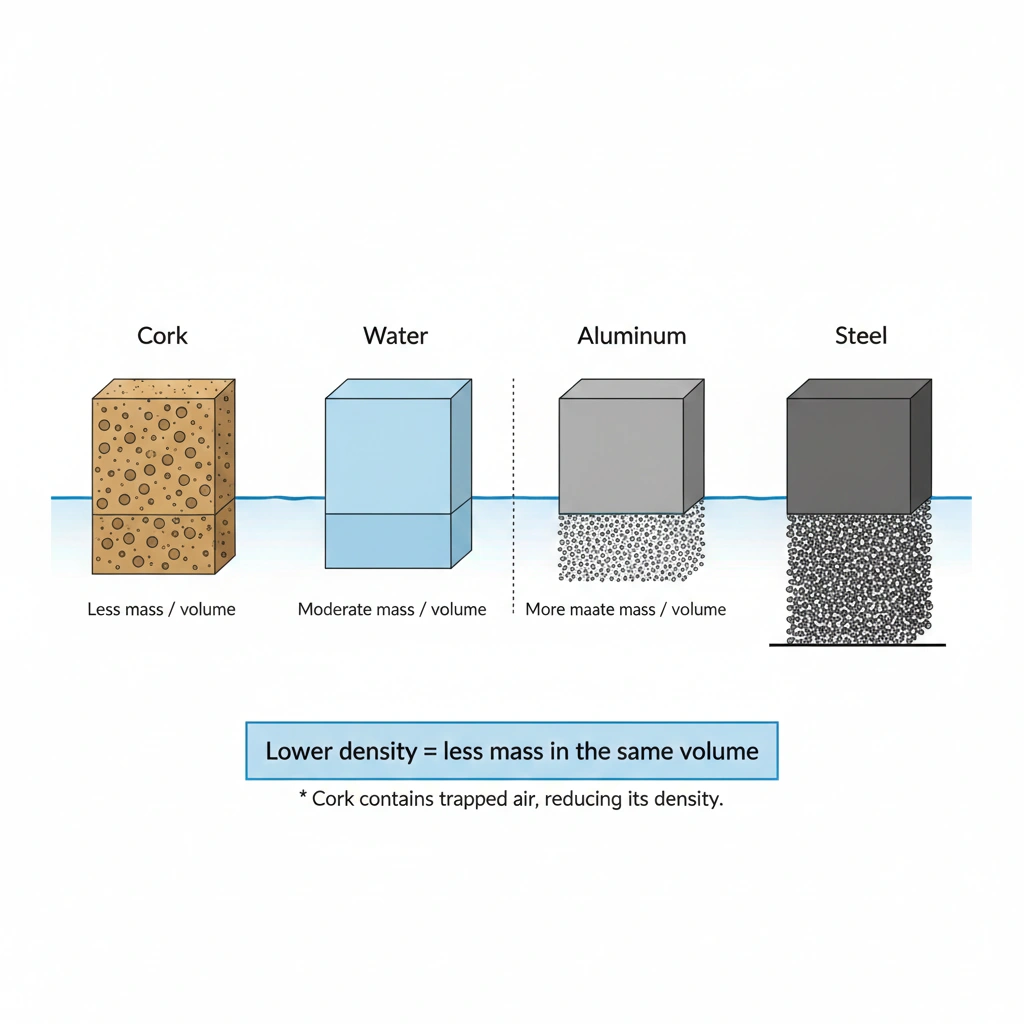
Which has the lowest density?
-
A
Water
-
B
Cork
-
C
Aluminum
-
D
Steel
The substance with the lowest density is cork.
Density is defined as mass per unit volume. Materials with a large amount of empty space within their structure have lower densities because less mass is packed into the same volume. Cork is composed of a porous, air-filled cellular structure, which gives it a very low density compared with liquids and metals.
A) Water
Water has a density of about 1.0 g/cm³. While this is relatively low compared with metals, it is still much higher than the density of cork.
B) Cork
Cork has a density of roughly 0.2–0.3 g/cm³ due to its porous structure filled with trapped air. This makes cork extremely light for its size and allows it to float easily on water, giving it the lowest density among the options.
C) Aluminum
Aluminum is a metal with a density of about 2.7 g/cm³. Although it is considered a lightweight metal, it is far denser than cork or water.
D) Steel
Steel is a dense metal with a density of approximately 7.8 g/cm³, making it the heaviest substance listed.
Conclusion
Comparing the densities shows that cork, with its air-filled structure, has the lowest density of all the choices.
Topic Flashcards
Click to FlipWhat is the definition of density, and what is its standard unit?
Density is mass per unit volume. Its standard unit is kilograms per cubic meter (kg/m³) or grams per cubic cubic centimeter (g/cm³).
Rank these materials from least dense to most dense: Cork, Steel, Water, Aluminum.
Cork (0.24 g/cm³) < Water (1.0 g/cm³) < Aluminum (2.7 g/cm³) < Steel (7.8 g/cm³).
Why does cork float on water while a solid piece of aluminum sinks, even though a large aluminum boat can float?
Cork floats because its density is less than water. Solid aluminum sinks because its density is greater. An aluminum boat floats because its shape displaces a large volume of water, creating an overall average density (mass of the boat / volume it occupies) that is less than water's density.
Cork's very low density is due to its physical structure. Describe that structure and explain how it affects density.
Cork has a porous, honeycomb-like structure filled with trapped air. Since air has very low mass, the overall mass of a cork block is low for its size, resulting in a low density (mass/volume).
How is the property of density used in practical applications? (Hint: think of life jackets, ship design, or insulation).
Low-density materials are used for buoyancy (life jackets, floats), thermal insulation (cork boards, foam), and lightweight construction. High-density materials are used for ballast, radiation shielding, and structural weight.