Which statement is most strongly supported by the cell theory?
-
A
Plant cells have similar cell parts to animal cells.
-
B
Cells house their genetic information in the nucleus.
-
C
Blood cells arise from stem cells in the bone marrow.
-
D
Nonliving things lack a cell and associated organelles.
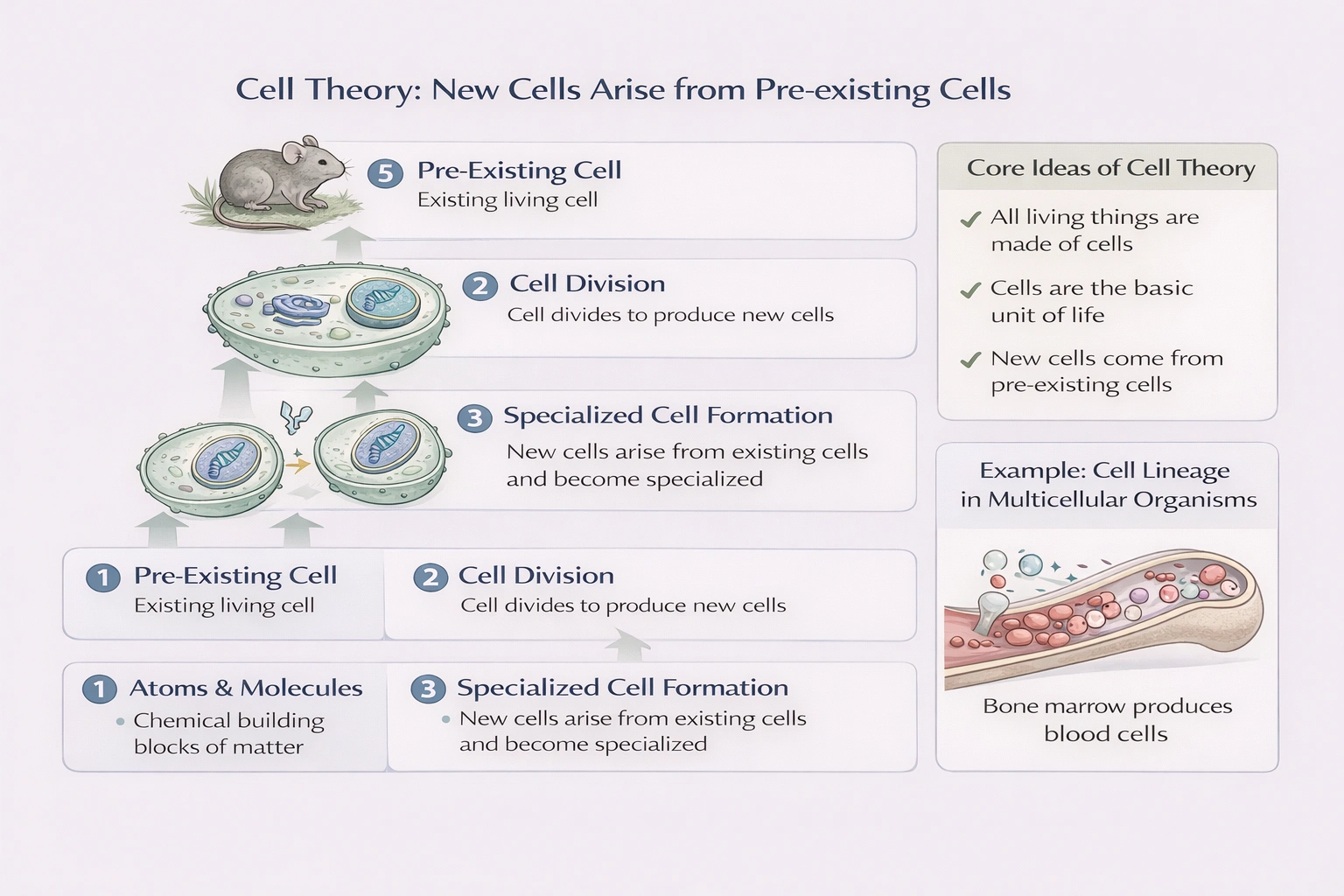
The statement most strongly supported by the cell theory is that blood cells arise from stem cells in the bone marrow.
The cell theory is a foundational principle of modern biology with three core tenets: 1) All living organisms are composed of one or more cells. 2) The cell is the basic unit of structure, function, and organization in all organisms. 3) All cells arise from pre-existing cells through cell division. The third tenet, emphasizing biogenesis (life from life), directly opposes the archaic idea of spontaneous generation. It asserts the continuity of cellular life, where every cell has a lineage traceable to a previous cell. The process of hematopoiesis, where hematopoietic stem cells in the bone marrow divide and differentiate into all types of blood cells, is a perfect, observable illustration of this principle. It demonstrates how new, specialized somatic cells are generated from existing, less specialized cells.
A) Plant cells have similar cell parts to animal cells.
While comparative cell biology reveals many shared organelles (ribosomes, mitochondria, Golgi apparatus), this observation is a consequence of common eukaryotic ancestry, not a direct postulate of the cell theory. The theory addresses the universality of cells as life's units but does not specify the degree of similarity between cell types. Furthermore, plant and animal cells also have significant differences (e.g., cell walls, chloroplasts).
B) Cells house their genetic information in the nucleus.
This statement is not universally true and therefore is not supported by the core cell theory. Prokaryotic cells (bacteria and archaea), which are unequivocally living organisms, do not have a membrane-bound nucleus. Their genetic material is located in a region called the nucleoid. The cell theory applies to all cells, so a claim that is specific only to eukaryotic cells contradicts the theory's broad applicability.
C) Blood cells arise from stem cells in the bone marrow.
This directly exemplifies the third tenet: all cells from pre-existing cells. Hematopoietic stem cells undergo mitosis and differentiation to produce erythrocytes, leukocytes, and platelets. This process provides a clear, modern example of how complex multicellular organisms generate their cellular components through cell division, reinforcing the principle of cellular lineage central to the theory.
D) Nonliving things lack a cell and associated organelles.
While this is a true inference, it is a corollary rather than a core tenet of the cell theory. The theory positively states what living things are made of (cells), not what nonliving things lack. Furthermore, some entities like viruses challenge simple definitions; they are nonliving but can contain genetic material and require cellular machinery to replicate. The theory's focus is on the nature of living organisms, not on defining the nonliving.
Conclusion
The cell theory provides the conceptual framework for understanding life at its most fundamental level. Its power lies in its three simple, universally applicable statements. The observation that blood cells originate from stem cells is a specific, empirical validation of the theory's assertion that cells beget cells. In contrast, statements about organelle similarity or location are either non-universal or descriptive details that extend from, but are not central to, the theory's foundational claims. The process of hematopoiesis provides a powerful, direct illustration of the theory's principle of cellular continuity.
Topic Flashcards
Click to FlipWhat is one core principle of the cell theory?
All cells arise from pre-existing cells.
Which biological process best demonstrates that new cells come from existing cells?
Stem cell division and differentiation.
How do blood cells form in the human body?
They arise from hematopoietic stem cells in the bone marrow.
What type of cells give rise to specialized cells like red and white blood cells?
Stem cells.
Which part of the cell theory rejects spontaneous generation?
The principle that cells come only from pre-existing cells.