What happens to glucose during glycolysis?
-
A
Its energy is entirely lost.
-
B
It splits into molecules of pyruvic acid.
-
C
It is stored in NADH.
-
D
It joins with molecules of citric acid.
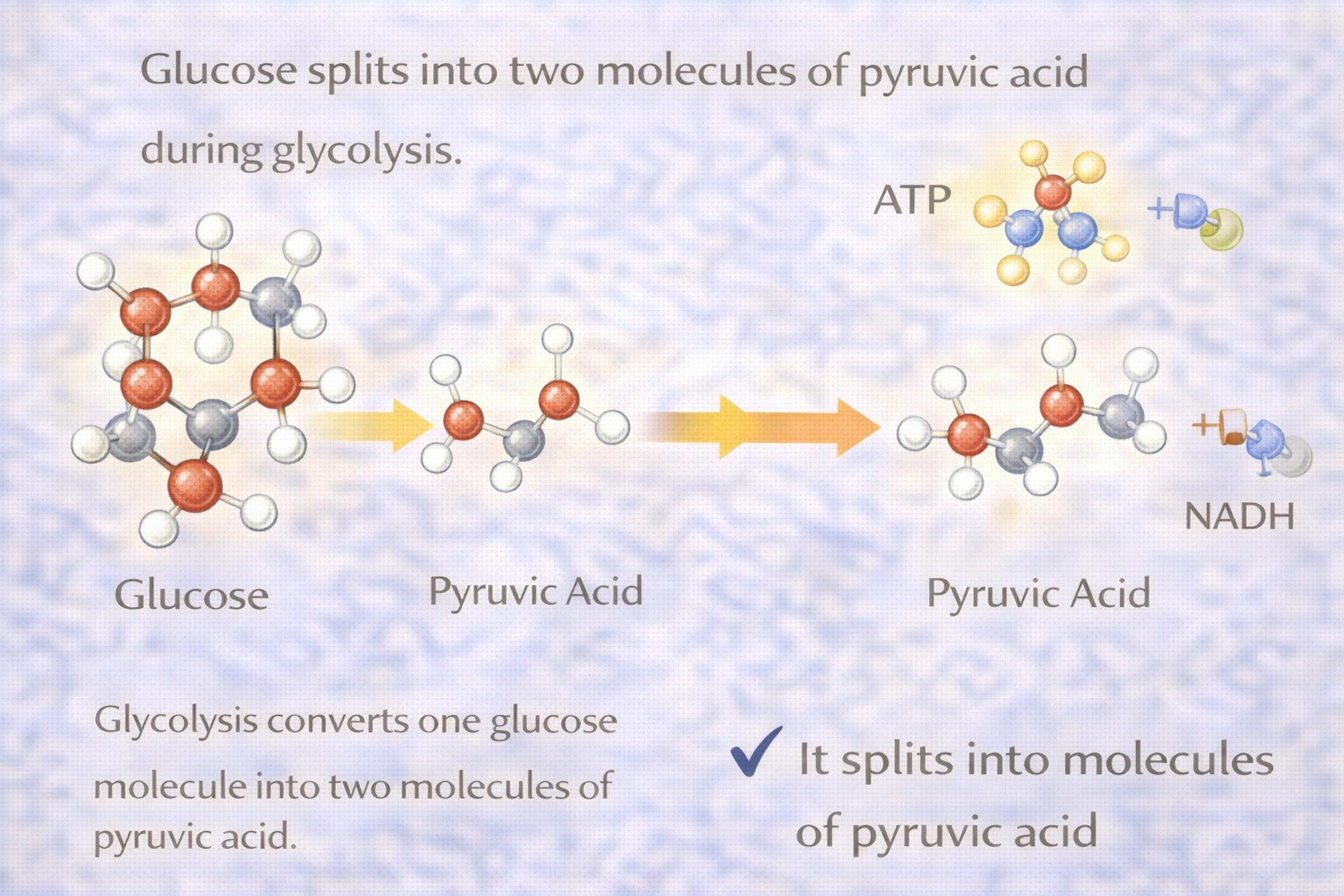
Glucose splits into two molecules of pyruvic acid during glycolysis.
Glycolysis is the first stage of cellular respiration and takes place in the cytoplasm of the cell. In this process, one molecule of glucose (which has 6 carbon atoms) is broken down through a series of enzyme-controlled reactions into two molecules of pyruvic acid (each with 3 carbon atoms). During this breakdown, some of the chemical energy stored in glucose is transferred to ATP and NADH, which the cell can later use to produce more energy. This step is essential because it prepares glucose for further energy extraction in the mitochondria.
A) Its energy is entirely lost
This is incorrect. Although some energy is released as heat, most of the energy from glucose is conserved in chemical form. Glycolysis produces a net gain of 2 ATP molecules and 2 NADH molecules, which store energy for later use in the electron transport chain. Therefore, glucose’s energy is not entirely lost.
B) It splits into molecules of pyruvic acid
This is correct. During glycolysis, one glucose molecule is divided into two molecules of pyruvic acid (also called pyruvate). This splitting is the defining outcome of glycolysis and allows the cell to continue extracting energy from glucose in later stages of respiration.
C) It is stored in NADH
This is incorrect. NADH does not store glucose. Instead, NADH is a carrier molecule that stores high-energy electrons and hydrogen ions released during glucose breakdown. The glucose molecule itself is chemically converted into pyruvic acid.
D) It joins with molecules of citric acid
This is incorrect. Citric acid is formed later during the Krebs cycle when acetyl-CoA (derived from pyruvic acid) combines with oxaloacetate. Glucose does not directly join with citric acid during glycolysis.
Conclusion
During glycolysis, glucose is broken down into two molecules of pyruvic acid while releasing energy stored in ATP and NADH. Therefore, the correct answer is B) It splits into molecules of pyruvic acid.

Topic Flashcards
Click to FlipWhat are the two primary 3-carbon molecules produced at the end of the glycolysis pathway?
Two molecules of pyruvic acid (pyruvate). This is the main chemical transformation of glycolysis.
In which part of the cell does glycolysis occur, and does it require oxygen?
It occurs in the cytoplasm. It does not require oxygen, making it an anaerobic process.
What are the two main energy-carrying molecules produced in small quantities during glycolysis?
A net gain of 2 ATP molecules and 2 NADH molecules. These capture some of the energy released from splitting glucose.
True or False: Glycolysis is the final stage of cellular respiration where glucose is completely broken down to CO₂ and water.
False. Glycolysis is only the first stage. It partially breaks down glucose to pyruvate, which is further processed in the mitochondria.
What is the net number of ATP molecules a cell gains from breaking down one glucose molecule via glycolysis?
Two ATP molecules (net gain). The process uses 2 ATP initially but produces 4 ATP, resulting in a net gain of 2.