What process do cells in the tip of a plant’s root undergo to increase in number?
-
A
Meiosis
-
B
Cytokinesis
-
C
Fractioning
-
D
Mitosis
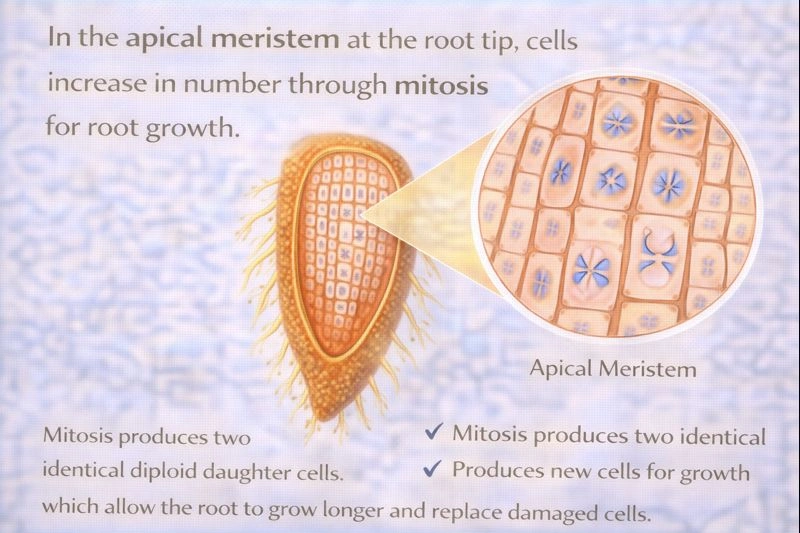
Cells in the tip of a plant’s root increase in number by undergoing mitosis.
Root tips contain a region called the apical meristem, which is made up of undifferentiated, actively dividing somatic cells. These cells are responsible for primary growth, meaning the increase in length of the root. To achieve this, the cells must divide in a controlled and accurate way so that new cells are genetically identical to the original ones and can continue to function as normal plant cells. This type of division is mitosis, which produces two identical diploid daughter cells from one parent cell. Continuous mitotic division in the root tip allows the root to grow longer, form new tissues, and replace damaged cells.
A) Meiosis
Meiosis is a type of cell division that occurs only in reproductive cells to produce gametes (such as pollen and ovules in plants). It reduces the chromosome number by half and produces four genetically different haploid cells. Since root tip cells are somatic cells involved in growth and not reproduction, they do not undergo meiosis.
B) Cytokinesis
Cytokinesis is the physical division of the cytoplasm that occurs after the nucleus has divided. Although it is an important step in cell division, it is not the main process that increases cell number on its own. Cytokinesis simply completes the division that was initiated by mitosis or meiosis. Without mitosis, cytokinesis would not produce properly formed new cells for growth.
C) Fractioning
Fractioning is not a biological process related to cell division or growth. It is not used to describe how cells reproduce or increase in number in living tissues. This option is incorrect and unrelated to root growth.
D) Mitosis
Mitosis is the correct process. It is the division of the nucleus in somatic cells that results in two genetically identical daughter cells. In root tips, mitosis occurs continuously in the meristematic tissue, providing new cells for elongation, tissue formation, and repair. This is the fundamental mechanism behind root growth.
Conclusion
Cells in the tip of a plant’s root increase in number through mitosis, which produces identical somatic cells needed for growth and development. Therefore, the correct answer is D) Mitosis.

Topic Flashcards
Click to FlipIn which specific region of a plant root are cells actively dividing to enable primary growth in length?
The apical meristem. This region at the root tip contains undifferentiated cells undergoing rapid mitosis.
What is the name of the nuclear division process that produces two genetically identical, diploid daughter cells from one parent cell?
Mitosis. This is the process used for growth and repair in somatic (body) cells of plants and animals.
True or False: Cytokinesis is the complete cell division process that increases the total number of cells.
False. Cytokinesis is the final step that splits the cytoplasm after mitosis. Mitosis (nuclear division) is the primary process that enables the increase in cell number.
Which type of cell division, mitosis or meiosis, would be involved in producing a plant's pollen or egg cells?
Meiosis. Gamete production requires meiosis to halve the chromosome number, while root growth uses mitosis.
What is a key genetic outcome for the new cells produced in the root tip compared to the original parent cell?
They are genetically identical. Mitosis ensures each daughter cell receives an exact copy of the parent cell's DNA.