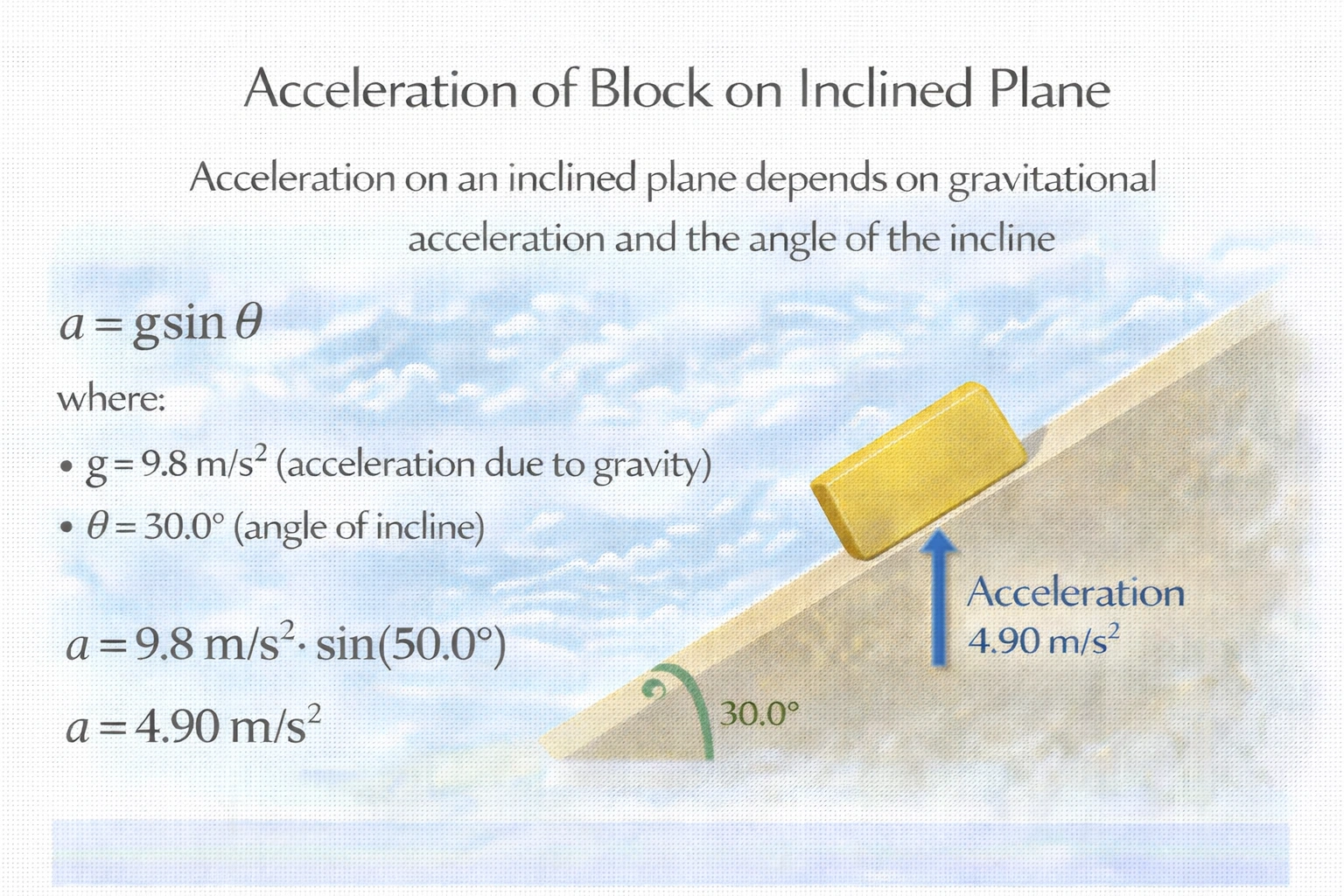
What is the acceleration of a 5.00 kg block standing on a frictionless 30.0º inclined plane? m = ?
-
A
8.49 s2
-
B
24.5 s2
-
C
4.90 s2
-
D
9.80 s2
The acceleration of the block on the inclined plane depends on the gravitational acceleration and the angle of the incline.
To calculate the acceleration of the block on the inclined plane, we use the formula for the acceleration due to gravity along the plane:
where:
- g is the acceleration due to gravity, approximately 9.8 m/s².
- θ is the angle of the incline, which is 30.0º.
Plugging in the values:
Therefore, the acceleration of the block is 4.90 m/s².
- A) 8.49 m/s²:
- This value does not match the calculation, as the correct answer is 4.90 m/s².
- B) 24.5 m/s²:
- This value is too high, and does not match the expected value based on the incline and gravity. The correct answer is 4.90 m/s².
- C) 4.90 m/s²:
- This is the correct answer, as shown by the calculation above.
- D) 9.80 m/s²:
- This value represents the acceleration due to gravity, but it is not the acceleration of the block on the incline. The block’s acceleration is reduced by the angle of the incline and is calculated as 4.90 m/s².
Conclusion: The correct acceleration of the block is 4.90 m/s², making C) 4.90 m/s² the correct answer.

Topic Flashcards
Click to FlipFor an object on a frictionless incline, which component of its weight is responsible for its acceleration down the plane, and how is it calculated?
The component parallel to the incline, calculated as m*g*sin(θ)
Using Newton's Second Law (F_net = m*a), derive the formula for the acceleration (a) of an object on a frictionless incline of angle θ. Show why the mass (m) cancels out.
The net force down the incline is F_parallel = m*g*sin(θ). Setting this equal to m*a gives m*a = m*g*sin(θ). Dividing both sides by m yields a = g*sin(θ). The mass cancels, showing the acceleration is independent of it.
On a frictionless 30° incline, an object accelerates at 4.90 m/s². If the incline angle is increased to 60°, would the acceleration increase, decrease, or stay the same? Calculate the new acceleration (use g = 9.80 m/s²).
It would increase. The new acceleration would be a = g*sin(60°) = 9.80 * 0.866 ≈ 8.49 m/s².
What is the magnitude and direction of the other component of the weight (the one perpendicular to the incline)? What force balances it for an object remaining on the surface?
It is m*g*cos(θ), directed perpendicularly into the incline. It is balanced by the normal force exerted by the surface, which is equal in magnitude and opposite in direction.
In this problem, the mass (5.00 kg) was given but not needed to find the acceleration. Describe a scenario involving an inclined plane where you would need to know the object's mass to solve the problem.
You would need the mass if calculating a force, such as the gravitational force down the incline (F_parallel = m*g*sinθ), the normal force (F_n = m*g*cosθ), or if friction were present (as the frictional force μ*m*g*cosθ depends on mass).