What is the result of meiosis II?
-
A
Two secondary sex cells
-
B
Four haploid daughter cells
-
C
Two primary sex cells
-
D
Duplication of primary sex cells
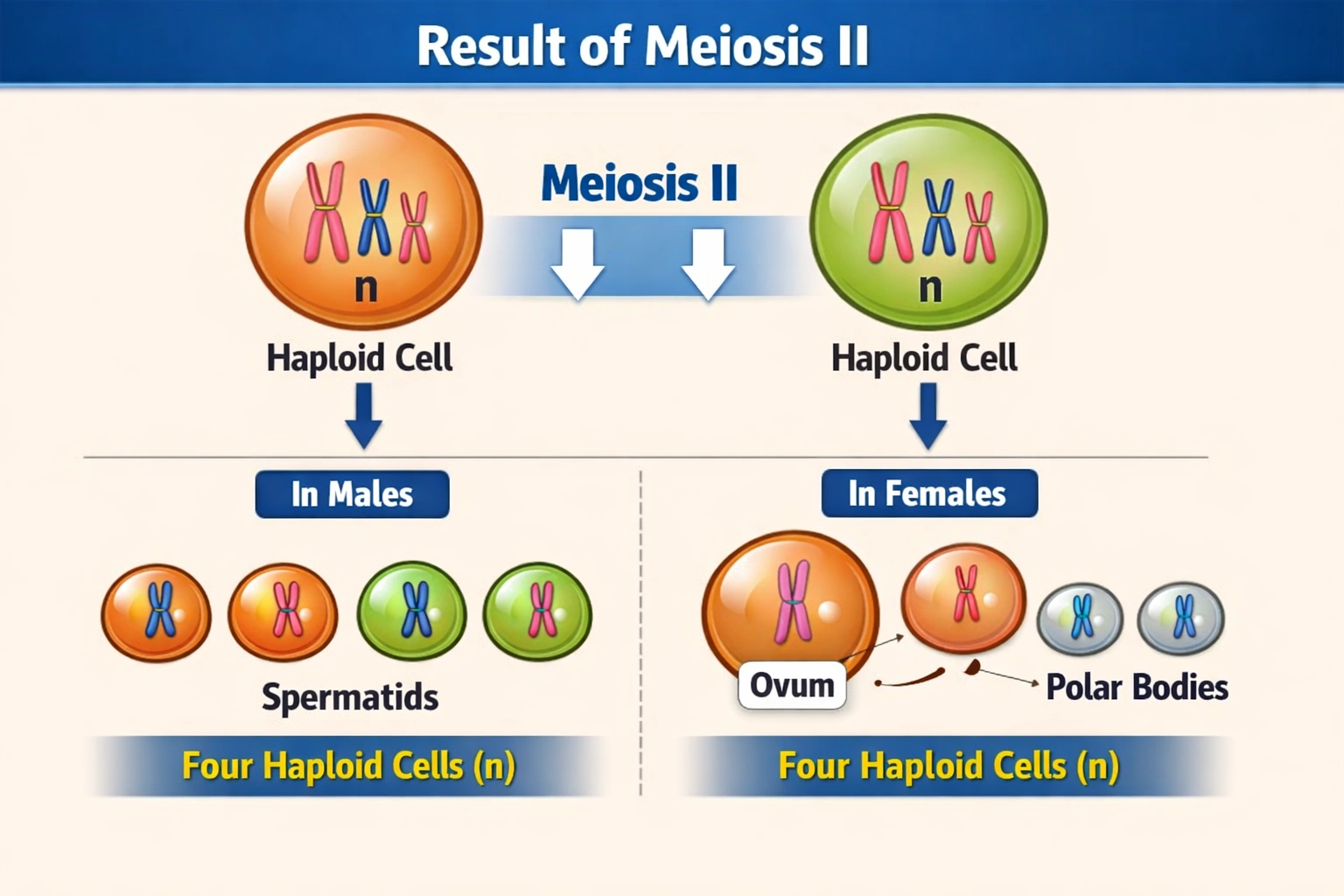
Meiosis II results in four haploid daughter cells.
Meiosis is a two-stage division process that produces gametes (sex cells) for sexual reproduction. After meiosis I reduces the chromosome number from diploid (2n) to haploid (n), meiosis II separates the sister chromatids of each chromosome. This second division is similar to mitosis in mechanism, but it begins with haploid cells. The final outcome is four genetically unique haploid cells, each containing one complete set of chromosomes.
A) Two secondary sex cells
Secondary sex cells (secondary spermatocytes in males or secondary oocytes in females) are produced at the end of meiosis I, not meiosis II. Meiosis I separates homologous chromosomes and produces two haploid cells. Meiosis II acts on these two cells to produce four total cells, so this option is incorrect.
B) Four haploid daughter cells
This is the correct answer. During meiosis II, each of the two haploid cells formed in meiosis I divides again. The sister chromatids are pulled apart, and each cell splits into two new cells. This results in a total of four haploid daughter cells.
In males, these cells become spermatids, which later mature into sperm. In females, meiosis II produces one ovum and additional polar bodies. All of these cells contain half the chromosome number of the original parent cell and are genetically different due to crossing over and independent assortment.
C) Two primary sex cells
Primary sex cells (spermatogonia in males and oogonia in females) are diploid germ cells that exist before meiosis begins. They divide by mitosis and then enter meiosis I. They are not produced by meiosis II, so this option is incorrect.
D) Duplication of primary sex cells
Cell duplication of primary sex cells occurs through mitosis, not meiosis. Meiosis is a reduction and separation process designed to form gametes, not to duplicate cells. Therefore, this option is incorrect.
Conclusion
Meiosis II separates sister chromatids in two haploid cells, producing a total of four haploid daughter cells that can function as gametes in sexual reproduction. Therefore, the correct answer is B) Four haploid daughter cells.

Topic Flashcards
Click to FlipAt the start of Meiosis II, what is the chromosome number (haploid or diploid) of the two cells that will divide?
Haploid. Meiosis I reduces the chromosome number from diploid to haploid. Meiosis II then divides these haploid cells.
What specific structures are separated from each other during the anaphase stage of Meiosis II?
Sister chromatids. In Meiosis II, the sister chromatids of each chromosome are pulled apart to opposite poles of the cell.
In human oogenesis (egg formation), how many functional haploid cells result from the completion of Meiosis II?
One functional ovum (egg) and additional polar bodies. While four haploid products are created, only one becomes a viable egg cell.
True or False: The four daughter cells produced at the end of meiosis are genetically identical to each other.
False. Due to crossing over in Prophase I and independent assortment in Meiosis I, the four haploid cells are genetically unique.
Does DNA replication occur between the end of Meiosis I and the beginning of Meiosis II?
No. DNA replication occurs only once, before Meiosis I begins. There is no S phase between Meiosis I and II.