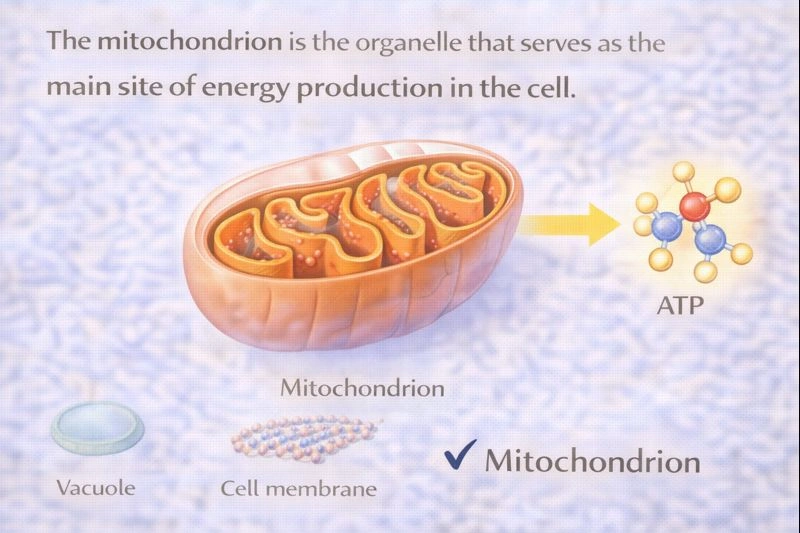
Which organelle is the site of energy production?
-
A
Mitochondrion
-
B
Vacuole
-
C
Cell membrane
-
D
Ribosome
The mitochondrion is the organelle that serves as the main site of energy production in the cell.
Cells require a constant supply of energy to carry out essential processes such as active transport, biosynthesis, cell division, and movement. This energy is provided in the form of ATP (adenosine triphosphate). The majority of ATP in eukaryotic cells is generated inside mitochondria through the process of cellular respiration, which includes the Krebs cycle and the electron transport chain. Because of this central role in energy production, mitochondria are commonly referred to as the “powerhouses of the cell.”
A) Mitochondrion
Mitochondria are double-membrane organelles specialized for ATP production. The outer membrane encloses the organelle, while the inner membrane is folded into structures called cristae, which increase surface area for chemical reactions. Inside the inner membrane is the matrix, which contains enzymes for the Krebs cycle.
Mitochondria produce ATP through oxidative phosphorylation, where electrons pass through the electron transport chain and drive the formation of ATP using oxygen as the final electron acceptor. They also contain their own DNA and ribosomes, allowing them to produce some of their own proteins. Because ATP synthesis occurs primarily in mitochondria, this option is correct.
B) Vacuole
Vacuoles function mainly in storage. In plant cells, the central vacuole stores water, ions, pigments, and waste products and helps maintain turgor pressure. In animal cells, vacuoles are smaller and involved in transport and storage.
Vacuoles do not participate in cellular respiration and do not generate ATP, so they are not sites of energy production.
C) Cell membrane
The cell membrane regulates what enters and leaves the cell and plays a role in cell communication and protection. Although it maintains ion gradients that are important for cellular function, it does not carry out ATP synthesis.
Therefore, it is not the primary site of energy production.
D) Ribosome
Ribosomes are responsible for protein synthesis. They read messenger RNA and assemble amino acids into polypeptide chains.
While this process requires energy, ribosomes do not produce ATP themselves. Instead, they consume ATP generated elsewhere in the cell.
Conclusion
ATP, the cell’s usable form of energy, is produced mainly in the mitochondria through cellular respiration. Therefore, the correct answer is A) Mitochondrion.

Topic Flashcards
Click to FlipWhat is the primary molecule produced by the mitochondrion that serves as the cell's universal energy currency?
ATP (Adenosine Triphosphate). The mitochondrion produces the majority of the cell's ATP through cellular respiration.
Which cellular process, involving the Krebs cycle and electron transport chain, occurs within the mitochondrion?
Aerobic cellular respiration. This process extracts energy from nutrients to produce ATP.
True or False: The inner membrane of the mitochondrion is smooth and unfolded to maximize storage capacity.
False. The inner membrane is folded into cristae, which dramatically increases surface area to house the proteins of the electron transport chain.
What organelle is often called the "powerhouse of the cell" and why?
The mitochondrion. This nickname comes from its central role in generating most of the cell's ATP, which powers cellular work.
Name one key structural feature that distinguishes the mitochondrion from organelles like the vacuole or ribosome.
It has a double membrane. The inner membrane is highly folded (forming cristae), and the organelle contains its own small loop of DNA.