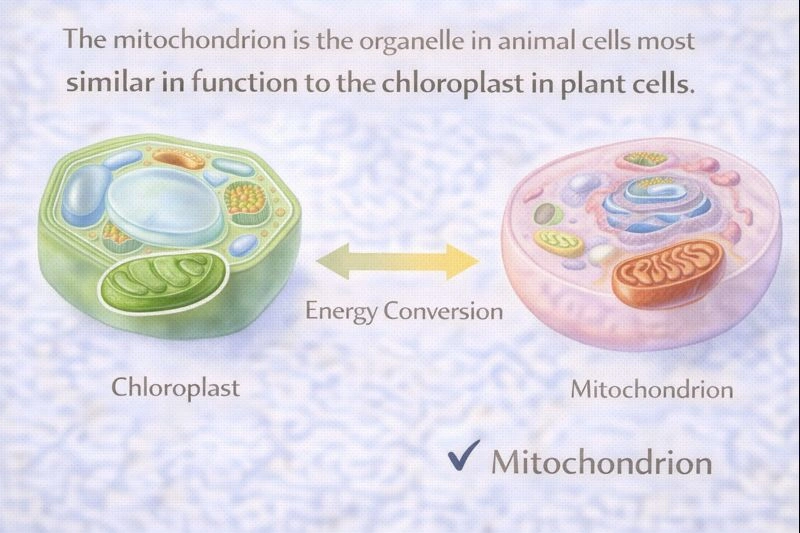
Which organelle in animal cells is most similar in function to the chloroplast in plant cells?
-
A
Cell membrane
-
B
Vacuole
-
C
Ribosome
-
D
Mitochondrion
The mitochondrion is the organelle in animal cells most similar in function to the chloroplast in plant cells.
Both chloroplasts and mitochondria are specialized for energy conversion, which is essential for cell survival. Chloroplasts capture light energy and convert it into chemical energy stored in glucose through photosynthesis. Mitochondria then take chemical energy from glucose and convert it into ATP through cellular respiration. Although these processes are different, both organelles serve the same fundamental purpose: transforming energy into a usable form for the cell. They also share structural similarities, including double membranes, their own DNA, and internal membrane systems involved in electron transport chains.
A) Cell membrane
The cell membrane forms the outer boundary of the cell and controls what enters and leaves. It also plays a role in communication between cells using receptors and signaling molecules. However, it does not perform energy conversion or energy production. Since chloroplasts specialize in converting energy, the cell membrane is not functionally similar.
B) Vacuole
Vacuoles are mainly involved in storage. In plant cells, the central vacuole stores water, ions, pigments, and waste products and helps maintain cell pressure. In animal cells, vacuoles are much smaller and also serve storage and transport functions. They do not participate in converting energy from one form to another, so they are not comparable to chloroplasts.
C) Ribosome
Ribosomes are responsible for protein synthesis. They read messenger RNA and assemble amino acids into polypeptide chains. While proteins are vital to metabolism, ribosomes themselves do not generate or convert energy. Their function is completely different from that of chloroplasts.
D) Mitochondrion
Mitochondria are the sites of cellular respiration in animal cells. They convert the chemical energy stored in glucose into ATP, the molecule that directly powers most cellular activities. Chloroplasts convert sunlight into glucose, and mitochondria convert glucose into ATP. Both organelles:
- Perform energy transformation
- Contain their own DNA
- Are surrounded by double membranes
- Use electron transport chains
- Are thought to have evolved from ancient bacteria through endosymbiosis
Because they both function as the main energy-processing centers of the cell, mitochondria are the closest functional equivalent to chloroplasts in animal cells.
Conclusion
Chloroplasts and mitochondria serve similar roles in different types of cells by converting energy into biologically useful forms. Chloroplasts convert light energy into glucose, while mitochondria convert glucose into ATP. Therefore, the correct answer is D) Mitochondrion.

Topic Flashcards
Click to FlipWhich two organelles are primarily responsible for transforming energy from one form into a usable form for the cell?
Chloroplasts (convert light to chemical energy in glucose) and mitochondria (convert chemical energy in glucose to ATP).
What is the key functional similarity between a plant's chloroplast and an animal cell's mitochondrion?
Both are the primary energy-converting organelles of their respective cells, acting as biochemical power plants.
Which organelle in an animal cell shares an evolutionary history with chloroplasts, suggested by having its own DNA and double membrane?
The mitochondrion. Both are thought to have originated from free-living bacteria via endosymbiosis.
True or False: Both chloroplasts and mitochondria are involved in the process of cellular respiration.
False. Mitochondria perform cellular respiration. Chloroplasts perform photosynthesis, which is the complementary process.
If a chloroplast is a "sugar factory," what is the analogous role of the mitochondrion in an animal cell?
It is the "ATP power plant." It takes the sugar (from food) and converts its energy into ATP, the cell's universal energy currency.