What is true of a measurement in which a chemical weighs 0.031 g?
-
A
It is accurate to 0.1 g and contains 4 significant figures.
-
B
. It is accurate to 0.01 g and contains 3 significant figures.
-
C
It is accurate to 0.001 g and contains 2 significant figures.
-
D
It is accurate to 0.0001 g and contains 1 significant figure.
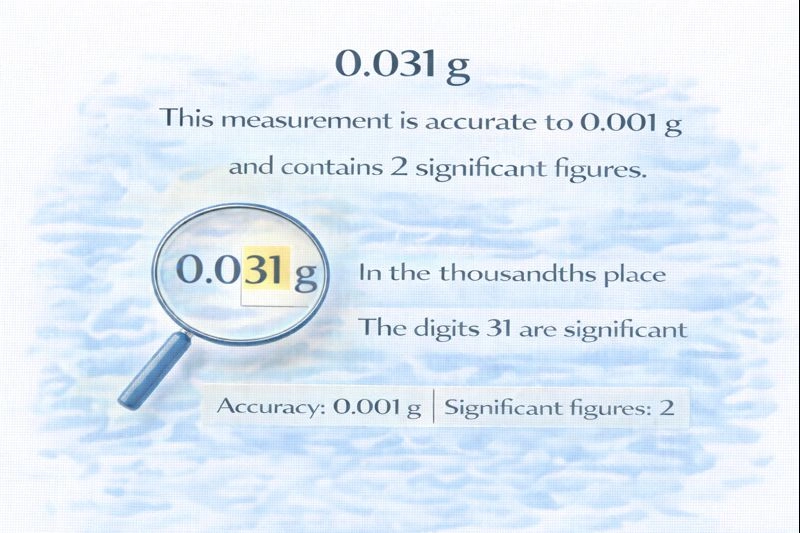
The measurement is accurate to 0.001 g and contains 2 significant figures.
The recorded mass is 0.031 g. To interpret this measurement correctly, two ideas are important: significant figures and the precision of the measuring instrument. Leading zeros (zeros before the first nonzero digit) do not count as significant figures; they only locate the decimal point. The significant digits here are the 3 and the 1, giving a total of two significant figures. The final recorded digit is in the thousandths place, indicating the measurement was taken to the nearest 0.001 g.
A. It is accurate to 0.1 g and contains 4 significant figures
The value is not measured to the tenths place, and the leading zeros do not count as significant figures. The measurement does not contain four significant figures.
B. It is accurate to 0.01 g and contains 3 significant figures
The measurement extends to the thousandths place, not the hundredths place, and only two digits (3 and 1) are significant, not three.
C. It is accurate to 0.001 g and contains 2 significant figures
This is correct. The last recorded digit is in the thousandths place (0.001 g), and only the digits 3 and 1 are significant.
D. It is accurate to 0.0001 g and contains 1 significant figure
There is no digit in the ten-thousandths place, and the measurement clearly has two significant figures, not one.
Conclusion
The measurement 0.031 g shows precision to the nearest thousandth of a gram, and only the nonzero digits contribute to its significance. This indicates a precision of 0.001 g and a total of two significant figures.

Topic Flashcards
Click to FlipThe rule for zeros that appear at the beginning of a decimal number (e.g., in 0.031).
Leading zeros are never significant; they only set the decimal place.
The place value of the last digit in a measurement determines its ______.
Leading zeros are never significant; they only set the decimal place.
The place value of the last digit in a measurement determines its ______.
Precision (or uncertainty).
The number of significant figures in the measurement 0.00520 kg.
Three (the 5, 2, and the trailing zero are all significant).
If a balance measures to the nearest 0.01 g, what is the correct way to record a mass of five grams?
5.00 g (to show precision to the hundredths place).