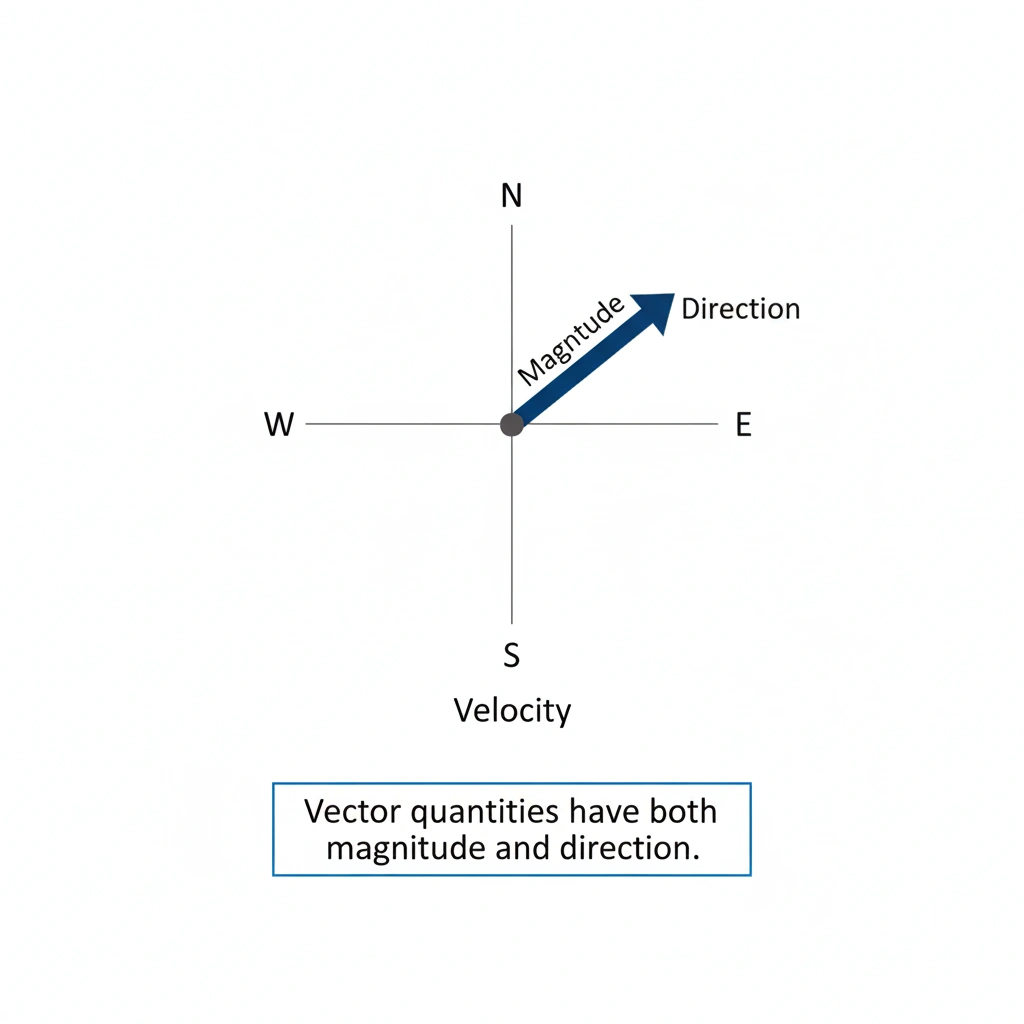
Which describes a vector quantity?
-
A
5 miles per hour due southwest
-
B
5 miles per hour
-
C
5 miles
-
D
None of the above
A vector quantity is described by “5 miles per hour due southwest.”
A vector quantity must include both a magnitude (how much) and a direction (which way). Velocity is a classic example of a vector because it specifies not only speed but also the direction of motion.
A) 5 miles per hour due southwest
This description includes a numerical value (5 miles per hour) and a direction (due southwest). Because it contains both magnitude and direction, it qualifies as a vector quantity.
B) 5 miles per hour
This describes speed only, without any direction. Speed is a scalar quantity, not a vector.
C) 5 miles
This represents distance, which has magnitude but no direction. Distance is also a scalar quantity.
D) None of the above
Since option A correctly describes a vector quantity, this choice does not apply.
Conclusion
Vector quantities require both magnitude and direction. Among the options given, only “5 miles per hour due southwest” satisfies this requirement.
Topic Flashcards
Click to FlipWhat two pieces of information are required to define a vector quantity?
A magnitude (size or amount) and a direction.
From the options given, which one is a vector and what is its name (e.g., velocity, force)?
"5 miles per hour due southwest" is the vector. It specifically describes velocity.
What is the name for a physical quantity that has only magnitude and no direction? Give an example from the options.
A scalar quantity. Examples from the options are "5 miles per hour" (speed) and "5 miles" (distance).
How would you graphically represent the vector "5 miles per hour due southwest"?
Draw an arrow. The length of the arrow represents the magnitude (5 mph), scaled appropriately. The direction of the arrow points to the southwest.
Two forces act on an object: 3 N north and 4 N east. Is the total force simply 7 N? Why or why not?
No. Because forces are vectors, you cannot simply add the magnitudes. You must consider their directions and use vector addition (like the parallelogram rule or Pythagorean theorem) to find the resultant.