Why are bacteria and blue-green algae often classified together?
-
A
Both are gymnosperms.
-
B
Both are prokaryotes.
-
C
Both are autotrophs.
-
D
Both are pathogens.
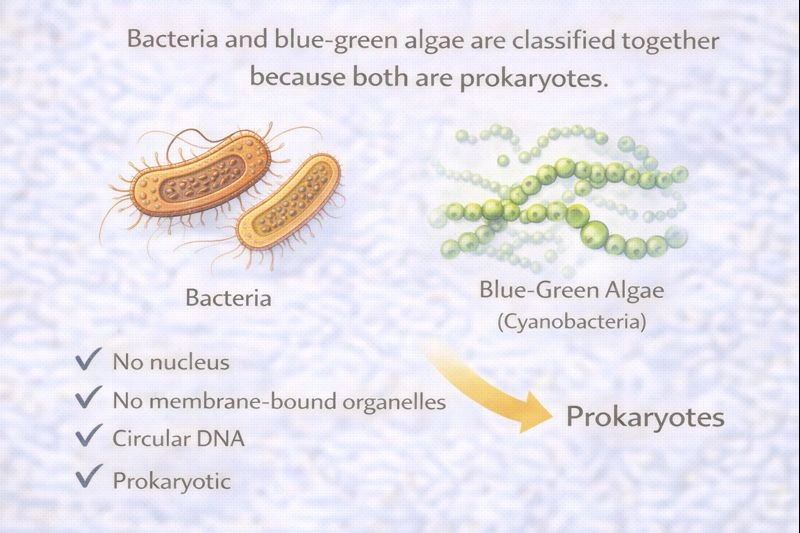
Bacteria and blue-green algae are classified together because both are prokaryotes.
Both organisms share the same basic cellular organization. They lack a true nucleus and membrane-bound organelles, have circular DNA located in a nucleoid region, and use simple internal structures for metabolism and reproduction. Although blue-green algae can perform photosynthesis, they are not true algae; they are cyanobacteria and belong to the same broad biological group as other bacteria.
A) Both are gymnosperms
Gymnosperms are seed-producing plants such as pine trees and cycads. They are complex, multicellular eukaryotic organisms with roots, stems, leaves, and vascular tissue. Bacteria and blue-green algae are microscopic, single-celled organisms and do not produce seeds or have plant structures. Therefore, this option is incorrect.
B) Both are prokaryotes
Bacteria and blue-green algae (cyanobacteria) are both prokaryotic organisms. This means:
- They do not have a membrane-bound nucleus.
- Their DNA is circular and located in a nucleoid region.
- They lack membrane-bound organelles such as mitochondria and chloroplasts.
- They contain small (70S) ribosomes.
- They reproduce mainly by binary fission.
Cyanobacteria were historically called “blue-green algae” because they perform photosynthesis, but structurally and genetically they are bacteria, not true algae (which are eukaryotic). This shared cellular organization is why they are classified together.
C) Both are autotrophs
Many cyanobacteria are autotrophic because they perform photosynthesis. However, bacteria as a group are extremely diverse. Some are autotrophs, but many are heterotrophs that obtain energy by consuming organic matter. Since not all bacteria are autotrophic, this is not a defining characteristic shared by both groups.
D) Both are pathogens
Only some bacteria cause disease, and most cyanobacteria do not infect humans at all. Many bacteria and cyanobacteria are beneficial or essential for ecosystems, such as nitrogen-fixing bacteria and oxygen-producing cyanobacteria. Being pathogenic is not a universal trait and is not used for classification.
Conclusion
Bacteria and blue-green algae are grouped together because they share the same fundamental cell structure: they are prokaryotes. This cellular similarity is the primary reason for their classification together. Therefore, the correct answer is B) Both are prokaryotes.

Topic Flashcards
Click to FlipWhat fundamental cellular feature do bacteria and blue-green algae (cyanobacteria) share that places them in the same overarching biological domain?
They are both prokaryotes. This means their cells lack a membrane-bound nucleus and other membrane-bound organelles.
Why is the shared trait of being "autotrophs" an incorrect reason for classifying all bacteria with blue-green algae?
While blue-green algae are photosynthetic autotrophs, bacteria as a group have diverse metabolisms. Many bacteria are heterotrophs (consumers), so autotrophy is not a universal classifying feature.
Blue-green algae perform photosynthesis like plants, but why are they not classified as true plants or algae?
True plants and algae are eukaryotes (have nuclei). Blue-green algae are prokaryotic cyanobacteria, sharing a fundamental cell structure with other bacteria, not plants.
If you examined the DNA of both a common bacterium and a cyanobacterium, what key structural similarity would you find?
Both have circular DNA floating freely in the cytoplasm (in a nucleoid region), unlike the linear DNA enclosed in a nucleus found in eukaryotes.
What cellular structure is absent in both bacteria and blue-green algae, but present in organisms like true algae, plants, and animals?
A membrane-bound nucleus. The absence of this and other membrane-bound organelles defines their prokaryotic classification.