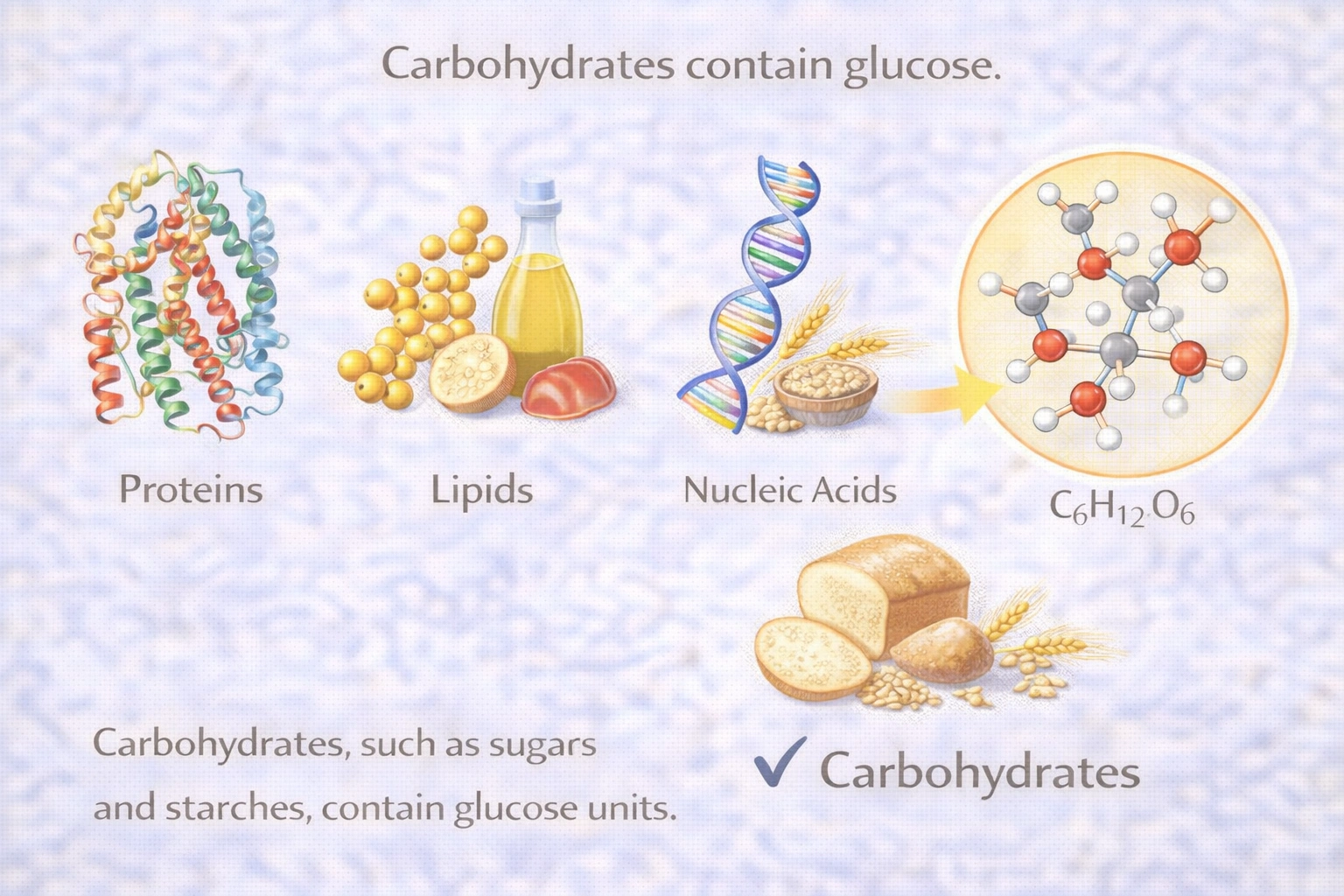
Which of these molecules contains glucose?
-
A
Proteins
-
B
Lipids
-
C
Nucleic acids
-
D
Carbohydrates
Carbohydrates contain glucose.
Glucose is a simple sugar (a monosaccharide) that serves as a fundamental building block for many larger biological molecules. It is the primary source of energy for cells and is commonly linked together to form more complex sugars and storage molecules. Any group of molecules that is defined by being built from sugars, especially glucose, belongs to the carbohydrate category.
A) Proteins
Proteins are made of long chains of amino acids joined by peptide bonds. Their structure and function depend on the sequence and folding of these amino acids. Although proteins may interact with glucose in the body (for example, enzymes that metabolize glucose), glucose is not a structural component of proteins. Therefore, proteins do not contain glucose.
B) Lipids
Lipids include fats, oils, waxes, phospholipids, and steroids. They are primarily composed of fatty acids and glycerol. Lipids are hydrophobic molecules and are not built from sugar units. While special molecules called glycolipids contain small carbohydrate groups, lipids as a general class do not contain glucose as a core structural unit. This makes this option incorrect.
C) Nucleic acids
Nucleic acids, such as DNA and RNA, are composed of nucleotides. Each nucleotide contains a phosphate group, a nitrogenous base, and a sugar. However, the sugar in DNA is deoxyribose and in RNA is ribose. Both are five-carbon sugars, not glucose, which is a six-carbon sugar. Therefore, nucleic acids do not contain glucose.
D) Carbohydrates
Carbohydrates are molecules made of carbon, hydrogen, and oxygen, and they are built from sugar units. Glucose itself is a carbohydrate and is the most common monosaccharide in biology. Many important carbohydrates are made from glucose, including:
- Disaccharides such as sucrose, lactose, and maltose
- Polysaccharides such as starch (plants), glycogen (animals), and cellulose (plant cell walls)
Because glucose is the basic unit of these molecules, carbohydrates are the correct answer.
Conclusion
Glucose is a simple sugar and serves as the building block for many larger biological molecules classified as carbohydrates. Proteins, lipids, and nucleic acids are built from different types of subunits. Therefore, the correct answer is D) Carbohydrates.

Topic Flashcards
Click to FlipWhat is the primary type of biological molecule that has glucose as its fundamental building block or monomer?
Carbohydrates. Glucose is a monosaccharide, the basic unit of many disaccharides (like sucrose) and polysaccharides (like starch and cellulose).
Which type of macromolecule is primarily used for long-term energy storage and insulation but is NOT built from glucose subunits?
Lipids. They are built from fatty acids and glycerol, not sugars like glucose.
Proteins are polymers built from amino acids. Do their structures contain glucose as part of their primary sequence?
No. The monomers of proteins are amino acids, which are chemically distinct from glucose. Enzymes may process glucose, but they don't contain it structurally.
What is the 5-carbon sugar found in the backbone of nucleic acids (DNA & RNA), and how does it differ from glucose?
Deoxyribose (DNA) and ribose (RNA). These are pentose sugars with 5 carbon atoms, while glucose is a hexose sugar with 6 carbon atoms.
Starch and glycogen are both energy-storage polysaccharides. What simple sugar are they primarily composed of?
Glucose. They are long, branched chains of glucose monomers used for storing energy in plants and animals, respectively.