Why do we perceive chlorophyll as green?
-
A
It absorbs yellow and blue light.
-
B
It primarily absorbs green light.
-
C
It fails to absorb green light.
-
D
It primarily absorbs red light.
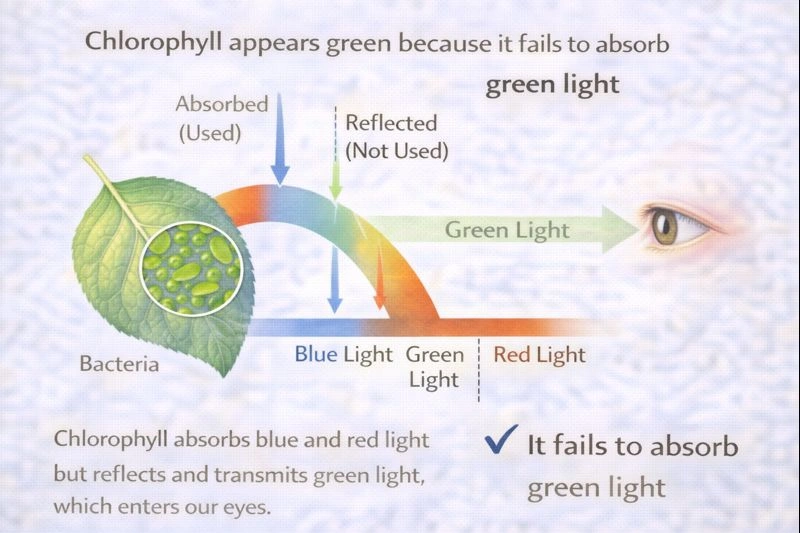
Chlorophyll appears green because it fails to absorb green light.
Chlorophyll is the main photosynthetic pigment in plants and is responsible for capturing light energy needed for photosynthesis. It absorbs light most efficiently in the blue and red regions of the visible spectrum. Green light, however, is not absorbed to any significant extent. Instead, it is reflected and transmitted. The reflected green wavelengths enter our eyes, which is why leaves and other plant parts rich in chlorophyll appear green to us.
A) It absorbs yellow and blue light
Chlorophyll does absorb blue light very strongly, but yellow light is not a major absorption peak for chlorophyll. More importantly, this option does not address what happens to green light. The green appearance of chlorophyll is explained by reflection, not by absorption of yellow light. Therefore, this statement does not correctly explain why chlorophyll looks green.
B) It primarily absorbs green light
If chlorophyll primarily absorbed green light, very little green light would be reflected back to our eyes. In that case, chlorophyll would appear dark or show the complementary color of green, not green itself. Since plants are visibly green, this statement is incorrect.
C) It fails to absorb green light
Chlorophyll strongly absorbs red and blue wavelengths but reflects and transmits green wavelengths. Because this green light is not used for photosynthesis and instead bounces off the plant tissues, it reaches our eyes and creates the perception of green color. This is the correct explanation.
D) It primarily absorbs red light
Chlorophyll does absorb red light, but it also absorbs blue light. More importantly, the question asks why chlorophyll appears green, and the key reason is not what it absorbs, but what it does not absorb. Since green light is reflected rather than absorbed, this option is incomplete and incorrect.
Conclusion
Chlorophyll absorbs red and blue light for photosynthesis but reflects green light. The reflected green wavelengths are what our eyes detect, making plants appear green. Therefore, the correct answer is C) It fails to absorb green light.

Topic Flashcards
Click to FlipWhat specific property of light interaction explains why a leaf containing chlorophyll appears green to our eyes?
The reflection of green wavelengths. Chlorophyll absorbs red and blue light but reflects green light, which is then detected by our eyes.
In the absorption spectrum of chlorophyll, which two colors of light show the highest peaks, indicating they are absorbed the most?
Red light and blue light. These wavelengths provide the energy for photosynthesis, while green light is not effectively absorbed.
If a pigment "appears" a certain color, is that because it is absorbing that color of light or reflecting it?
Reflecting it. We see the color of light that is reflected off an object, not the colors it absorbs.
What would happen to the color of a plant leaf if chlorophyll primarily absorbed green light instead of red and blue?
It would appear a dark or blackish color, or the complementary color of green (like magenta), because little to no green light would be reflected for us to see.
True or False: The reason chlorophyll is vital for plants is because its green color directly powers the photosynthetic reactions.
False. The color is a byproduct of its absorption spectrum. The vital function is capturing the energy from absorbed red and blue light to fuel photosynthesis.