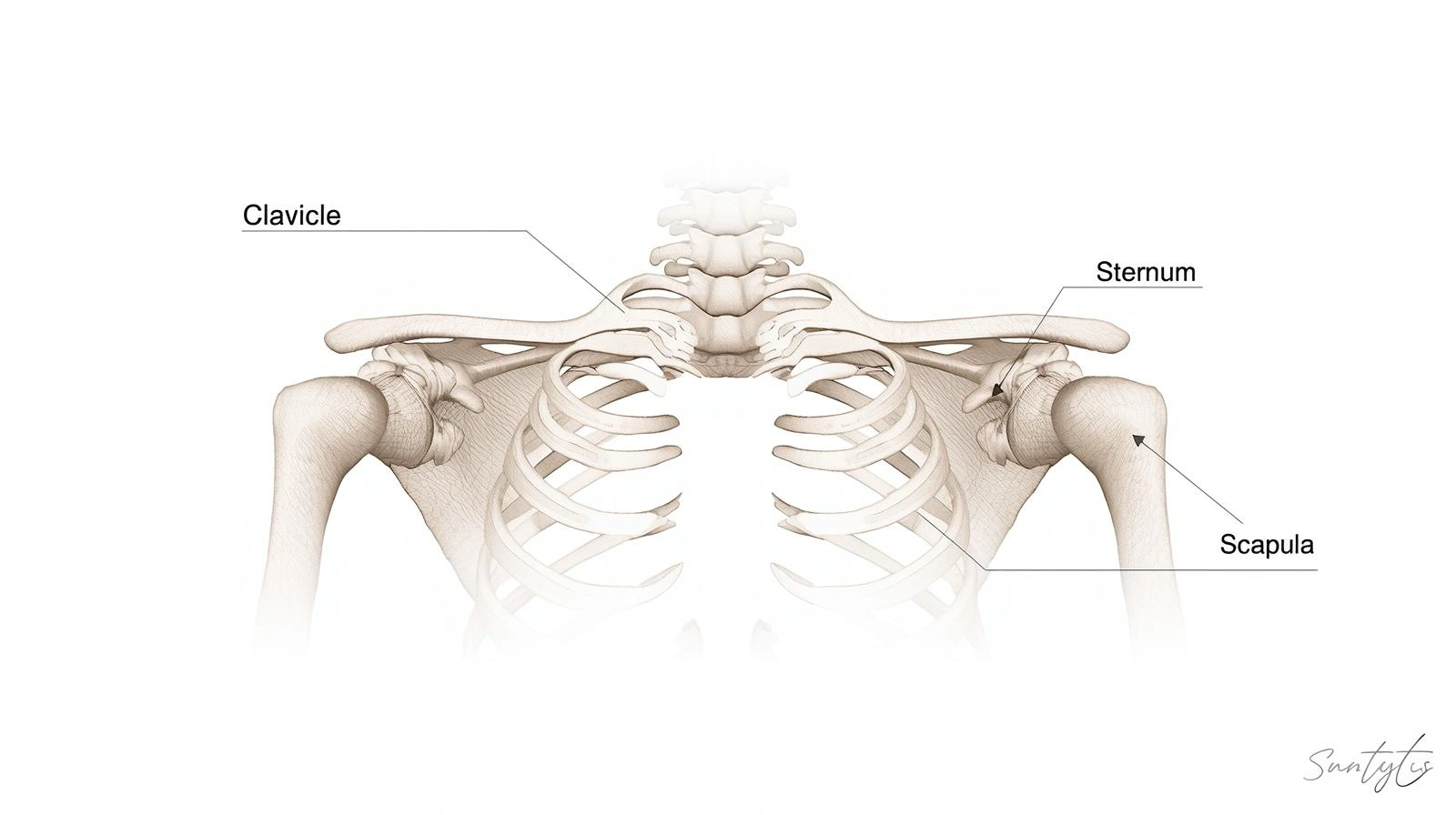
Which is the only long bone in the human body to lie horizontally?
-
A
Clavicle
-
B
Humerus
-
C
Scapula
-
D
Ischium
The only long bone in the human body that lies horizontally is the clavicle.
Long bones are typically characterized by their greater length than width, and they are usually oriented vertically. The clavicle, however, is unique because of its horizontal orientation, running across the upper chest and serving as the primary connection between the upper limb and the axial skeleton. It spans horizontally from the sternum (breastbone) to the acromion, which is part of the scapula. This horizontal placement of the clavicle makes it distinct from other long bones in the body, which tend to be positioned in a vertical alignment. The clavicle plays a vital role in stabilizing the shoulder, helping to maintain the position of the scapula, and providing structural support for the upper limb. This makes the clavicle both unique in its positioning and crucial in terms of function.
- A. Clavicle: This is the correct answer. The clavicle, or collarbone, is indeed the only long bone that lies horizontally across the body. It has a specific, horizontally oriented structure that bridges the gap between the axial skeleton (the sternum) and the appendicular skeleton (the scapula). The clavicle’s horizontal alignment allows it to stabilize the shoulder and transfer mechanical forces from the arm to the trunk. Its positioning and role in shoulder mobility are critical, and it is one of the few bones in the body with this unique anatomical feature.
- B. Humerus: The humerus is a long bone located in the upper arm, running vertically from the shoulder to the elbow. It is responsible for a range of movements, such as flexion and extension, and it plays a vital role in supporting the arm. However, unlike the clavicle, the humerus is oriented in the standard vertical position for long bones. It does not lie horizontally across the body, and it is not involved in stabilizing the upper body in the same way that the clavicle does. The humerus is part of the appendicular skeleton but is not horizontally aligned.
- C. Scapula: The scapula, or shoulder blade, is a flat, triangular bone located on the back of the rib cage. It is not a long bone and does not lie horizontally like the clavicle. The scapula serves as an attachment point for several muscles that control the movement of the arm and shoulder. Though it plays a critical role in the shoulder's function, its position is more posterior (on the back of the rib cage), and its shape is flat rather than elongated, making it distinct from long bones like the clavicle or humerus.
- D. Ischium: The ischium is one of the three bones that make up the pelvis, along with the ilium and pubis. It is not a long bone and does not lie horizontally across the body. Instead, the ischium is located at the bottom part of the pelvis, forming the lower and back portion of the hip bone. Its primary role is in weight-bearing while sitting, but it does not have the same elongated shape or horizontal position as the clavicle.
Conclusion: The clavicle is the only long bone in the human body that lies horizontally, providing an essential connection between the axial and appendicular skeletons. Its unique position helps stabilize the shoulder and supports the upper limb's movements. Therefore, the correct answer is A. Clavicle.

Topic Flashcards
Click to FlipWhat are the two defining characteristics of a long bone, and why does the clavicle qualify?
1) Greater length than width, 2) A shaft (diaphysis) and two ends (epiphyses). The clavicle has a shaft and two articular ends, making it a long bone despite its unusual shape.
What two joints does the clavicle form to connect the upper limb to the axial skeleton?
The sternoclavicular joint (with the sternum) and the acromioclavicular joint (with the acromion of the scapula).
What is the medical term for a broken collarbone, one of the most common fractures, especially in children and athletes?
Clavicular fracture.
Which part of the clavicle is most commonly fractured due to its thin structure and direct transmission of force?
The middle third (or midshaft) of the clavicle.
What is the name of the ligament that anchors the clavicle to the coracoid process of the scapula, providing critical stability?
The coracoclavicular ligament.