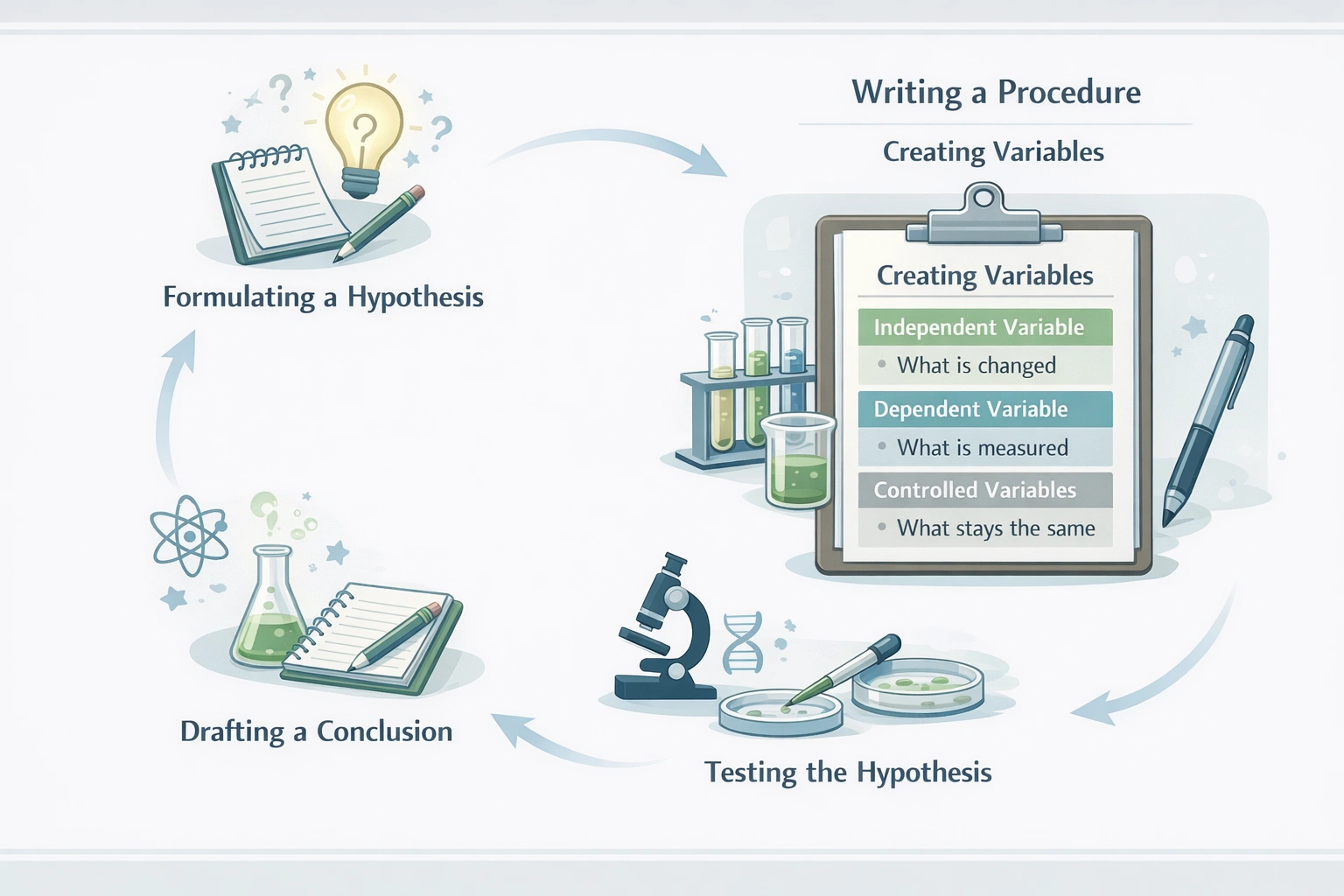
Which part of the scientific method requires a researcher to create variables?
-
A
Writing a procedure
-
B
Testing a hypothesis
-
C
Drafting a conclusion
-
D
Formulating a hypothesis
Variables are created during the process of testing a hypothesis.
A hypothesis is a proposed, testable explanation for an observation. To move from this theoretical prediction to an empirical test, an experiment must be designed. This design phase necessitates the operational creation of variables. The researcher must define the independent variable (the specific condition to be manipulated), the dependent variable (the specific outcome to be measured), and identify control variables (conditions to be held constant). These defined variables form the backbone of the experimental design, allowing for the systematic collection of data that can support or refute the initial hypothesis.
A) Writing a procedure
Writing a procedure involves creating a step-by-step plan for conducting the experiment. This plan details how to manipulate the independent variable and how to measure the dependent variable. However, the variables themselves must be identified and conceptually created before a meaningful procedure can be drafted. The procedure is the implementation guide for an experimental design that already includes its defined variables; it does not encompass the initial act of defining those variables.
B) Testing a hypothesis
The phase of testing a hypothesis is where the abstract idea is translated into a concrete, actionable experiment. This translation is the point at which variables are operationally defined and brought into existence for the purpose of measurement and manipulation. The act of deciding what to change, what to measure, and what to keep constant is intrinsic to constructing a valid test. Therefore, the creation of variables is a fundamental and inseparable component of testing a hypothesis.
C) Drafting a conclusion
Drafting a conclusion is the analytical stage where the collected data is interpreted. The researcher examines the results from the measurements of the dependent variable in relation to the manipulations of the independent variable. By this stage, the experiment is complete, and all data has been gathered using the variables that were established during the experimental design. No new variables are created; instead, the existing variables and their associated data are analyzed to draw inferences about the hypothesis.
D) Formulating a hypothesis
Formulating a hypothesis involves making an educated prediction about a relationship between phenomena. A hypothesis often implies potential variables (e.g., "Increased fertilizer leads to increased plant growth"). At this stage, these are conceptual placeholders. The hypothesis proposes what might be tested but does not involve the practical, operational work of defining exactly how "increased fertilizer" will be quantified or how "plant growth" will be measured. That operational definition occurs when planning the experiment to test the hypothesis.
Conclusion:
The scientific method is a sequential process of inquiry. While formulating a hypothesis suggests a potential relationship, it is during the subsequent phase—designing and executing an experiment to test that hypothesis—that a researcher must concretely create variables. These variables, defined as independent, dependent, and controlled, become the tangible elements of the experiment, enabling the collection of objective evidence. Thus, the creation of variables is intrinsically linked to the process of testing a hypothesis.
Topic Flashcards
Click to FlipIn an experiment, what is the specific name for the variable that the researcher deliberately changes or manipulates?
The independent variable.
What is the specific name for the variable that is measured or observed as the outcome in an experiment?
The dependent variable.
At which two distinct stages of the scientific method are a "hypothesis" first proposed and then operationally tested?
Proposed during hypothesis formulation; tested during experimentation (testing the hypothesis).
Why is the step of "creating variables" not part of drafting the conclusion?
Variables are defined and used during the experimental design and data collection; the conclusion analyzes the results from those already-defined variables.
What is the purpose of identifying control variables when designing an experiment?
To keep other factors constant so that any change in the dependent variable can be attributed only to the independent variable.