Extract:

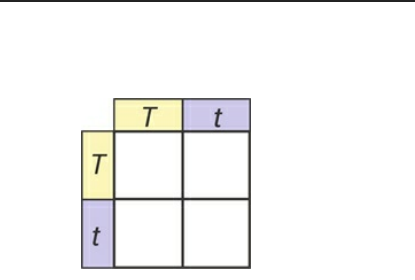
Which statement is supported by the Punnett square above, if "T" = Tall and "t" = short?
-
A
Both parents are homozygous tall.
-
B
100% of the offspring will be tall because both parents are tall.
-
C
There is a 25% chance that an offspring will be short.
-
D
The short allele will soon die out.
There is a 25% chance that an offspring will be short.
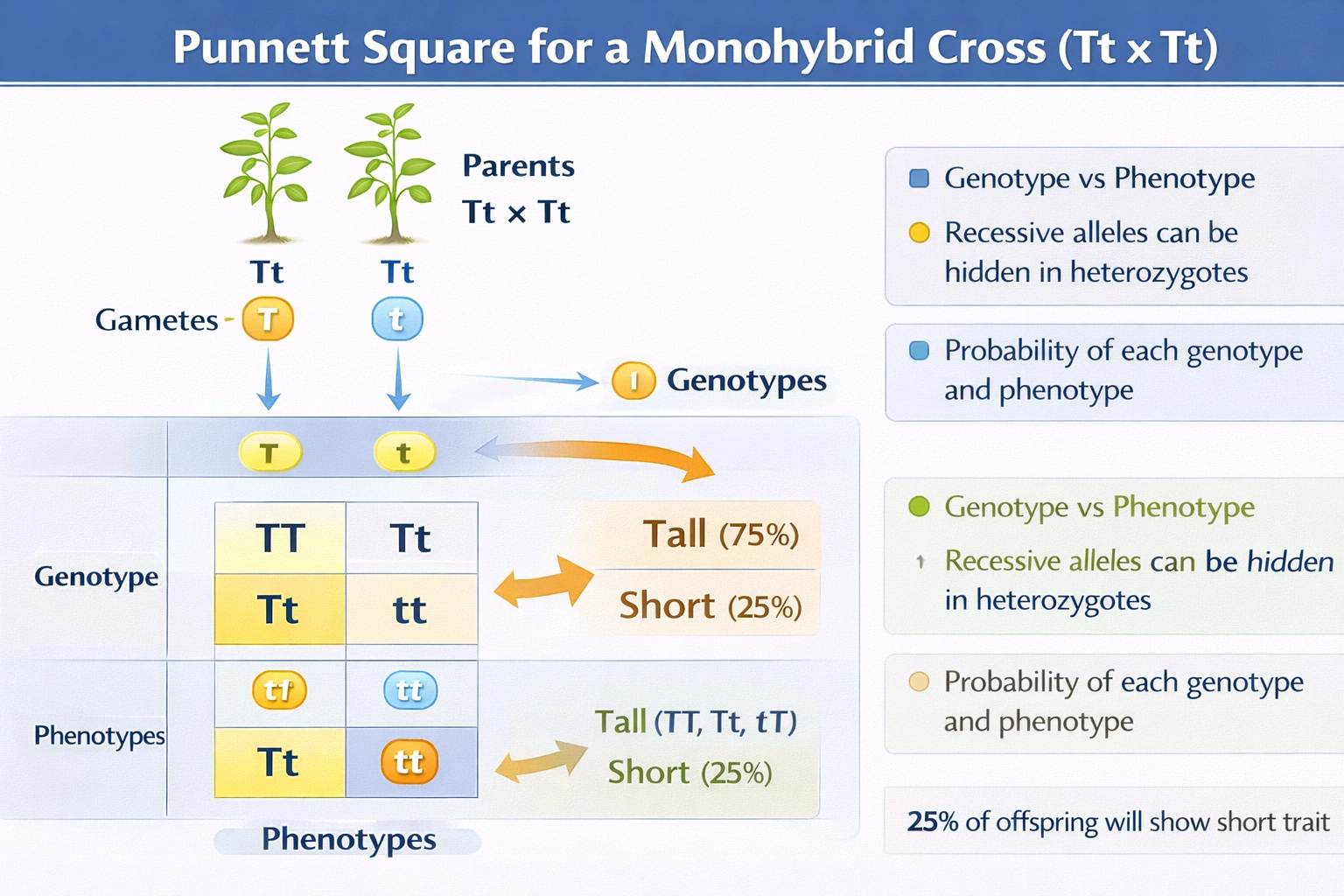
The Punnett square represents a cross between two heterozygous parents (Tt × Tt), with each parent contributing either a T or t allele. The square shows four possible genotypic combinations: TT, Tt, tT, and tt. Since T (tall) is dominant over t (short), only the tt genotype expresses the short phenotype—occurring in one out of four possible combinations (25%).
A) Both parents are homozygous tall
Homozygous tall parents would both have genotype TT, producing a Punnett square with only T alleles (all offspring TT). The given square shows both parents contributing T and t alleles, indicating heterozygous genotypes (Tt) rather than homozygous tall. The presence of t alleles in both parental contributions confirms they are not homozygous for the tall trait.
B) 100% of the offspring will be tall because both parents are tall
While both parents are tall (expressing the dominant phenotype), they are heterozygous (Tt), meaning they carry the recessive allele. In a Tt × Tt cross, 25% of offspring will be homozygous recessive (tt) and express the short phenotype. This option incorrectly assumes that parental tallness guarantees all offspring will be tall, ignoring the principles of Mendelian inheritance where recessive alleles can be expressed in homozygous offspring.
C) There is a 25% chance that an offspring will be short
The Punnett square shows four equally probable genotypic outcomes: TT (tall), Tt (tall), tT (tall), and tt (short). The tt genotype—occurring in one out of four boxes—expresses the short phenotype due to homozygous recessive inheritance. This 1:3 ratio (25% short, 75% tall) is the classic Mendelian monohybrid cross result for heterozygous parents. The probability remains consistent across multiple offspring, making this a statistically reliable prediction for each conception event.
D) The short allele will soon die out
The recessive allele (t) persists in the population through heterozygous carriers (Tt) who express the tall phenotype but can transmit the short allele to offspring. In this cross, 50% of offspring are heterozygous carriers (Tt), ensuring the allele's continuation. Natural selection only eliminates alleles when homozygous expression reduces reproductive fitness, but the short allele remains protected in heterozygotes—a principle known as "heterozygote advantage" in some genetic contexts. Without selective pressure against heterozygotes, recessive alleles remain stable in populations indefinitely.
Conclusion:
The Punnett square demonstrates fundamental Mendelian inheritance patterns where heterozygous parents produce offspring with a 3:1 phenotypic ratio (tall:short). This 25% probability of short offspring reflects the mathematical certainty of allele segregation during gamete formation. Option C accurately describes this probabilistic outcome, while other options misinterpret parental genotypes, inheritance patterns, or allele persistence in populations. Understanding these ratios is essential for genetic counseling, agricultural breeding, and evolutionary biology—where predicting trait expression from parental genotypes forms the basis of selective practices and disease risk assessment.