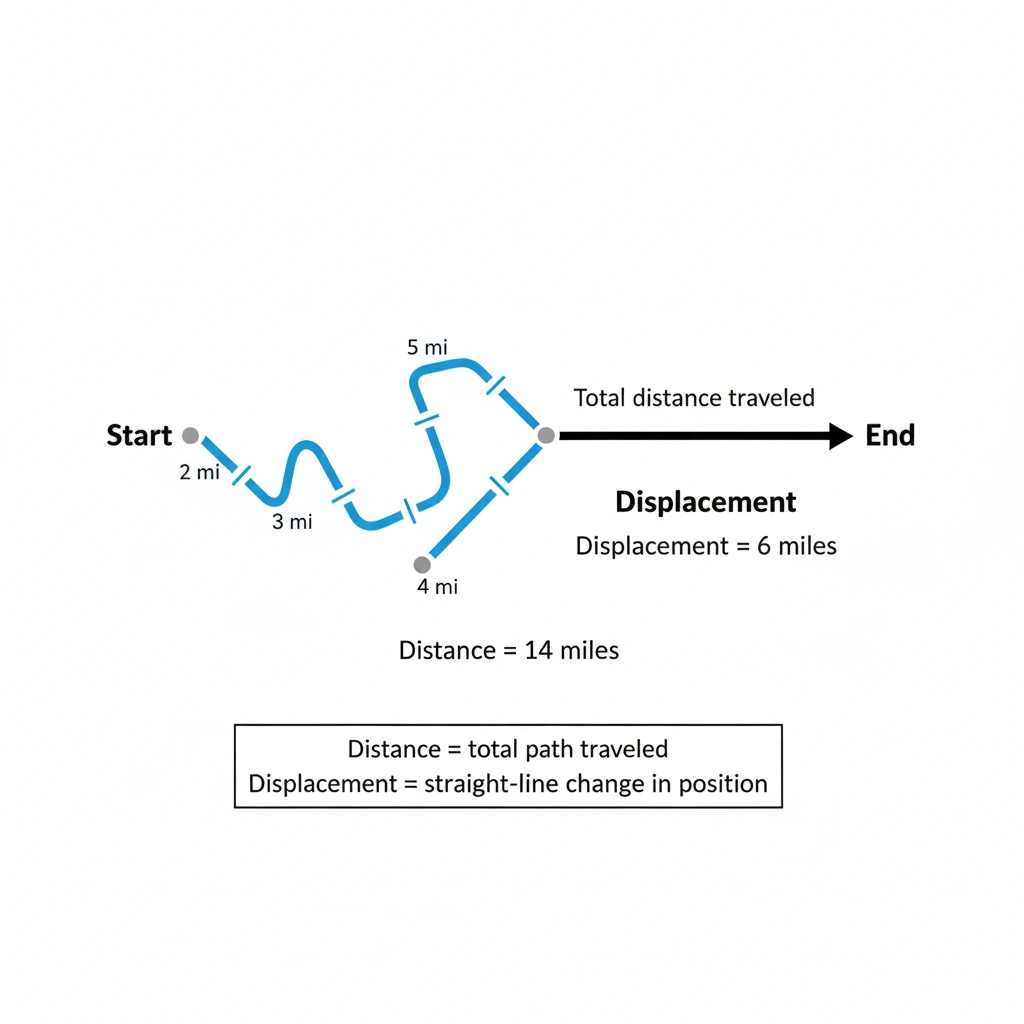
Marilyn’s trip: displacement vs distance statement true?
-
A
Disp 6, Dist 6
-
B
Disp 14, Dist 14
-
C
Disp 8, Dist 14
-
D
Disp 6, Dist 14
Marilyn’s trip has a displacement of 6 miles and a total distance of 14 miles.
Distance measures the total path traveled regardless of direction, while displacement is a vector that represents the net change in position from start to finish, including direction. By adding the segments of Marilyn’s trip carefully, the total distance and the net displacement can be determined.
A) Displacement 6 miles, Distance 6 miles
This option treats distance and displacement as the same quantity. Distance must include all segments traveled, not just the net change in position, so this value undercounts the trip.
B) Displacement 14 miles, Distance 14 miles
This option ignores direction when computing displacement. Displacement is not the sum of all path lengths; it depends on the net effect of movements in opposite directions.
C) Displacement 8 miles, Distance 14 miles
The total distance is correct here, but the displacement is miscalculated. Adding the directional segments incorrectly leads to an overestimate of the net change in position.
D) Displacement 6 miles, Distance 14 miles
Adding the distances traveled gives a total distance of 4 + 4 + 1 + 5 = 14 miles. Accounting for direction, the northward and southward motions partially cancel, leaving a net displacement of 6 miles south. This correctly distinguishes between distance (a scalar) and displacement (a vector).
Conclusion
Marilyn travels a total distance of 14 miles, but because parts of her trip cancel in opposite directions, her net displacement is 6 miles. Therefore, the correct statement is displacement 6 miles, distance 14 miles.
Topic Flashcards
Click to FlipWhat is the fundamental difference between distance and displacement in physics?
Distance is a scalar quantity that measures the total length of the path traveled. Displacement is a vector quantity that measures the net change in position from the starting point to the ending point (straight-line direction and magnitude).
For Marilyn's trip, the total distance is 14 miles and the displacement is 6 miles. What does the fact that displacement is less than distance tell you about the nature of her journey?
It tells you that her path was not a straight line. She must have changed direction, with some parts of the trip canceling each other out in terms of net position change.
If Marilyn's displacement is 6 miles south, what is the single, straight-line description of how her final position relates to her starting point?
Her final position is 6 miles directly south of her starting point.
Imagine a person walks 10 meters east and then 10 meters west. What is their total distance traveled and their total displacement?
Distance = 20 meters. Displacement = 0 meters (because they returned to the starting point)
Can the magnitude of displacement ever be greater than the total distance traveled? Why or why not?
No. The straight-line distance between two points is the shortest possible path. The total distance traveled along any actual path must always be equal to or greater than the magnitude of the displacement.