Zinc-64 is one possible isotope of the element zinc. Which of the atoms described below is a different isotope of zinc?
-
A
34 protons, 34 neutrons, 34 electrons
-
B
34 protons, 30 neutrons, 34 electrons
-
C
30 protons, 36 neutrons, 30 electrons
-
D
64 protons, 34 neutrons, 34 electrons
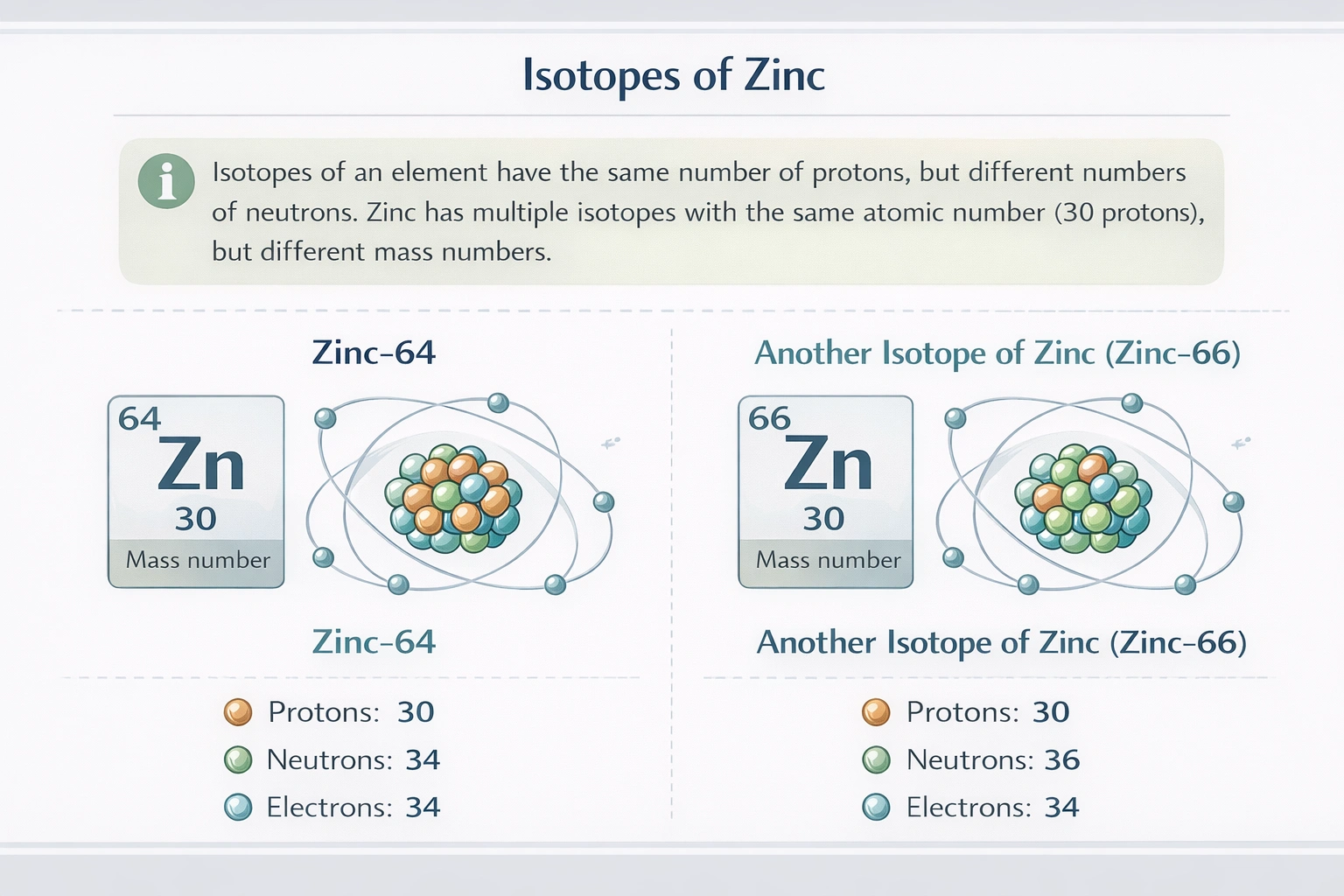
The atom with 30 protons, 36 neutrons, and 30 electrons is a different isotope of zinc.
Isotopes are variants of a particular chemical element that share the same number of protons (defining the element) but differ in their number of neutrons. Zinc has an atomic number of 30, meaning every atom of zinc contains 30 protons. Zinc-64 has a mass number of 64 (protons + neutrons), so it contains 34 neutrons (64 - 30 = 34). A different isotope of zinc must also have 30 protons but a different number of neutrons.
A) 34 protons, 34 neutrons, 34 electrons
An atom with 34 protons is not zinc; it is the element selenium. The number of protons defines the element's identity on the periodic table. Regardless of the neutron or electron count, 34 protons always corresponds to selenium. This is therefore an atom of a different element, not an isotope of zinc.
B) 34 protons, 30 neutrons, 34 electrons
This atom also possesses 34 protons, identifying it as selenium. The neutron count is irrelevant for elemental identification when the proton count is incorrect for zinc. This represents an isotope of selenium, not zinc.
C) 30 protons, 36 neutrons, 30 electrons
This atom has 30 protons, confirming it is zinc. The neutral charge is confirmed by 30 electrons matching the 30 protons. The mass number is 30 + 36 = 66, making it Zinc-66. Since it has the same number of protons as Zinc-64 (30) but a different number of neutrons (36 vs. 34), it qualifies as a different isotope of the same element.
D) 64 protons, 34 neutrons, 34 electrons
An atom with 64 protons would be the element gadolinium. This option confuses the mass number (64 in Zinc-64) with the atomic number. The "64" refers to the total nucleons, not just the protons. No atom of zinc has 64 protons; its atomic number is fixed at 30.
Conclusion:
Identifying an isotope requires a two-step verification: first, confirming the atom belongs to the correct element by its proton count, and second, verifying it has a different neutron count than the given isotope. Only the atom with 30 protons satisfies the first condition for being zinc. Its neutron count of 36 differs from the 34 neutrons in Zinc-64, confirming it is a distinct isotope, specifically Zinc-66.

Topic Flashcards
Click to FlipWhat defines the identity of an element (e.g., zinc vs. selenium)?
The number of protons (atomic number) in its nucleus.
How do isotopes of the same element, like Zinc-64 and Zinc-66, differ from each other?
They have the same number of protons but different numbers of neutrons.
How many neutrons are in an atom of Zinc-64? (Atomic number of Zn = 30)
34 neutrons (Mass number 64 - 30 protons = 34 neutrons).
An atom has 30 protons, 35 neutrons, and 30 electrons. What is its isotope notation?
Zinc-65 (atomic number 30, mass number = 30 + 35 = 65).
If you change the number of protons in an atom's nucleus, what have you changed it into?
A different element.