100% 4 Rated
Attempts 127

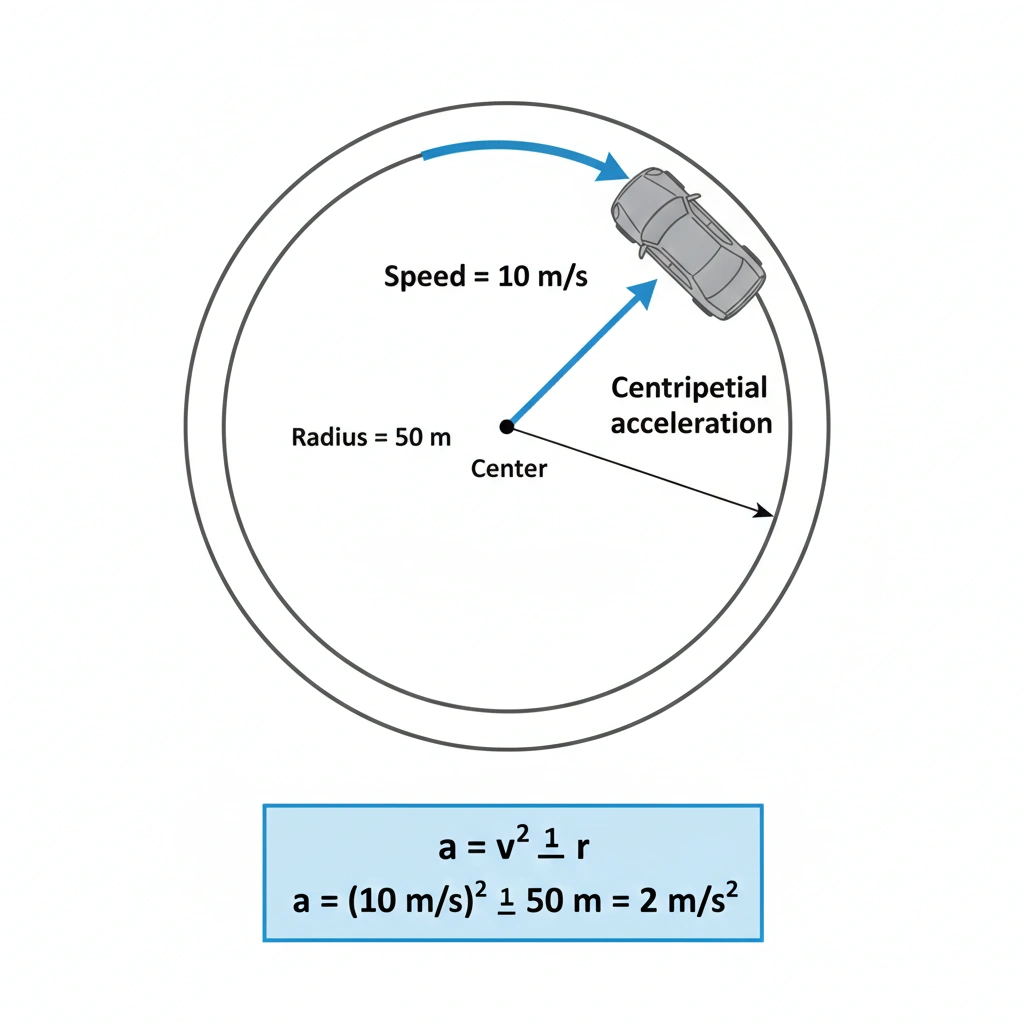
1 000 kg car, 10 m/s, radius 50 m. Centripetal acceleration?

  1. A
    2 m/s²
  2. B
    4 m/s²
  3. C
    5 m/s²
  4. D
    10 m/s²

Topic Flashcards

Click to Flip
Question

What is the formula for calculating centripetal acceleration (a_c) when you know an object's constant linear speed (v) and the radius (r) of its circular path?

Answer

a_c = v² / r

Question

A 1000 kg car travels at 10 m/s around a curve with a radius of 50 m. Calculate its centripetal acceleration. Why is the car's mass not needed for this calculation?

Answer

a_c = (10 m/s)² / 50 m = 2 m/s². Mass is not needed because centripetal acceleration depends only on speed and radius (a_c = v²/r), not on mass.

Question

If the car in the previous question doubles its speed to 20 m/s while on the same 50 m curve, what happens to the required centripetal acceleration?

Answer

It quadruples to 8 m/s². (a_c = (20)²/50 = 400/50 = 8 m/s²). Since a_c ∝ v², doubling speed increases acceleration by a factor of four.

Question

What real-world force acts as the centripetal force that allows a car to turn on a flat, unbanked road?

Answer

Static friction between the tires and the road surface.

Question

In uniform circular motion, the centripetal acceleration is constant in magnitude but not in direction. Explain why.

Answer

The magnitude is constant if speed (v) and radius (r) are constant (a_c = v²/r). However, its direction is always changing because it must continuously point toward the center of the circle as the object moves.

Mini Quiz

1 / 3
Is the direction of centripetal acceleration tangent to the circular path?
Available Test Sets
Available FREE Test Sets