100% 4 Rated
Attempts 127

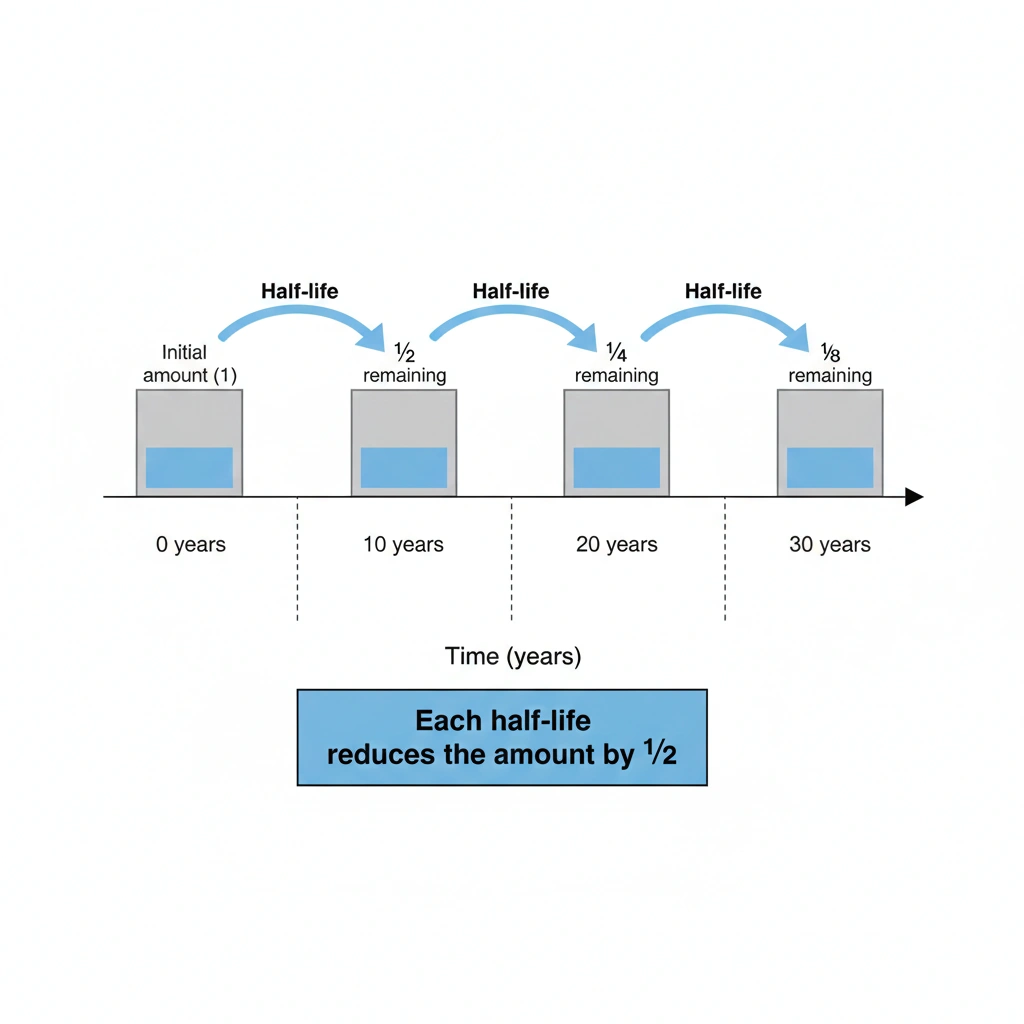
Half life 10 y. Fraction left after 30 y?

  1. A
    ½
  2. B
  3. C
    ¼
  4. D

Topic Flashcards

Click to Flip
Question

What is the mathematical relationship between the number of half-lives (n) that have passed and the fraction of a radioactive sample remaining?

Answer

Fraction Remaining = (1/2)^n, where *n* is the number of half-lives (n = total time / half-life).

Question

A sample has a half-life of 10 years. How much time is required for the sample to decay to 1/16 of its original amount?

Answer

40 years. 1/16 = (1/2)^4, so 4 half-lives are needed. 4 half-lives * 10 years/half-life = 40 years

Question

If 1/8 of a sample remains after 30 years, what is its half-life? What is its decay constant (λ)?

Answer

Half-life = 10 years (3 half-lives in 30 years). Decay constant, λ = ln(2) / T_{1/2} ≈ 0.693 / 10 yr ≈ 0.0693 per year.

Question

On a graph plotting the remaining number of atoms (N) versus time (t) for a radioactive substance, what is the shape of the curve? What does the slope at any point represent?

Answer

It is a downward-sloping exponential curve. The slope at any point represents the activity (or decay rate), which is -λN.

Question

Why is the concept of half-life more practical for understanding radioactive decay than the decay constant (λ) for most people?

Answer

Half-life provides an intuitive, time-based measure (e.g., "half is gone in 10 years") rather than an abstract instantaneous probability of decay per unit time (λ).

Mini Quiz

1 / 3
If two different radioactive elements both have a half-life of 10 years, will they always have the same fraction remaining after 30 years?
Available Test Sets
Available FREE Test Sets