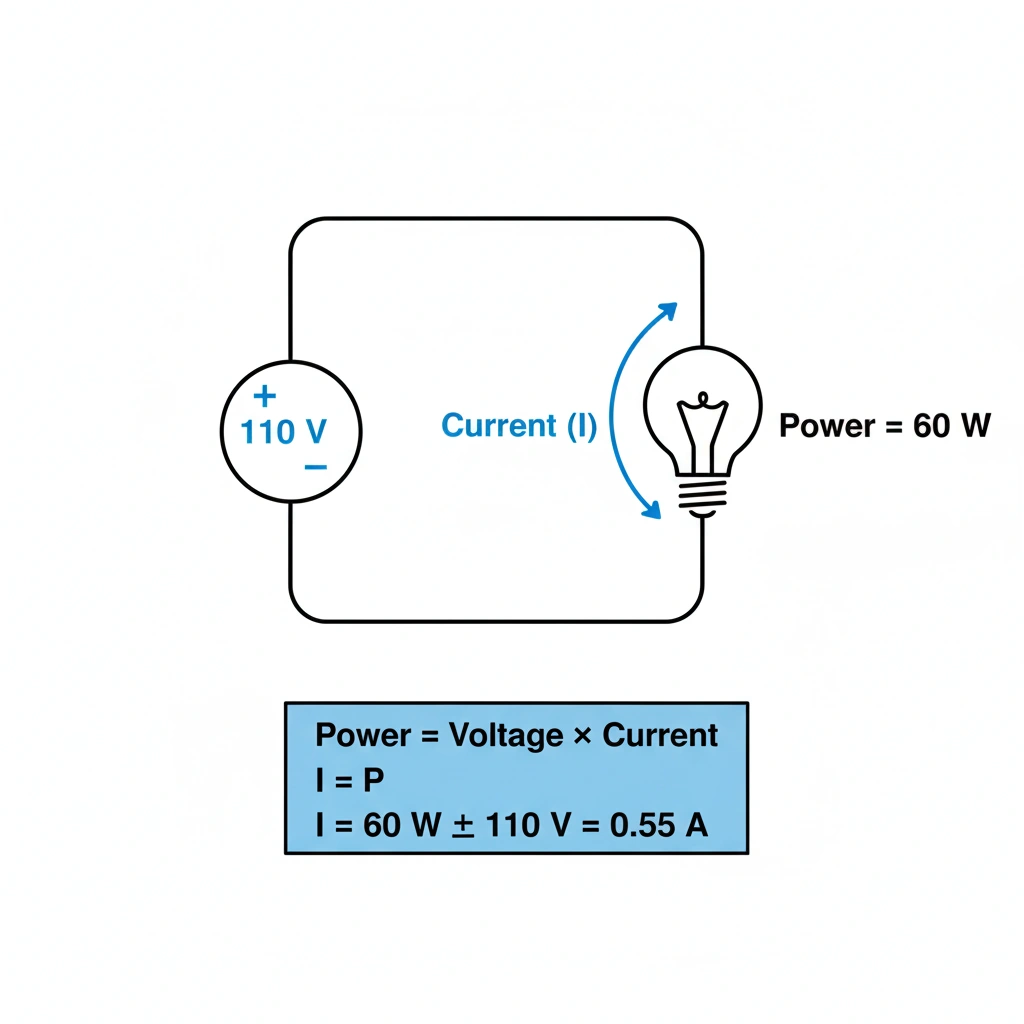
60 W bulb on 110 V. Current drawn?
-
A
0.55 A
-
B
1.83 A
-
C
50 A
-
D
6 600 A
The current drawn by the bulb is 0.55 A.
Electrical power, voltage, and current are related by the relationship that power equals voltage multiplied by current. When power and voltage are known, the current can be found by dividing power by voltage. In this case, the bulb is rated at 60 watts and operates on a 110-volt supply.
A) 0.55 A
Using the correct relationship gives:
current equals 60 watts divided by 110 volts
current equals approximately 0.55 amperes
This correctly calculates the current drawn by the bulb under normal operating conditions.
B) 1.83 A
This value comes from inverting the relationship and dividing voltage by power. Power is equal to voltage multiplied by current, not voltage divided by power, so this option is based on an incorrect rearrangement.
C) 50 A
This value is far too large for a household light bulb and likely results from a major arithmetic or conceptual error, such as ignoring units or misplacing a decimal point.
D) 6 600 A
This option reflects an extreme calculation error, possibly from multiplying voltage and power instead of dividing them. Such a current would be unrealistic and dangerous in a standard electrical circuit.
Conclusion
Current is found by dividing power by voltage. For a 60-watt bulb operating at 110 volts, the correct current drawn is 0.55 amperes.
Topic Flashcards
Click to FlipWhat is the formula that relates electrical power (P), voltage (V), and current (I)? Rearrange it to solve for current.
P = I × V. Therefore, I = P / V.
A 60 W light bulb is designed for a 110 V circuit. What is its operating current? If you mistakenly plug it into a 220 V outlet, what would happen to the current, assuming its resistance stays constant?
Operating current at 110 V: I = 60 W / 110 V ≈ 0.55 A. At 220 V, if resistance (R) is constant, current would double to about 1.1 A, and the bulb would draw about 240 W, causing it to burn out almost instantly.
Using the power formula, calculate the resistance of the 60 W, 110 V light bulb filament during normal operation. (Hint: Use P = V²/R or find R from V and I).
R = V² / P = (110 V)² / 60 W ≈ 12,100 / 60 ≈ 202 Ω. Alternatively, I = 0.55 A, so R = V / I = 110 V / 0.55 A = 200 Ω (approximation differences are due to rounding).
A device draws 0.55 A from a 110 V source. What is its power consumption in watts? How much energy in kilowatt-hours (kWh) does it use if left on for 10 hours?
Power = 0.55 A × 110 V = 60.5 W. Energy = 0.0605 kW × 10 h = 0.605 kWh
An incandescent bulb is rated 60 W at 110 V. An LED bulb producing the same brightness is rated 9 W at 110 V. How much current does the LED bulb draw, and how does this illustrate improved efficiency?
I_LED = 9 W / 110 V ≈ 0.082 A. The LED provides similar light using ~85% less current (0.082 A vs. 0.55 A), meaning it converts much more electrical energy into light and less into heat.