100% 4 Rated
Attempts 127

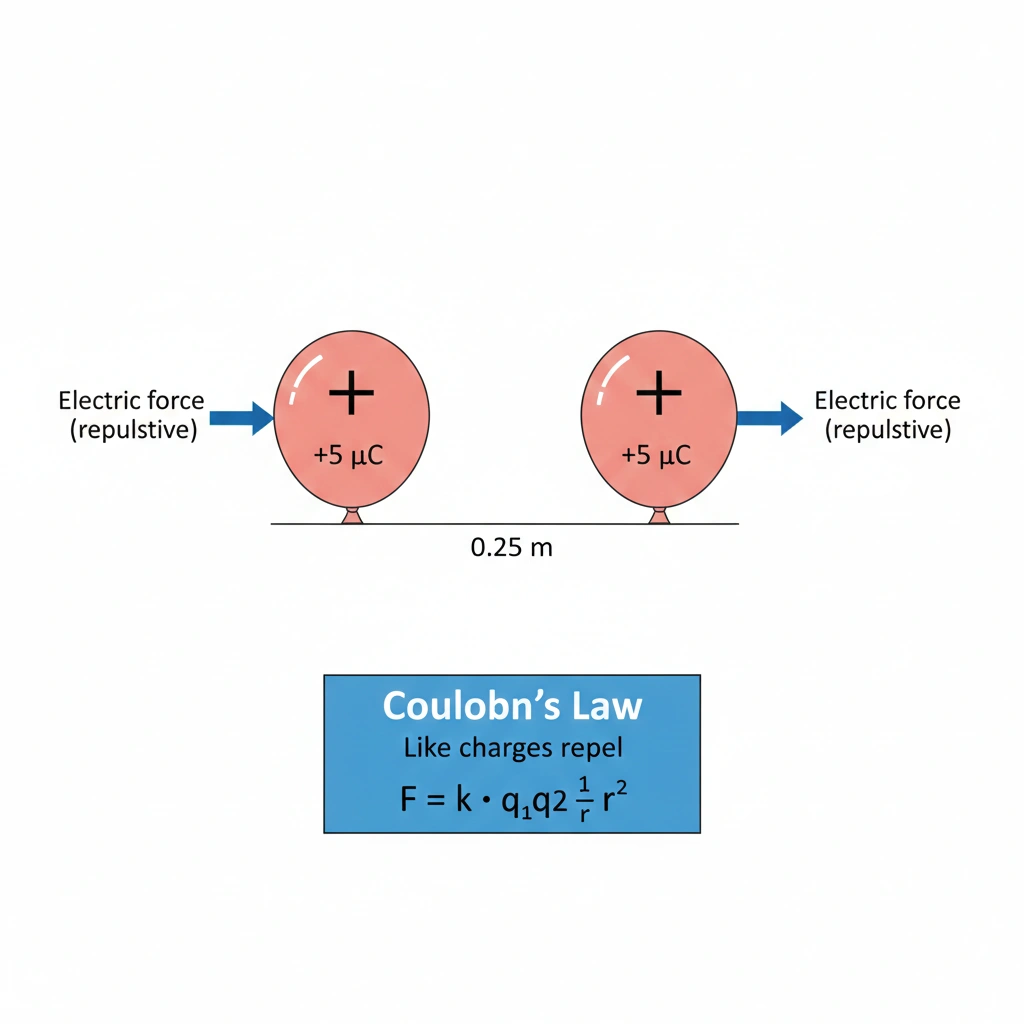
Two 5 μC balloons 25 cm apart. Repulsive force?

  1. A
    0.36 N
  2. B
    3.6 N
  3. C
    10⁻³ N
  4. D
    5×10⁻³ N

Topic Flashcards

Click to Flip
Question

In Coulomb's Law, how is the electrostatic force affected if the distance between two identical point charges is tripled?

Answer

The force is reduced to 1/9th of its original value, because F ∝ 1 / r 2 F∝1/r 2 .

Question

Two 5 µC charges are 25 cm apart. What would the force be (in N) if the charges were instead 10 µC each and the distance was kept the same?

Answer

14.4 N. Since both charges double, the product q 1 q 2 q 1 ​ q 2 ​ increases by a factor of 4: F new = 4 × 3.6   N = 14.4   N F new ​ =4×3.6N=14.4N.

Question

Coulomb’s Law is mathematically similar to Newton’s Law of Universal Gravitation. What are the two key differences between these two force laws?

Answer

Gravity is always attractive, while electrostatic force can be attractive or repulsive. Electrostatic force depends on charge; gravitational force depends on mass.

Question

If the two charged balloons in the problem were immersed in water (dielectric constant ~80) instead of air, how would the electrostatic force between them change?

Answer

The force would be reduced by a factor of about 80 because F medium = F vacuum / κ F medium ​ =F vacuum ​ /κ, where κ κ is the dielectric constant.

Question

What is the direction of the force that each balloon exerts on the other? How does this illustrate Newton’s Third Law?

Answer

The forces are equal in magnitude, opposite in direction, and act along the line joining the two charges. Each balloon repels the other with a force of 3.6 N, illustrating Newton’s Third Law (action–reaction pair).

Mini Quiz

1 / 3
If the distance between two identical point charges is halved, does the electrostatic force between them quadruple?
Available Test Sets
Available FREE Test Sets