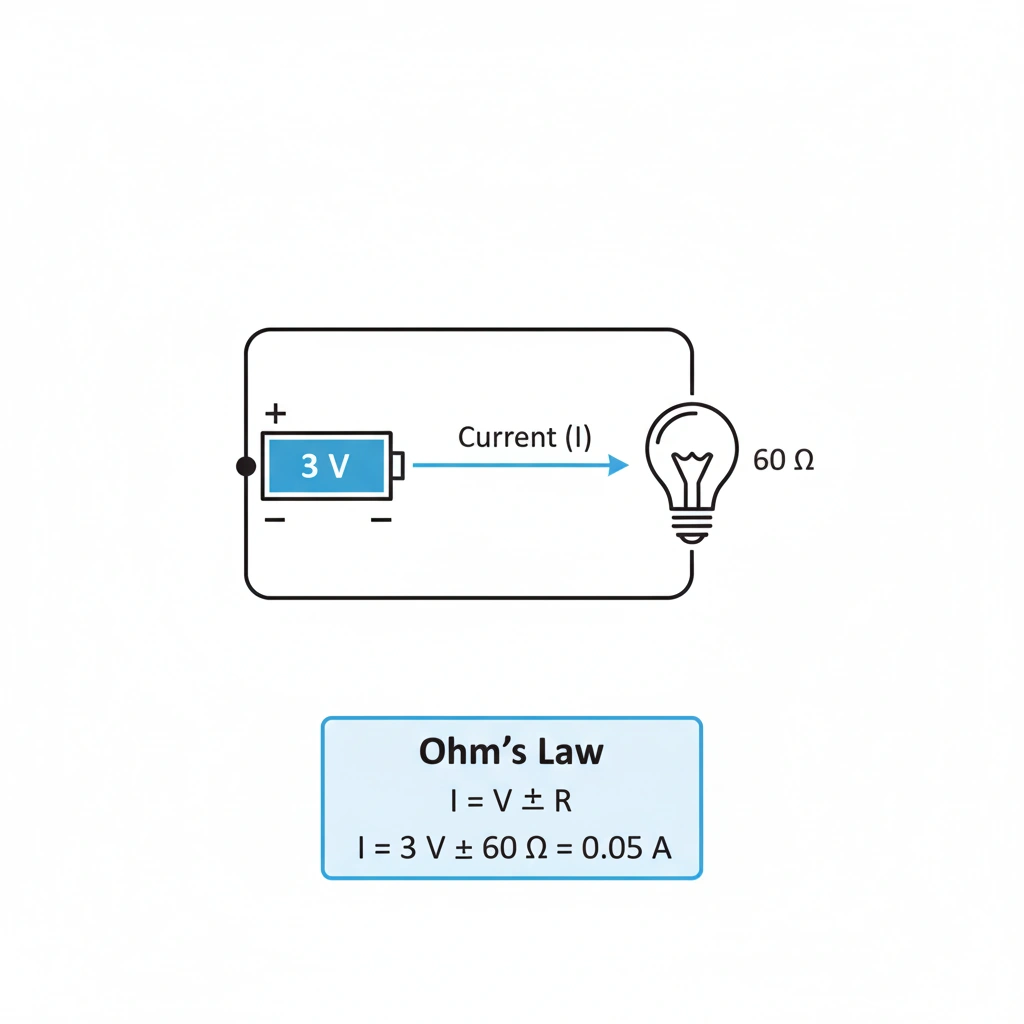
3 V flashlight, 60 Ω bulb. Current?
-
A
0.05 A
-
B
0.5 A
-
C
1.8 A
-
D
18 A
The current in the flashlight circuit is 0.05 A.
Electric current is determined by the relationship between voltage, current, and resistance, which is described by Ohm’s law. Ohm’s law states that the current flowing through a conductor is equal to the applied voltage divided by the resistance of the conductor. The relationship used is:
current equals voltage divided by resistance
where current is the flow of electric charge, voltage is the electrical potential difference, and resistance is the opposition to current flow. In this case, the flashlight provides 3 volts and the bulb has a resistance of 60 ohms.
A) 0.05 A
Applying Ohm’s law gives:
current equals 3 volts divided by 60 ohms
current equals 0.05 amperes
This calculation correctly uses the given voltage and resistance and produces the correct current.
B) 0.5 A
This value results from a decimal-point error, such as dividing 3 by 6 instead of 60. It overestimates the current by a factor of ten.
C) 1.8 A
This option comes from inverting the relationship and calculating resistance divided by voltage instead of voltage divided by resistance. Ohm’s law requires voltage to be divided by resistance, not the other way around.
D) 18 A
This value reflects a major arithmetic or conceptual error, such as multiplying voltage and resistance or misplacing the decimal by several orders of magnitude. A small flashlight circuit cannot produce such a large current.
Conclusion
Using Ohm’s law, the current in a 3-volt circuit with a 60-ohm bulb is found by dividing voltage by resistance. This gives a current of 0.05 amperes.

Topic Flashcards
Click to FlipWhat is the mathematical relationship defined by Ohm's Law, and how is it commonly expressed as an equation?
Ohm's Law states that the current through a conductor between two points is directly proportional to the voltage across the two points, and inversely proportional to the resistance. It is expressed as V = I × R, or rearranged as I = V/R or R = V/I.
A circuit consists of a 9-volt battery and a resistor. If the current measured is 0.3 amperes, what is the resistance of the resistor?
R = V/I = 9 V / 0.3 A = 30 Ω.
If you replace the 60 Ω bulb in the 3 V flashlight with a bulb of 30 Ω, what happens to the current? Calculate the new current.
The current increases. New current: I = V/R = 3 V / 30 Ω = 0.1 A (which is double the original 0.05 A).
What three fundamental electrical quantities are related by Ohm's Law, and what are their standard units?
Voltage (Volts, V), Current (Amperes, A), and Resistance (Ohms, Ω).
In a simple series circuit with a single resistor, if you want to reduce the current flowing, what two changes can you make to the circuit parameters?
You can increase the resistance or decrease the voltage (since I = V/R)