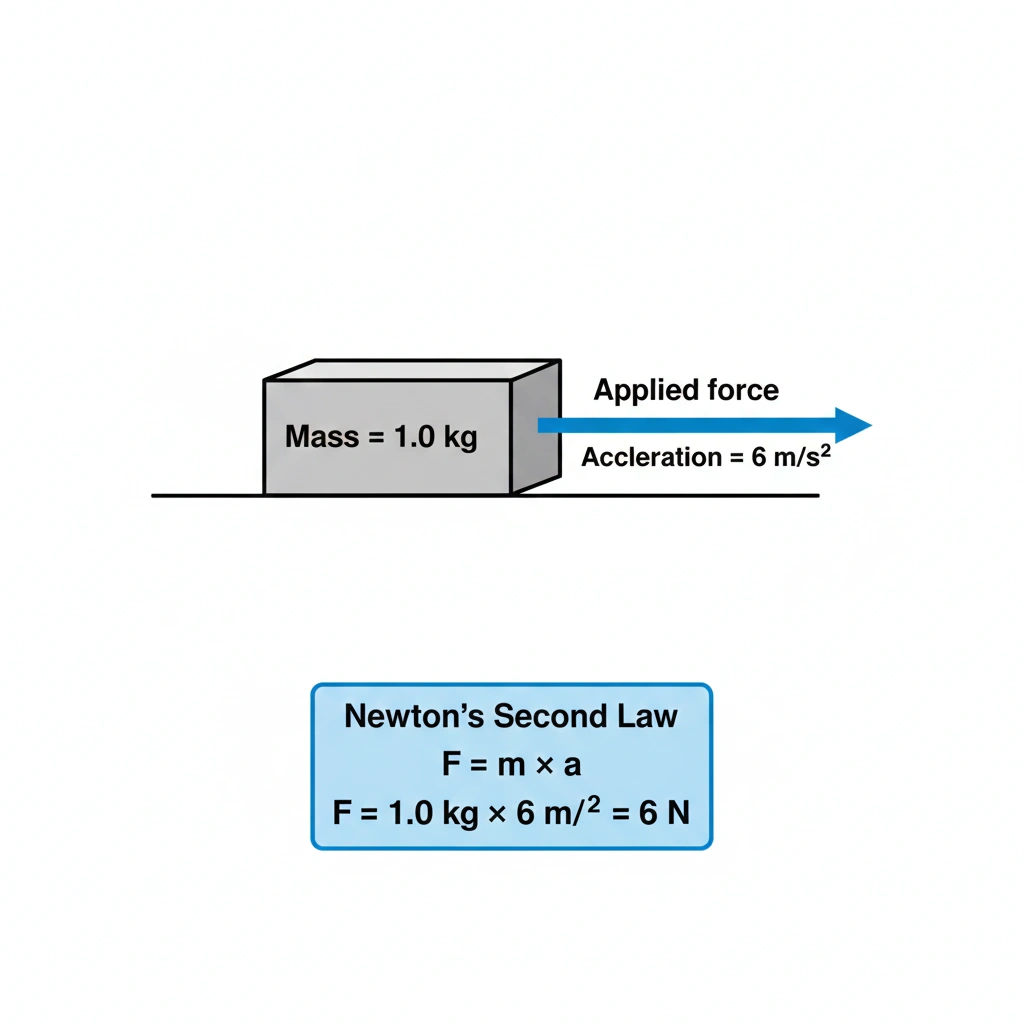
1.0 kg block, a = 6 m/s². Applied force?
-
A
0 N
-
B
3 N
-
C
6 N
-
D
Cannot determine
The applied force on the block is 6 newtons.
Newton’s Second Law of Motion states that the net force acting on an object is equal to the product of its mass and its acceleration. The relationship used is:
force equals mass multiplied by acceleration
where force is the applied force, mass is the mass of the object, and acceleration is the rate of change of velocity. With a mass of 1.0 kg and an acceleration of 6 meters per second squared, the force can be calculated directly.
A) 0 N
A force of zero would result in no acceleration. Since the block is accelerating at 6 meters per second squared, a nonzero force must be acting on it.
B) 3 N
This value is half of the correct force and would correspond to either a smaller acceleration or a smaller mass. It does not satisfy the given conditions.
C) 6 N
Applying Newton’s Second Law gives:
force equals 1.0 kilogram multiplied by 6 meters per second squared
force equals 6 newtons
This correctly matches the given mass and acceleration.
D) Cannot determine
All necessary information, mass and acceleration, is provided, so the applied force can be determined.
Conclusion
Using Newton’s Second Law, the applied force required to produce an acceleration of 6 meters per second squared on a 1.0 kg block is 6 newtons.
Topic Flashcards
Click to FlipIf a 1.0 kg block is accelerating at 6 m/s², what net force must be acting on it according to Newton's Second Law?
6 N (F_net = m*a = 1.0 kg * 6 m/s² = 6 N).
In the equation F_net = m*a, what does "F_net" specifically represent? Why is this distinction important?
It represents the vector sum of all forces acting on the object. This is crucial because multiple forces (like friction, applied force, gravity) can act simultaneously; only their net value determines the acceleration.
How would the calculated applied force change if the 1.0 kg block were on a frictionless horizontal surface versus being pushed vertically upward against gravity? Explain.
On a frictionless horizontal surface, the 6 N force is the applied force. To push it vertically upward at 6 m/s², the applied force must overcome gravity and provide the acceleration: F_app = m*(g + a) = 1.0 kg * (9.8 + 6) m/s² ≈ 15.8 N.
What is the weight (gravitational force) of the 1.0 kg block on Earth? How does this compare to the 6 N net force accelerating it?
Weight = m*g ≈ 9.8 N. The accelerating net force (6 N) is less than the block's weight.
If the same 6 N net force were applied to a 2.0 kg block, what would its acceleration be?
F_net / m = 6 N / 2.0 kg = 3.0 m/s².