Which of these statements is true regarding the way light travels?
-
A
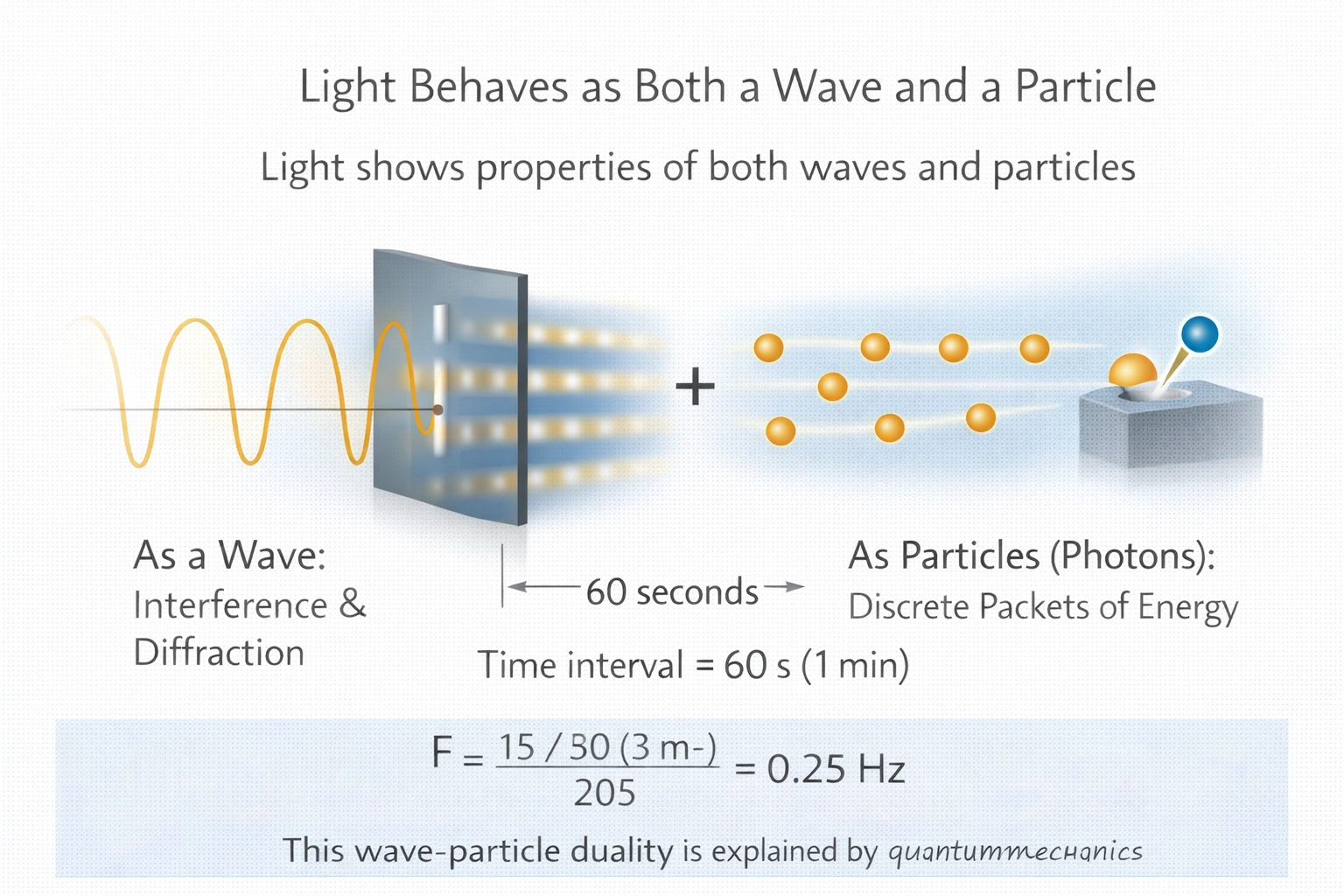
Light travels as both a wave and a particle
-
B
The speed of light is always the same regardless of the medium through which it travels
-
C
Light cannot travel through a vacuum.
-
D
Sound travels faster than light.
Light has a unique nature, showing properties of both waves and particles.
This is central to understanding phenomena like interference and diffraction.
A) Light travels as both a wave and a particle.
Light exhibits properties of both a wave and a particle. This is known as wave-particle duality, a fundamental concept in quantum mechanics. As a wave, light can exhibit phenomena such as interference and diffraction. As a particle, light is composed of photons, which are discrete packets of energy. This dual nature of light was confirmed by experiments like the photoelectric effect, which showed that light behaves as particles when interacting with matter. Therefore, A) is the correct answer.
B) The speed of light is always the same regardless of the medium through which it travels.
This statement is false. While the speed of light in a vacuum is constant at approximately 3.00 × 10⁸ m/s, its speed slows down when it passes through different mediums (e.g., air, water, glass). The speed of light depends on the refractive index of the medium it is traveling through. Thus, this statement is incorrect.
C) Light cannot travel through a vacuum.
This statement is also false. Light can travel through a vacuum (space) without the need for a medium. This is in contrast to sound, which requires a medium (such as air or water) to propagate. Light's ability to travel through a vacuum is essential for phenomena such as the light from the sun reaching the Earth through the empty space of the vacuum of space.
D) Sound travels faster than light.
This statement is false. Sound travels much slower than light. The speed of sound in air is approximately 343 m/s, while light travels at around 3.00 × 10⁸ m/s in a vacuum. Therefore, light is far faster than sound.
Conclusion: Light exhibits both wave-like and particle-like behavior, making A) the correct answer.

Topic Flashcards
Click to FlipWhat fundamental concept describes light's ability to behave as both a wave and a particle?
Wave-particle duality
What are the discrete packets of energy that make up light called?
Photons.
Through which medium does light travel fastest?
A vacuum
Name one wave phenomenon (other than diffraction) that demonstrates light's wave-like behavior.
Interference
Which experiment provided key evidence for the particle nature of light?
The photoelectric effect.