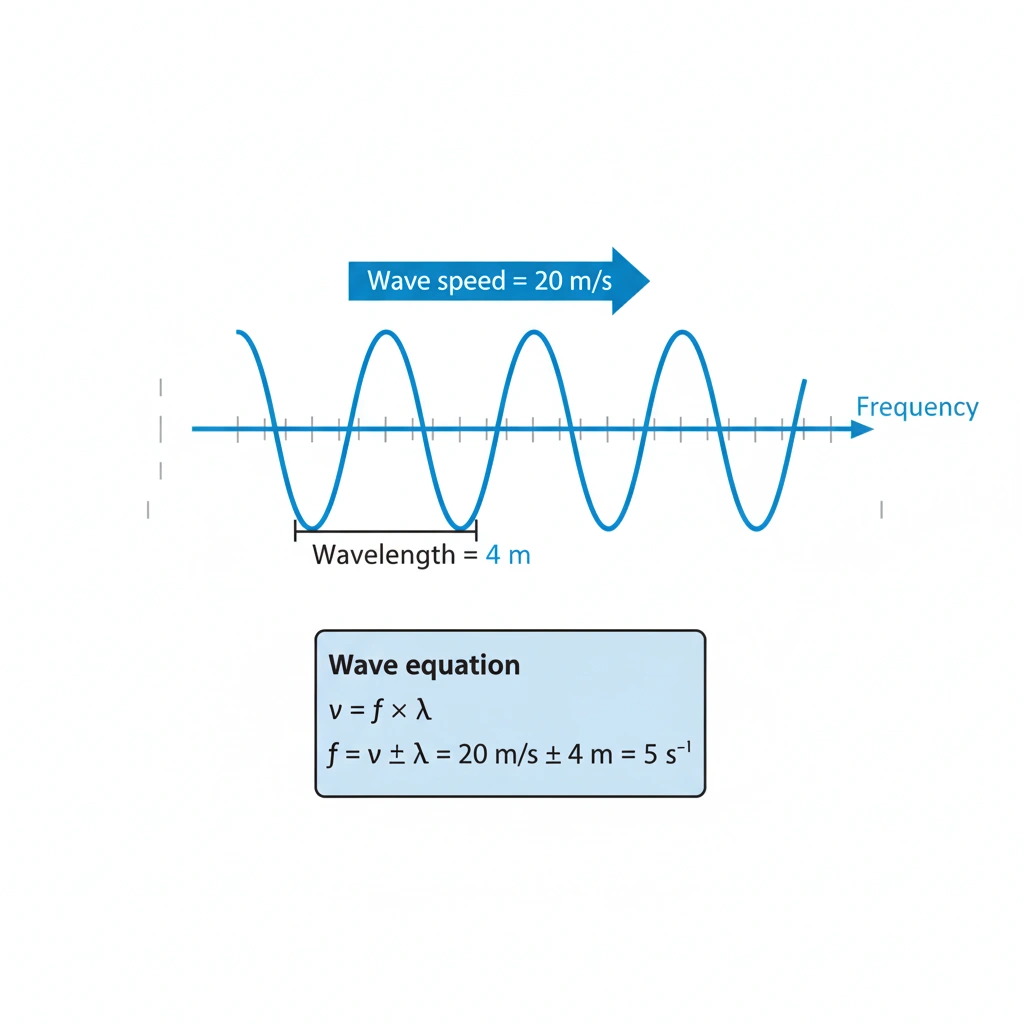
Wave 20 m/s, λ = 4 m. Frequency?
-
A
5 s⁻¹
-
B
16 s⁻¹
-
C
24 s⁻¹
-
D
80 s⁻¹
The frequency of the wave is 5 s⁻¹ (5 Hz).
Wave speed, wavelength, and frequency are related by the fundamental wave relationship that wave speed equals frequency multiplied by wavelength. To find the frequency, this relationship is rearranged so that frequency equals wave speed divided by wavelength. With a wave speed of 20 meters per second and a wavelength of 4 meters, the frequency can be calculated directly.
A) 5 s⁻¹
Substituting the given values gives:
frequency equals 20 meters per second divided by 4 meters
frequency equals 5 per second
This correctly applies the wave relationship and yields the correct frequency.
B) 16 s⁻¹
This value results from an incorrect calculation, such as multiplying instead of dividing or misusing one of the given quantities. It does not follow from the wave relationship.
C) 24 s⁻¹
This option reflects an arithmetic or conceptual error, possibly involving adding or multiplying values rather than using the correct ratio of wave speed to wavelength.
D) 80 s⁻¹
This value comes from multiplying the wave speed and wavelength instead of dividing them. Frequency is inversely proportional to wavelength, not directly proportional.
Conclusion
Frequency is found by dividing wave speed by wavelength. Using the given values, the frequency is exactly 5 s⁻¹, which is also written as 5 hertz.
Topic Flashcards
Click to FlipA sound wave travels from air into a denser medium like water. Its speed and wavelength both change. What happens to its frequency? Why?
Its frequency remains constant. Frequency is determined by the source and does not change when the wave enters a new medium; only the speed and wavelength adjust to satisfy v = fλ.
If a wave's speed is doubled while its wavelength is held constant, how does the frequency change? What if the speed is constant and the wavelength is doubled?
1) If speed doubles (v' = 2v) and λ is constant, then f' = v'/λ = 2v/λ = 2f (frequency doubles). 2) If speed is constant and λ doubles, then f' = v/(2λ) = f/2 (frequency halves).
The wave equation v = fλ is fundamental. What are the units for each variable in the SI system, and how does this ensure dimensional consistency in the equation?
v in m/s, f in Hz (1/s or s⁻¹), λ in m. Therefore, (m/s) = (1/s) × (m), which is dimensionally consistent.
An ocean wave has a wavelength of 40 m and a frequency of 0.1 Hz. What is its speed? How does this compare to the speed of a radio wave (an electromagnetic wave) of the same frequency?
v_water = fλ = 0.1 Hz × 40 m = 4 m/s. A radio wave of 0.1 Hz would travel at c ≈ 3×10⁸ m/s (the speed of light in a vacuum). Same frequency, vastly different speeds and wavelengths because they are different types of waves.
For a standing wave on a string fixed at both ends, the fundamental frequency is given by f = v/(2L), where L is the string length. If you want to double this fundamental frequency, what are two distinct ways you could adjust the string's physical properties (consider v = √(Tension/μ))?
1) Halve the length L (f ∝ 1/L). 2) Quadruple the tension T (since v ∝ √T, and f ∝ v, so f ∝ √T; to double f, you need v to double, which requires T to quadruple).