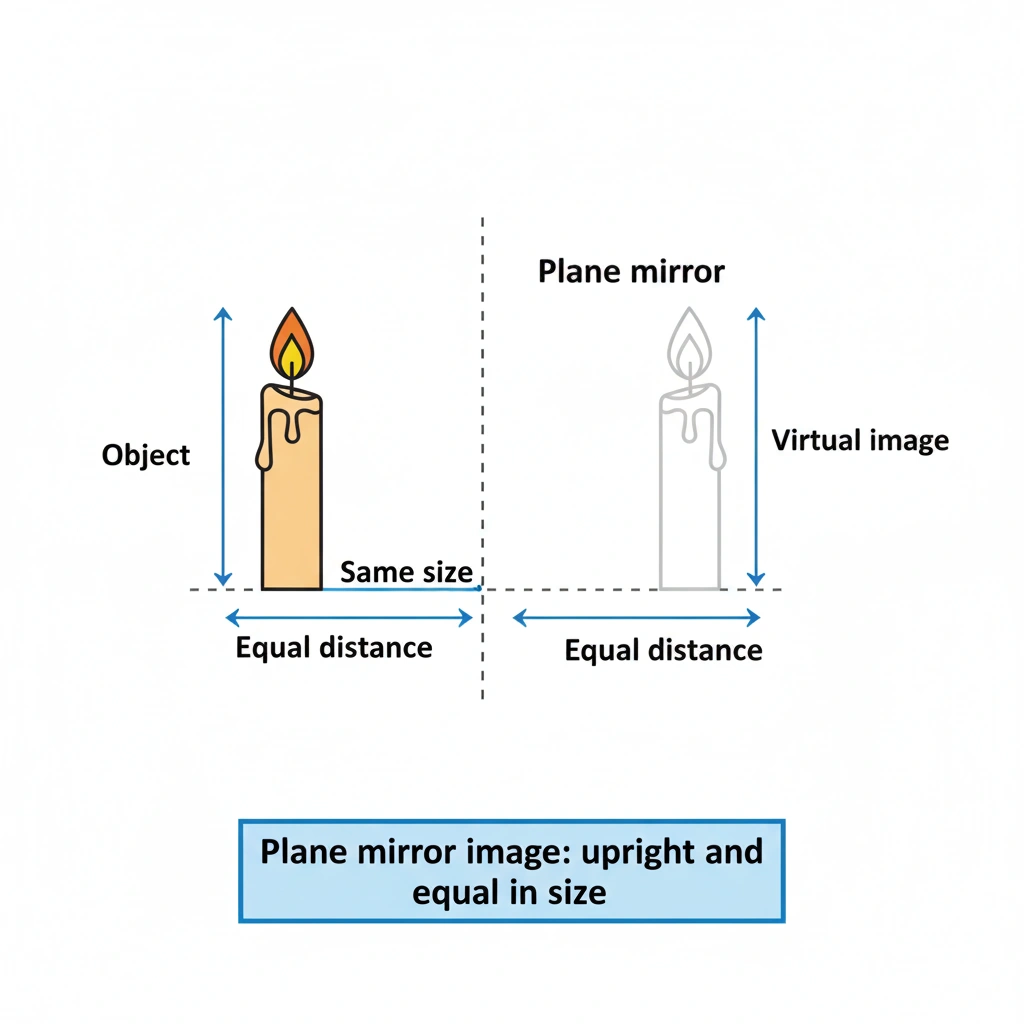
Candle in plane mirror appears _______.
-
A
inverted & reduced
-
B
inverted & enlarged
-
C
upright & reduced
-
D
upright & equal
A candle in a plane mirror appears upright and equal in size.
A plane mirror forms a virtual image that has specific, well-defined properties. The image appears the same distance behind the mirror as the object is in front, resulting in no magnification or reduction. Because the image is virtual, it is not inverted top to bottom; instead, it remains upright, although it is laterally reversed (left–right).
A) inverted & reduced
Plane mirrors do not produce inverted images. Inversion is a property of certain curved mirrors (such as concave mirrors beyond the focal point), not plane mirrors. Additionally, plane mirrors do not change the size of the image, so reduction is incorrect.
B) inverted & enlarged
This option combines two properties that do not apply to plane mirrors. Plane mirrors do not invert images and do not enlarge them. Enlargement occurs with concave mirrors or lenses under specific conditions.
C) upright & reduced
While the image in a plane mirror is upright, it is not reduced. The size of the image formed by a plane mirror is always exactly the same as the size of the object.
D) upright & equal
A plane mirror produces an upright image that is equal in size to the object. The image is virtual, appears behind the mirror, and is laterally reversed, but its height and orientation remain unchanged.
Conclusion
A plane mirror always forms a virtual image that is upright and the same size as the object. Therefore, a candle viewed in a plane mirror appears upright and equal in size.

Topic Flashcards
Click to FlipWhat type of image (real or virtual) is formed by a plane mirror, and how is it formed?
A virtual image. It is formed by the apparent divergence of light rays from a point behind the mirror; the rays do not actually converge there.
A person stands 2 meters in front of a plane mirror. Where does their image appear to be located, and what is the total distance between the person and their image?
The image appears 2 meters behind the mirror. The total person-to-image distance is 4 meters.
Explain the phenomenon of "lateral inversion" in a plane mirror. Provide a common example.
Lateral inversion is the left-right reversal of the image. A common example is text appearing backwards in a mirror (e.g., "AMBULANCE" written reversed on vehicle fronts so it reads correctly in a rearview mirror).
If you raise your right hand while facing a plane mirror, which hand does your image appear to raise? What does this demonstrate?
Your image raises its left hand. This demonstrates lateral inversion, where the image is reversed along the axis parallel to the mirror's surface.
What is the minimum height a vertical, full-length plane mirror must be for a person to see their entire body, and how must it be positioned? (Assume the person's eyes are at a height h from the ground and their total height is H).
Minimum mirror height = H/2. The top must be placed midway between eye level and the top of the head, and the bottom midway between eye level and the feet.