100% 4 Rated
Attempts 127

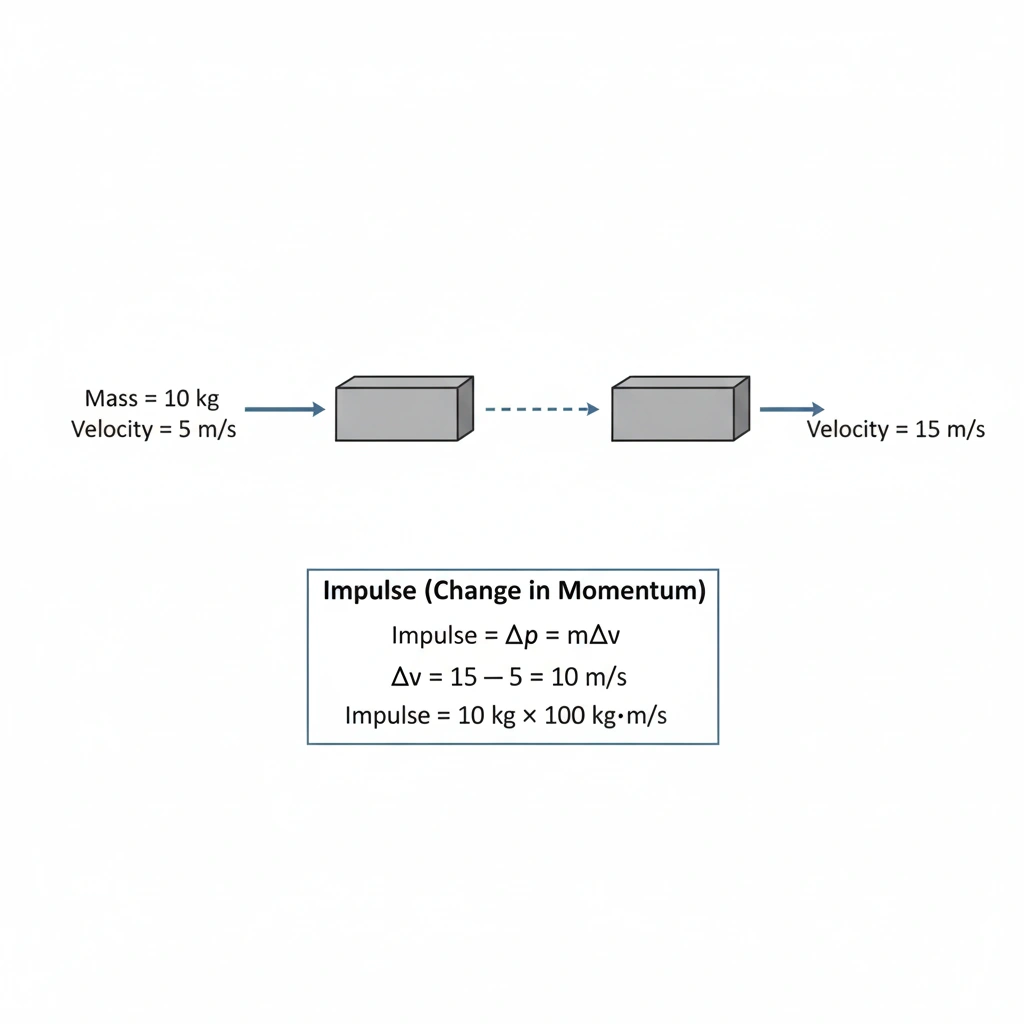
A 10 kg object changes velocity from 5 m/s to 15 m/s. What impulse was applied?

  1. A
    10 kg⋅m/s
  2. B
    15 kg⋅m/s
  3. C
    20 kg⋅m/s
  4. D
    100 kg⋅m/s

Topic Flashcards

Click to Flip
Question

State the Impulse-Momentum Theorem. What fundamental physics principle does it represent?

Answer

The theorem states that the impulse (J) applied to an object equals the change in its momentum (Δp). Mathematically, J = Δp = m*(v_f - v_i). It represents the application of Newton's Second Law over a time interval, showing how force acting over time changes motion.

Question

Write the two equivalent formulas used to calculate impulse.

Answer

1. J = F_avg * Δt (Average force multiplied by time interval). 2. J = Δp = m * (v_f - v_i) (Change in momentum: mass times change in velocity).

Question

A 5 kg cart is rolling at 2 m/s. You apply a force to stop it (v_f = 0 m/s). What impulse did you apply?

Answer

J = m*(v_f - v_i) = 5 kg * (0 - 2 m/s) = 5 kg * (-2 m/s) = -10 kg·m/s. The negative sign indicates the impulse is opposite the initial direction of motion.

Question

Using the impulse-momentum theorem (J = F*Δt), explain how airbags in cars reduce injury during a crash.

Answer

In a collision, the change in momentum (Δp) of a passenger is fixed. An airbag increases the time (Δt) over which this change occurs. Since J = F*Δt = Δp, a larger Δt results in a smaller average force (F) on the passenger, reducing injury.

Question

The unit for impulse is kg·m/s. Show that this unit is equivalent to the newton-second (N·s).

Answer

Since 1 N = 1 kg·m/s², then 1 N·s = 1 (kg·m/s²)·s = 1 kg·m/s. Therefore, kg·m/s and N·s are equivalent units.

Mini Quiz

1 / 3
Is impulse a vector quantity? (Does it have both magnitude and direction?)
Available Test Sets
Available FREE Test Sets