Which is true of water?
-
A
Opaque to visible, transparent to UV
-
B
Opaque to UV, transparent to visible
-
C
Opaque to both
-
D
Transparent to both
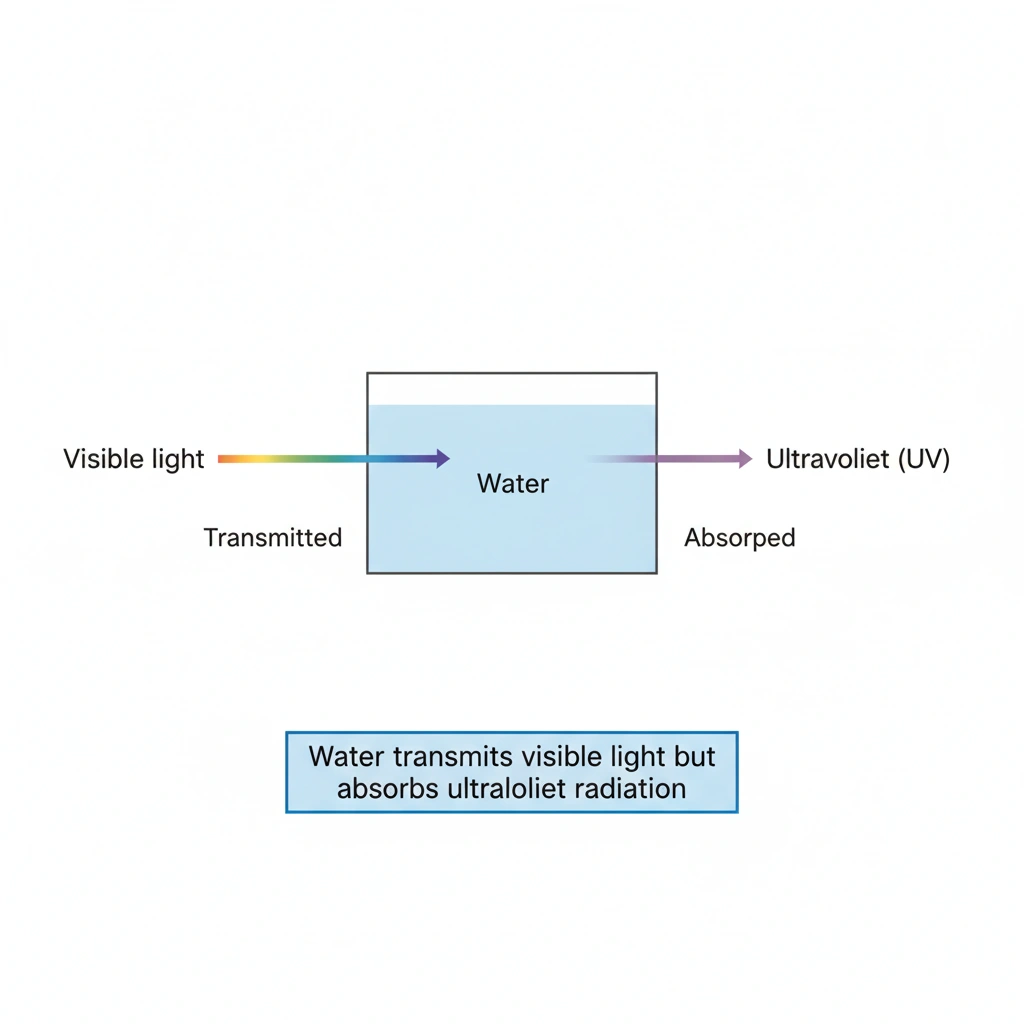
Water is opaque to ultraviolet light and transparent to visible light.
Water allows most visible light to pass through, which is why it appears clear to the human eye. However, water absorbs a significant portion of ultraviolet (UV) radiation due to electronic transitions within its molecules. This absorption prevents much of the UV light from penetrating through water.
A) Opaque to visible, transparent to UV
This description is the opposite of water’s actual behavior. Water is clearly transparent to visible light and does not block it, while UV light is absorbed rather than transmitted.
B) Opaque to UV, transparent to visible
Visible light passes easily through water, allowing us to see through it. At the same time, water absorbs much of the ultraviolet spectrum, especially UV-B and UV-C radiation. This makes water effectively opaque to UV while remaining transparent to visible light.
C) Opaque to both
If water were opaque to visible light, it would appear cloudy or solid-colored. Since water is clear under normal conditions, it cannot be opaque to visible light.
D) Transparent to both
Although water is transparent to visible light, it is not transparent to ultraviolet radiation. Significant UV absorption occurs, so this option does not accurately describe water’s properties.
Conclusion
Water appears clear because it transmits visible light, but it absorbs much of the ultraviolet spectrum. Therefore, it is transparent to visible light and opaque to ultraviolet radiation.

Topic Flashcards
Click to FlipWhat is the fundamental formula that defines the relationship between power (P), energy (E), and time (t)?
E = P × t. (Energy equals power multiplied by time).
Rearrange the formula E = P × t to solve for power (P).
P = E / t.
What is the unit 'kilowatt-hour (kWh)' a measure of, and how does it relate to the formula E = P × t?
It is a unit of energy. It comes from multiplying power in kilowatts (kW) by time in hours (h).
A 1200-watt microwave runs for 15 minutes. How much energy does it use in kilowatt-hours (kWh)?
Energy = Power × Time = 1.2 kW × 0.25 h = 0.3 kWh.
Why is the formula E = P × t more useful for calculating an appliance's energy use than P = E / t in this context?
Because we typically know an appliance's power rating (P) and how long (t) we use it, allowing us to directly calculate the total energy consumed (E) for billing or assessment.