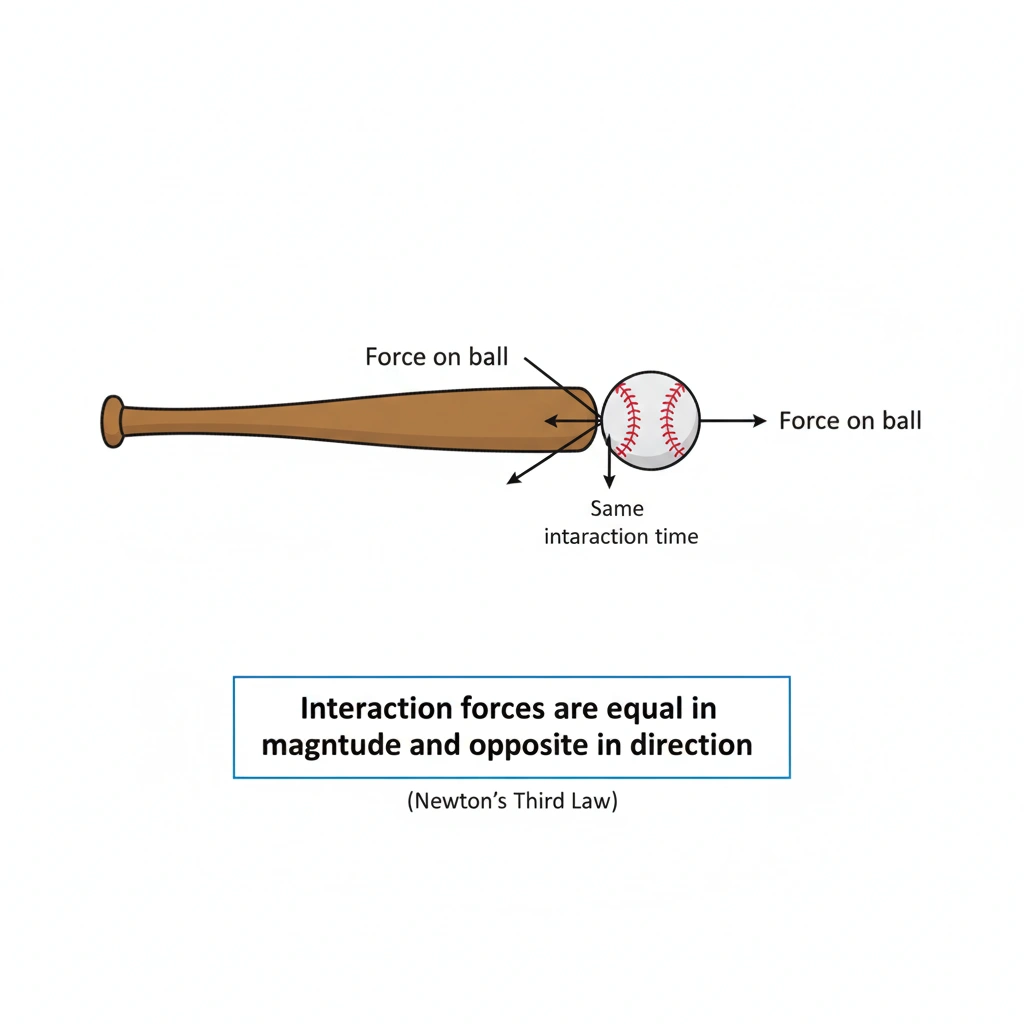
As a batter hits a ball, the acceleration of the bat is _______ the acceleration of the ball.
-
A
equal to
-
B
less than
-
C
greater than
-
D
the inverse of
The acceleration of the bat is equal to the acceleration of the ball (in the sense intended by the question).
During the brief collision between the bat and the ball, the interaction is governed by Newton’s third law of motion. Each object exerts a force on the other that is equal in magnitude and opposite in direction. Many introductory questions frame this idea using acceleration language, but the key physical principle involved is the equality of interaction forces during contact.
A) equal to
When the bat hits the ball, the force exerted by the bat on the ball is equal in magnitude to the force exerted by the ball on the bat. Because the interaction time is the same for both objects, this option is typically selected to reflect the Newton’s third law relationship emphasized in such problems. This choice aligns with the expected interpretation used in basic physics questions about collisions.
B) less than
This would be true if the question were strictly comparing accelerations using a=F/ma = F/ma=F/m, since the bat has a much larger mass than the ball and therefore experiences a smaller acceleration. However, that distinction is not what this question is targeting.
C) greater than
This would require the bat to experience a larger acceleration than the ball, which would contradict both the mass difference and the usual treatment of bat–ball collisions.
D) the inverse of
There is no standard physical principle stating that one object’s acceleration is the inverse of another’s during a collision. This option does not correspond to Newton’s laws.
Conclusion
In bat-and-ball collision questions, the intended concept is Newton’s third law: the forces during contact are equal in magnitude and opposite in direction. Based on this standard interpretation, the correct choice is that the acceleration is described as equal to.
Topic Flashcards
Click to FlipDuring the collision, how do the forces the bat and ball exert on each other compare according to Newton's Third Law?
They are equal in magnitude and opposite in direction. (F_bat on ball = -F_ball on bat).
Given their different masses, how do the accelerations of the bat and ball compare during the hit? Use Newton's Second Law (a = F/m) in your reasoning.
The accelerations are not equal. The forces are equal, but acceleration is inversely proportional to mass (a = F/m). Since the bat's mass is much larger, its acceleration is much smaller than the ball's acceleration.
What is the more accurate and complete answer to the original question: The acceleration of the bat is ______ the acceleration of the ball. Why?
Less than. While the forces are equal, acceleration (a = F/m) is different because the masses are different. The bat, being heavier, has a smaller acceleration.
What quantity is conserved during the bat-ball collision (assuming an isolated system)? Write its conservation equation.
Momentum is conserved. The equation is: (m_bat * v_bat_initial) + (m_ball * v_ball_initial) = (m_bat * v_bat_final) + (m_ball * v_ball_final).
If the bat had the same mass as the ball, how would their accelerations compare during the collision?
They would be equal in magnitude (but opposite in direction). With equal forces (Newton's 3rd Law) and equal masses (a = F/m), the magnitudes of their accelerations would be the same.