What happens when you polarize light?
-
A
You absorb most of its electromagnetic radiation.
-
B
You reduce the amplitude of the waves.
-
C
You separate it into individual colors.
-
D
You restrict its vibrations to a single plane.
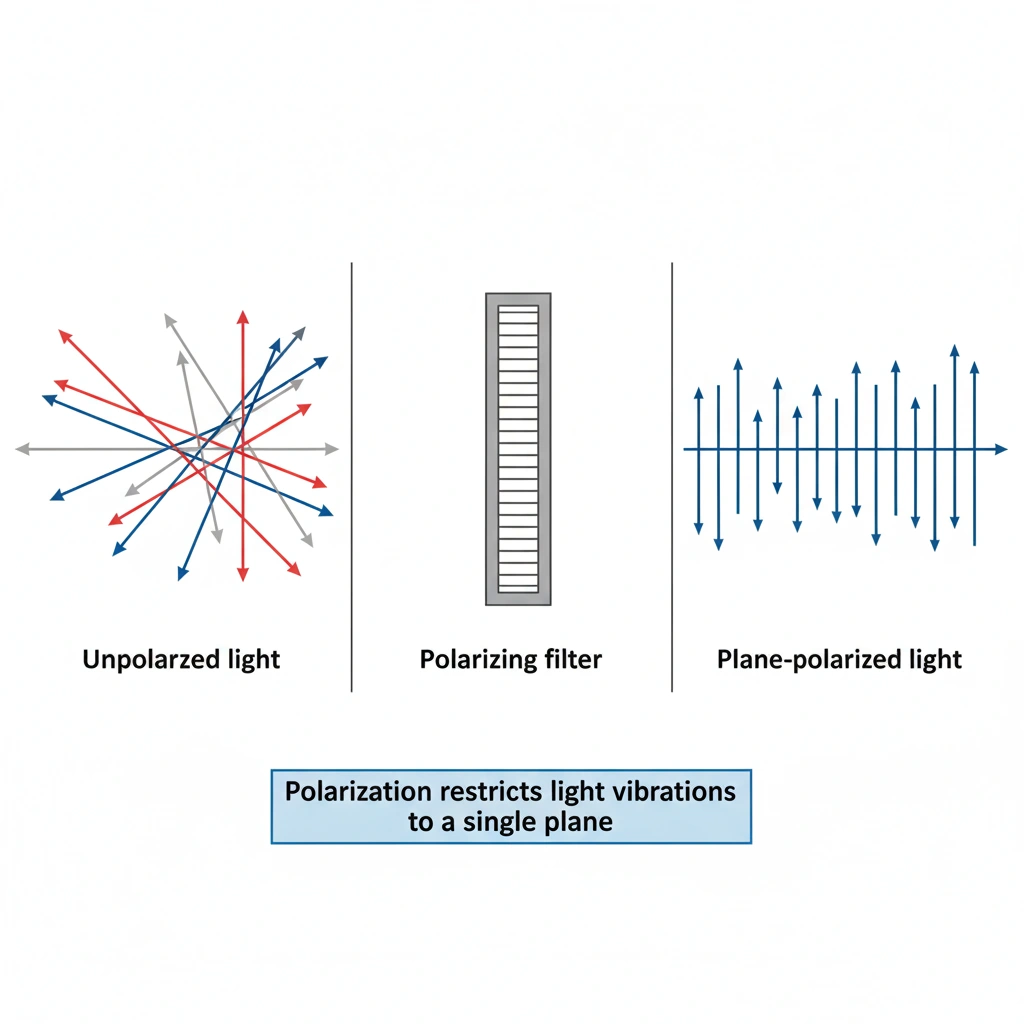
When you polarize light, you restrict its vibrations to a single plane.
Light is an electromagnetic wave in which the electric field normally vibrates in many planes perpendicular to the direction of travel. Polarization is the process of limiting these vibrations so that the electric field oscillates in just one specific direction or plane. This is commonly achieved using polarizing filters, reflection, or scattering.
A) You absorb most of its electromagnetic radiation.
Polarization does not inherently involve absorbing most of the radiation. While some light intensity may be reduced when passing through a polarizing filter, the defining feature of polarization is the control of vibration direction, not large-scale absorption of energy.
B) You reduce the amplitude of the waves.
Amplitude relates to the intensity or brightness of light. Although intensity can decrease when light passes through a polarizer, this reduction is a side effect of filtering out certain vibration directions, not the fundamental purpose of polarization.
C) You separate it into individual colors.
Separating light into different colors is the result of dispersion, such as when light passes through a prism. Polarization does not change the wavelength or frequency of light and therefore does not separate colors.
D) You restrict its vibrations to a single plane.
A polarizing process allows only the component of the electric field aligned with a specific direction to pass through. As a result, the light emerging from the polarizer has its electric field oscillating in one plane only, which defines plane-polarized light.
Conclusion
Polarization controls the orientation of light’s electric field without altering its color or fundamentally absorbing it. By restricting the vibrations to a single plane, polarization produces plane-polarized light.
Topic Flashcards
Click to FlipName two common methods or natural processes that can produce polarized light.
) Passing light through a polarizing filter (like Polaroid sunglasses). 2) Reflection from a non-metallic surface like water or glass (Brewster's angle).
What is the fundamental difference between unpolarized light and plane-polarized light?
In unpolarized light, the electric field oscillates in all possible planes perpendicular to the direction of travel. In plane-polarized light, it oscillates in only one specific plane
Explain why the intensity of unpolarized light is reduced by 50% after passing through an ideal polarizing filter.
An ideal filter transmits only the component of the electric field aligned with its axis. Unpolarized light's vibrations are equally distributed in all planes, so the average transmitted intensity is exactly half of the incident intensity.
What is Malus's Law, and what physical quantity does it relate?
Malus's Law states that the intensity (I) of plane-polarized light after passing through a polarizer is given by I = I₀ cos²θ, where I₀ is the initial intensity and θ is the angle between the light's polarization direction and the polarizer's axis.
What is the key characteristic that changes when you polarize light?
You restrict the electric field's oscillations (vibrations) to a single plane perpendicular to the direction of propagation.