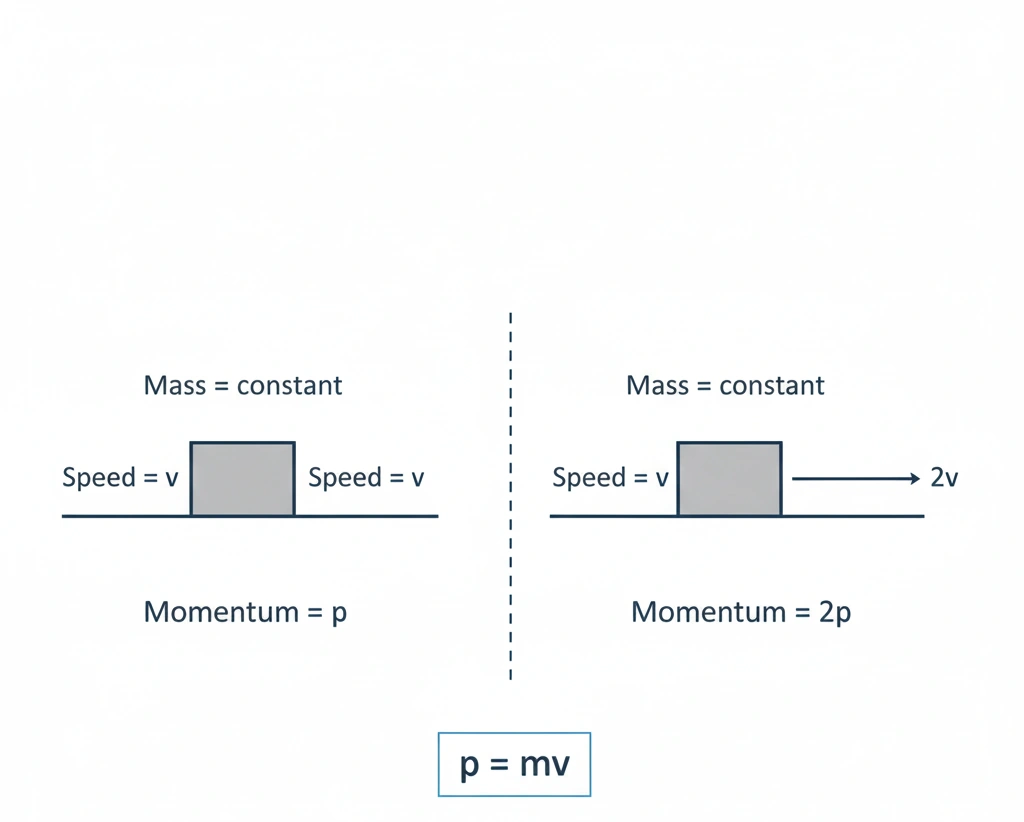
If you double the speed of a moving object, what else doubles?
-
A
Its potential energy
-
B
Its kinetic energy
-
C
Its acceleration
-
D
Its momentum
Doubling the speed of a moving object doubles its momentum.
Momentum depends directly on an object’s mass and velocity, as given by the relationship:
momentum equals mass multiplied by velocity
If the mass remains constant and the speed is doubled, the momentum also doubles. This linear relationship makes momentum the quantity that changes proportionally with speed.
A) Its potential energy
Potential energy depends on an object’s position, height, or configuration, not on how fast it is moving. Changing speed does not directly affect potential energy.
B) Its kinetic energy
Kinetic energy depends on the square of the speed, according to the relationship:
kinetic energy equals one half multiplied by mass multiplied by velocity squared
Doubling the speed results in four times the kinetic energy, not twice.
C) Its acceleration
Acceleration depends on the net force acting on an object and its mass. Simply changing the speed does not necessarily change the acceleration.
D) Its momentum
Momentum is directly proportional to velocity. When speed doubles and mass stays the same, momentum doubles as well, making this the correct choice.
Conclusion
Because momentum varies linearly with speed, doubling an object’s speed results in a doubling of its momentum.
Topic Flashcards
Click to FlipWhat is the definition of linear momentum (p), and how is it mathematically related to mass (m) and velocity (v)?
Momentum (p) is the product of an object's mass and its velocity: p = m * v. It is a vector quantity with direction the same as the velocity.
If speed doubles, what happens to kinetic energy? Write the kinetic energy formula and show the calculation for a change from v to 2v.
Kinetic energy quadruples. KE = ½ * m * v². For speed 2v, KE_new = ½ * m * (2v)² = ½ * m * 4v² = 4 * (½ * m * v²) = 4 * KE_original.
A 5 kg object moves at 4 m/s. Calculate its momentum and kinetic energy. What are the new values if its speed doubles to 8 m/s?
Original: p = 5 kg * 4 m/s = 20 kg·m/s; KE = ½ * 5 * (4)² = 40 J. Doubled speed: p = 5 kg * 8 m/s = 40 kg·m/s (doubled); KE = ½ * 5 * (8)² = 160 J (quadrupled).
Why does potential energy not double when speed doubles? On what does gravitational potential energy (a common type) depend?
Gravitational potential energy (PE = m * g * h) depends on height (h), not speed. Changing an object's speed at the same height does not change its potential energy.
In a car crash, why is the damage much more severe at 60 mph compared to 30 mph, given that the momentum only doubles?
While momentum doubles, the kinetic energy quadruples. The work needed to stop the car (and the damage done) relates to the energy dissipated. Quadruple the energy means a far more severe collision.