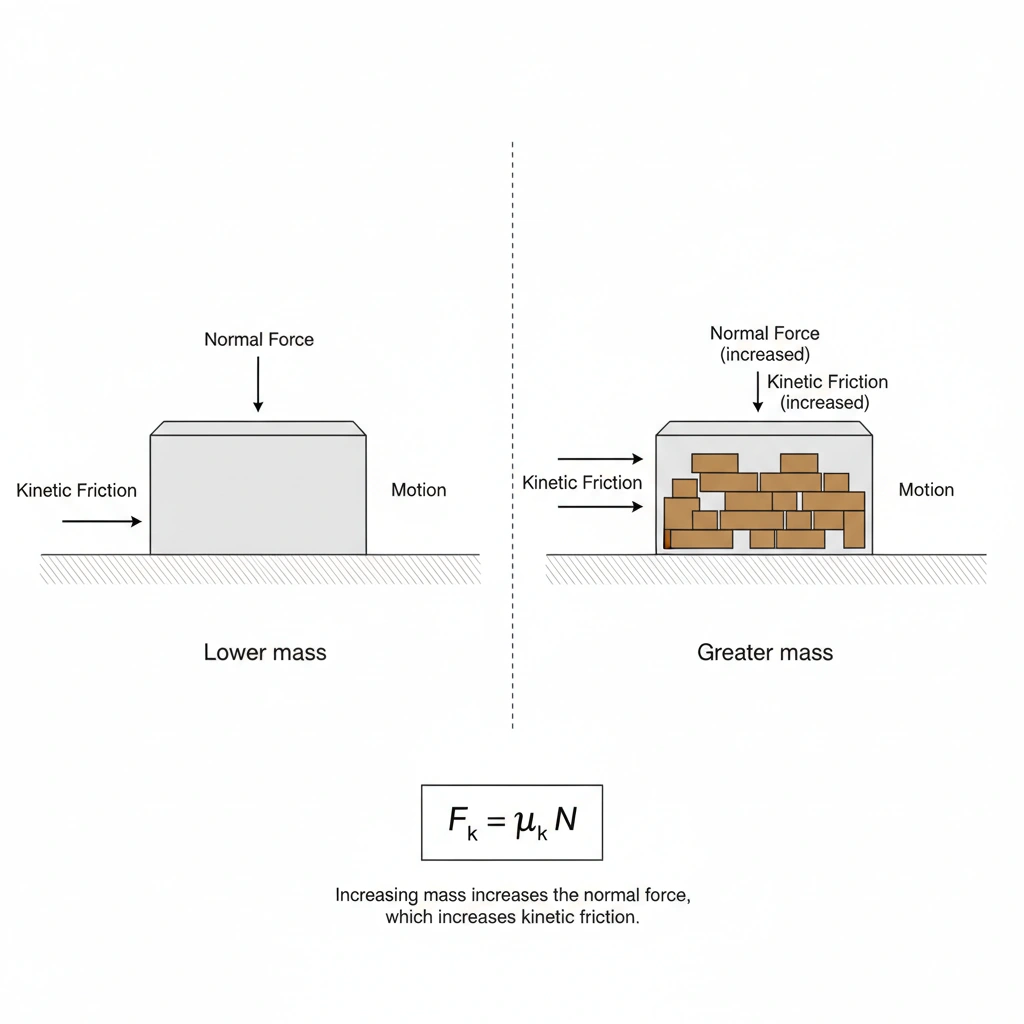
A baby slides an empty box across the floor. If the baby puts wooden blocks into the box and continues to slide it, what happens to the force of kinetic friction?
-
A
It decreases.
-
B
It increases.
-
C
It remains the same.
-
D
It is halved.
The force of kinetic friction increases.
Kinetic friction depends on the normal force between two surfaces and the coefficient of kinetic friction. When the baby adds wooden blocks to the box, the total mass of the box increases. This increases the weight of the box, which in turn increases the normal force exerted by the floor on the box. Because kinetic friction is directly proportional to the normal force, the frictional force becomes larger.
A) It decreases.
Reducing kinetic friction would require a decrease in the normal force or a lower coefficient of friction. Adding mass to the box does the opposite by increasing the force pressing the box against the floor.
B) It increases.
Kinetic friction is given by the equation Fk=μkNF_k = \mu_k NFk=μkN. Adding wooden blocks increases the total weight of the box, which increases the normal force NNN. Assuming the surface and material remain the same, the coefficient of kinetic friction μk\mu_kμk stays constant, so the frictional force increases.
C) It remains the same.
For the frictional force to stay the same, the normal force would need to remain unchanged. Adding blocks clearly increases the normal force, so the friction cannot remain constant.
D) It is halved.
There is no physical reason for the frictional force to be reduced by half when mass is added. Increasing the load leads to greater friction, not less.
Conclusion
Adding wooden blocks increases the mass of the box, which increases the normal force between the box and the floor. Since kinetic friction is proportional to the normal force, the force of kinetic friction increases.
Topic Flashcards
Click to FlipWhat is the formula for calculating the force of kinetic friction (F_k), and what does each variable represent?
F_k = μ_k * N, where μ_k is the coefficient of kinetic friction (a property of the surfaces), and N is the normal force (the force pressing the surfaces together, often equal to weight on a flat surface).
How does adding mass to the box sliding on a flat floor change the normal force (N), and why?
Adding mass increases the weight of the box. On a flat floor, the normal force is equal and opposite to the weight. Therefore, increasing the mass increases the normal force (N).
Assuming the floor and box material don't change, what two things must you know to calculate the new force of kinetic friction after blocks are added?
You must know the coefficient of kinetic friction (μ_k), which remains constant, and the new total mass (to calculate the new normal force: N = m*g)
If the original empty box had a kinetic friction force of 5 N, and adding blocks doubled its total mass, what is the new friction force (assuming the same surface)?
Doubling the mass doubles the normal force (N). Since F_k ∝ N, the kinetic friction force also doubles to 10 N.
Why does the force required to push the box at a constant speed also increase when blocks are added?
To keep an object moving at constant velocity, the applied force must exactly balance the kinetic friction force. Since adding blocks increases the kinetic friction, the required pushing force must increase by the same amount.