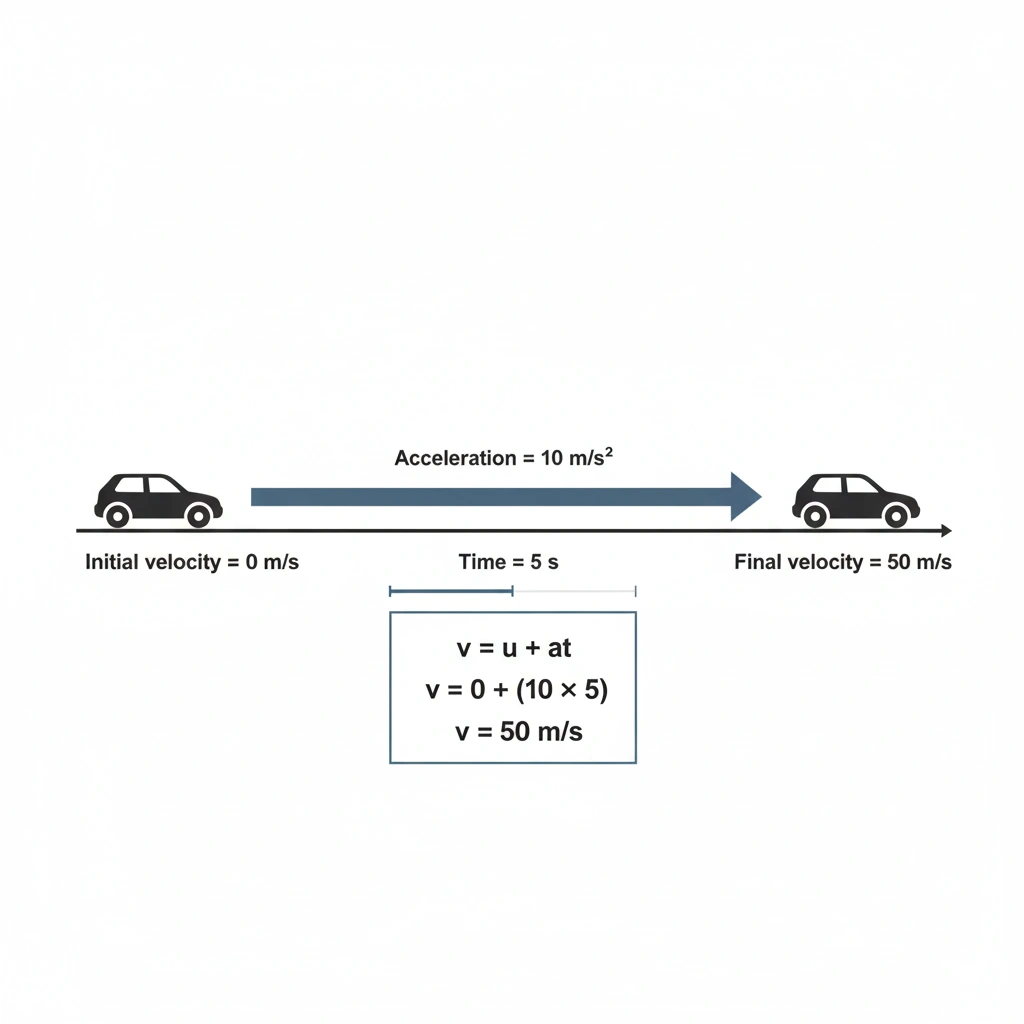
A car starts from rest and accelerates at 10 m/s² for 5 s. What is its final velocity?
-
A
2 m/s
-
B
5 m/s
-
C
50 m/s
-
D
Cannot be determined
The car’s final velocity is 50 m/s.
When an object accelerates at a constant rate, its final velocity can be found using the kinematic equation:
final velocity equals initial velocity plus acceleration multiplied by time
where u is the initial velocity, a is the acceleration, and t is the time. In this case, the car starts from rest, so the initial velocity is zero.
A) 2 m/s
This value results from incorrectly dividing the acceleration by the time or misusing the relationship between acceleration and velocity. Acceleration represents the rate of change of velocity per second, not a value to be divided by time in this way.
B) 5 m/s
This option uses only the time component and ignores the magnitude of the acceleration. Velocity depends on both how fast the speed changes and how long the acceleration acts, so time alone is insufficient.
C) 50 m/s
Starting from rest means the initial velocity is 0 m/s. Applying the kinematic equation gives:
final velocity equals zero plus acceleration multiplied by time
final velocity equals zero plus 10 m per second squared multiplied by 5 seconds
final velocity equals 50 m per second
This correctly accounts for both the acceleration and the time over which it acts.
D) Cannot be determined
All necessary information is provided: initial velocity, acceleration, and time. With these values, the final velocity can be calculated directly, so the result is determinable.
Conclusion
A constant acceleration of 10 m per second squared acting for 5 seconds increases the car’s velocity by 50 m per second. Therefore, the final velocity is 50 m per second.
Topic Flashcards
Click to FlipWhat is the basic kinematic equation for calculating final velocity (v) when an object starts with an initial velocity (u) and undergoes constant acceleration (a) for a time (t)?
v = u + a*t.
Using the formula v = u + at, calculate the final velocity of a bicycle that starts from rest (u=0) and accelerates at 2 m/s² for 6 seconds.
v = 0 + (2 m/s²)*(6 s) = 12 m/s.
In the car problem, the acceleration is 10 m/s². What does this numerical value mean physically?
It means the car's velocity increases by 10 meters per second for every second it accelerates.
If the car in the problem did not start from rest but had an initial velocity of 5 m/s, what would its final velocity be after accelerating at 10 m/s² for 5 s?
v = u + a*t = 5 m/s + (10 m/s²)*(5 s) = 5 + 50 = 55 m/s.
Show how the units in the calculation (m/s² * s) correctly yield the units for velocity (m/s).
Acceleration (m/s²) multiplied by time (s) gives: (m/s²) * s = m/s. The seconds (s) partially cancel, leaving meters per second.