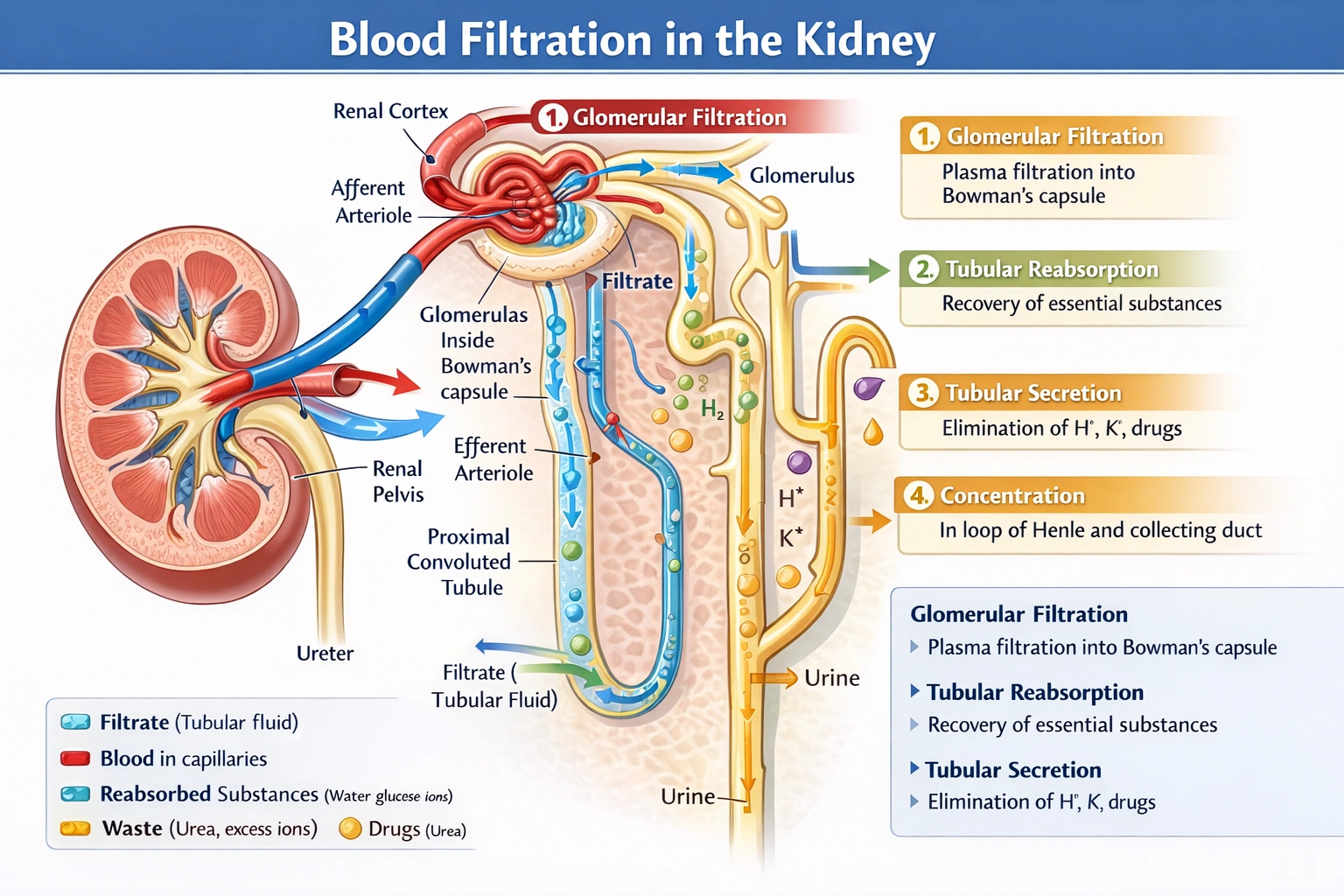
A patient's body is not properly filtering blood. Which of the following body parts is most likely malfunctioning?
-
A
Medulla
-
B
Heart
-
C
Nephrons
-
D
Renal cortex
Nephrons represent the functional filtration units of the kidney where blood purification occurs.
Each kidney contains approximately one million nephrons that execute blood filtration via the glomerular capillary network—where hydrostatic pressure forces plasma components through a three-layer filtration barrier (endothelium, basement membrane, podocyte slit diaphragms) into Bowman's capsule—followed by selective reabsorption and secretion along the renal tubule to form urine while maintaining homeostasis.
A) Medulla
The renal medulla consists of renal pyramids containing loops of Henle and collecting ducts that concentrate urine through countercurrent multiplication—but does not perform initial blood filtration. The medulla's primary role involves establishing an osmotic gradient for water conservation, not plasma filtration. While medullary damage impairs urine concentration (causing dilute urine), it does not prevent filtration itself; glomerular filtration continues even with medullary injury. The term "medulla" alone could ambiguously refer to brainstem medulla (cardiovascular/respiratory control) or adrenal medulla (catecholamine secretion), neither involved in blood filtration.
B) Heart
The heart functions as a muscular pump circulating blood through vascular systems but lacks filtration capability. Cardiac output influences glomerular filtration rate (GFR) through renal perfusion pressure—reduced cardiac output can decrease GFR secondarily—but the heart itself contains no structures that remove waste products, excess ions, or regulate blood composition. Heart failure may reduce kidney perfusion leading to decreased filtration, but the filtration defect originates in renal hemodynamics rather than cardiac tissue malfunction per se.
C) Nephrons
Nephrons constitute the microscopic functional units executing blood filtration through three integrated processes: (1) glomerular filtration—where ~180 L/day of plasma ultrafiltrate forms as blood passes through glomerular capillaries; (2) tubular reabsorption—where essential substances (glucose, amino acids, 99% of water, ions) return to peritubular capillaries; and (3) tubular secretion—where additional wastes (H⁺, K⁺, drugs) enter the tubule lumen. Damage to nephrons (e.g., from diabetes, hypertension, glomerulonephritis) directly impairs filtration capacity, elevating blood urea nitrogen (BUN) and creatinine—clinical markers of filtration failure. No other structure performs this integrated purification function.
D) Renal cortex
The renal cortex houses glomeruli and convoluted tubules—the anatomical location of nephron filtration components—but "renal cortex" describes a tissue region rather than the functional unit itself. Cortical damage would impair filtration only because it contains nephrons; the cortex is not the filtering mechanism but rather the structural compartment housing nephrons. Nephrons extend from cortex into medulla (juxtamedullary nephrons), making "nephrons" the precise functional answer rather than their anatomical location.
Conclusion:
Blood filtration occurs exclusively within nephrons through specialized microanatomical structures—the glomerulus for initial plasma ultrafiltration and renal tubules for selective modification of filtrate composition. While the renal cortex provides anatomical housing and the heart supplies perfusion pressure, nephrons themselves execute the filtration process. Medullary structures concentrate urine but do not filter blood. When clinical presentation indicates filtration failure (elevated creatinine, proteinuria, reduced GFR), nephron dysfunction—whether from glomerular, tubular, or vascular pathology within the nephron—represents the direct cause. Option C correctly identifies nephrons as the functional filtration units whose malfunction produces impaired blood purification.