A pediatrician notes that an infant's cartilage is disappearing and being replaced by bone. What process has the doctor observed?
-
A
Mineralization
-
B
Ossification
-
C
Osteoporosis
-
D
Calcification
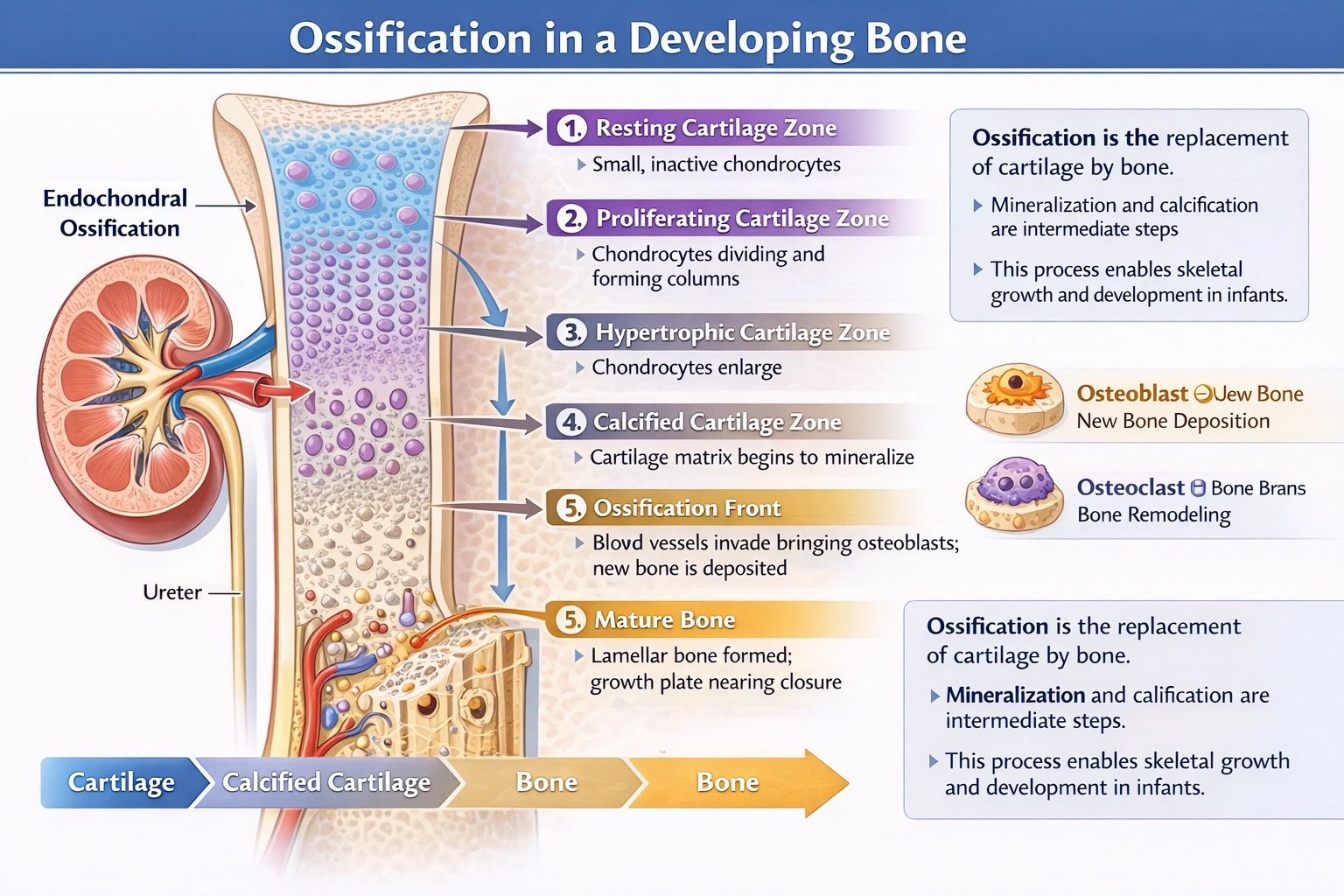
Ossification describes the developmental process where cartilage templates are systematically replaced by bone tissue during skeletal maturation, particularly through endochondral ossification in long bones.
This precisely orchestrated sequence involves chondrocyte hypertrophy and apoptosis within cartilage models, vascular invasion bringing osteoprogenitor cells, deposition of woven bone on calcified cartilage remnants, and subsequent remodeling into mature lamellar bone—transforming the embryonic cartilaginous skeleton into a mineralized bony framework capable of supporting body weight and enabling growth at epiphyseal plates.
A) Mineralization
Mineralization refers specifically to hydroxyapatite crystal deposition within organic matrices—occurring in both bone formation (osteoid mineralization) and pathological soft tissue calcification. While mineralization constitutes one phase of ossification (when osteoblasts deposit calcium phosphate into osteoid), it represents only a component process rather than the comprehensive cartilage-to-bone replacement sequence. Cartilage itself undergoes transient mineralization before resorption during endochondral ossification, but mineralization alone does not encompass cellular replacement, vascular invasion, or tissue remodeling that defines skeletal development.
B) Ossification
Ossification encompasses two primary mechanisms: intramembranous ossification (mesenchymal cells directly differentiating into osteoblasts forming flat bones like the skull) and endochondral ossification (cartilage models replaced by bone in long bones, vertebrae, and pelvis). The pediatric observation of cartilage "disappearing and being replaced by bone" specifically describes endochondral ossification—where growth plates contain zones of resting cartilage, proliferating chondrocytes, hypertrophic chondrocytes, calcified cartilage, and ossification front where osteoblasts deposit bone on cartilage scaffolds. This process enables longitudinal bone growth during childhood and completes skeletal maturation at epiphyseal closure during adolescence.
C) Osteoporosis
Osteoporosis represents pathological bone density reduction from imbalanced remodeling (resorption exceeding formation), causing fragility fractures in elderly populations—not developmental cartilage replacement in infants. This metabolic bone disease involves osteoclast hyperactivity or osteoblast insufficiency in already-formed bone, with no cartilage involvement. Infants cannot develop osteoporosis as their skeletons are actively mineralizing and growing; the condition requires pre-existing mature bone undergoing net loss—a pathophysiological state entirely unrelated to normal skeletal development.
D) Calcification
Calcification denotes calcium salt deposition in tissues, occurring physiologically in bone formation or pathologically in soft tissues (e.g., arterial walls in atherosclerosis). During endochondral ossification, cartilage matrix temporarily calcifies to facilitate chondrocyte apoptosis and vascular invasion—but calcification alone does not constitute bone replacement. The calcified cartilage scaffold serves as a template for osteoblasts to deposit true bone matrix; without subsequent cellular replacement and collagen type switching (from type II cartilage collagen to type I bone collagen), calcified cartilage remains cartilage—not bone. Calcification is an intermediate step, not the comprehensive replacement process.
Conclusion:
Ossification—specifically endochondral ossification—defines the developmental transformation of cartilaginous skeletal templates into mineralized bone through coordinated cellular differentiation, matrix replacement, and vascular invasion. While mineralization and calcification represent component biochemical events within this process, they lack the comprehensive scope of tissue replacement that characterizes ossification. Osteoporosis represents pathological bone loss unrelated to developmental cartilage replacement. The pediatric observation of cartilage disappearance with concurrent bone formation precisely matches endochondral ossification—the fundamental mechanism building the postnatal skeleton. Option B correctly identifies this essential developmental process governing skeletal maturation from infancy through adolescence.