Extract:

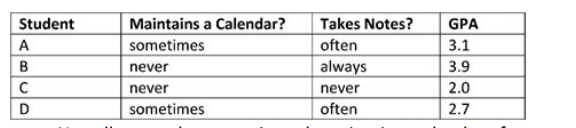
A researcher is exploring factors that contribute to the GPA of college students. While the sample is small, the researcher is trying to determine what the data shows. What can be reasoned from the table below?
-
A
A researcher is exploring factors that contribute to the GPA of college students. While the sample is small, the researcher is trying to determine what the data shows. What can be reasoned from the table below?
-
B
There is an inverse correlation between maintaining a calendar and GPA, and there is a positive correlation between taking notes and GPA.
-
C
There is a positive correlation between maintaining a calendar and GPA, and there is no correlation between taking notes and GPA.
-
D
There is no correlation between maintaining a calendar and GPA, and there is a positive correlation between taking notes and GPA.
The data shows inconsistent relationships between calendar maintenance and GPA, but a discernible pattern where increased note-taking frequency associates with higher GPAs. With such a small sample, statistical significance cannot be established, but the observed patterns support this interpretation as the most reasonable conclusion from the available data.
A) No college students consistently maintain a calendar of events
This statement makes an absolute claim about all college students based on a four-person sample, which is methodologically unsound. The data only shows "never" and "sometimes" for calendar maintenance, with no "always" category present. Even if "always" were an option, the sample size is insufficient to generalize to all college students. Additionally, the question asks what can be "reasoned" from the data—not what absolute truths can be declared making this overgeneralization invalid for the given sample.
B) There is an inverse correlation between maintaining a calendar and GPA, and there is a positive correlation between taking notes and GPA
An inverse correlation would mean that as calendar maintenance increases, GPA decreases. However, the data shows no consistent inverse pattern: Student B (never maintains calendar) has the highest GPA (3.9), while Student C (never maintains calendar) has the lowest GPA (2.0). Student A (sometimes maintains calendar) has a moderate GPA (3.1), and Student D (sometimes maintains calendar) has a low GPA (2.7). There is no clear inverse relationship between calendar maintenance and GPA. While the note-taking correlation appears positive (as explained in option D), the calendar claim makes this option incorrect.
C) There is a positive correlation between maintaining a calendar and GPA, and there is no correlation between taking notes and GPA
A positive correlation would mean that as calendar maintenance increases, GPA increases. However, Student B (never maintains calendar) has the highest GPA (3.9), which contradicts this claim. Student C (never maintains calendar) has the lowest GPA (2.0), but Student A (sometimes maintains calendar) has a moderate GPA (3.1), and Student D (sometimes maintains calendar) has a low GPA (2.7). There is no consistent positive pattern between calendar maintenance and GPA. Additionally, the note-taking data shows a pattern where increased frequency associates with higher GPAs (Student B: always takes notes, GPA 3.9; Students A/D: often take notes, GPAs 3.1 and 2.7; Student C: never takes notes, GPA 2.0), indicating at least a potential positive correlation rather than "no correlation."
D) There is no correlation between maintaining a calendar and GPA, and there is a positive correlation between taking notes and GPA
The calendar maintenance data shows no consistent pattern:
- Students who "never" maintain a calendar have both high (3.9) and low (2.0) GPAs
- Students who "sometimes" maintain a calendar have both moderate (3.1) and low (2.7) GPAs
- This inconsistent distribution indicates no discernible correlation between calendar maintenance and GPA.
For note-taking, the data shows a pattern consistent with positive correlation:
- Student C (never takes notes): GPA 2.0 (lowest)
- Students A and D (often take notes): GPAs 3.1 and 2.7 (moderate to low)
- Student B (always takes notes): GPA 3.9 (highest)
- This progression (never → often → always) associates with increasing GPA (2.0 → 2.7-3.1 → 3.9), suggesting a positive relationship. While the sample size is too small for statistical significance, this pattern represents the most reasonable interpretation from the given data.
Conclusion:
With such a limited dataset, definitive conclusions about causation or statistical significance are impossible. However, the observed patterns support the interpretation that calendar maintenance shows no consistent relationship with GPA, while note-taking frequency demonstrates a pattern consistent with positive correlation. Option D correctly identifies these observed relationships without overstating the data's implications. Other options either mischaracterize the calendar-GPA relationship (B and C) or make unwarranted generalizations beyond the data (A). In research methodology, recognizing patterns in small samples while acknowledging limitations represents appropriate scientific reasoning—making option D the most reasonable conclusion from the provided data.