Which of the following is a standard or series of standards to which the results from an experiment are compared?
-
A
A control
-
B
A variable
-
C
A constant
-
D
Collected data
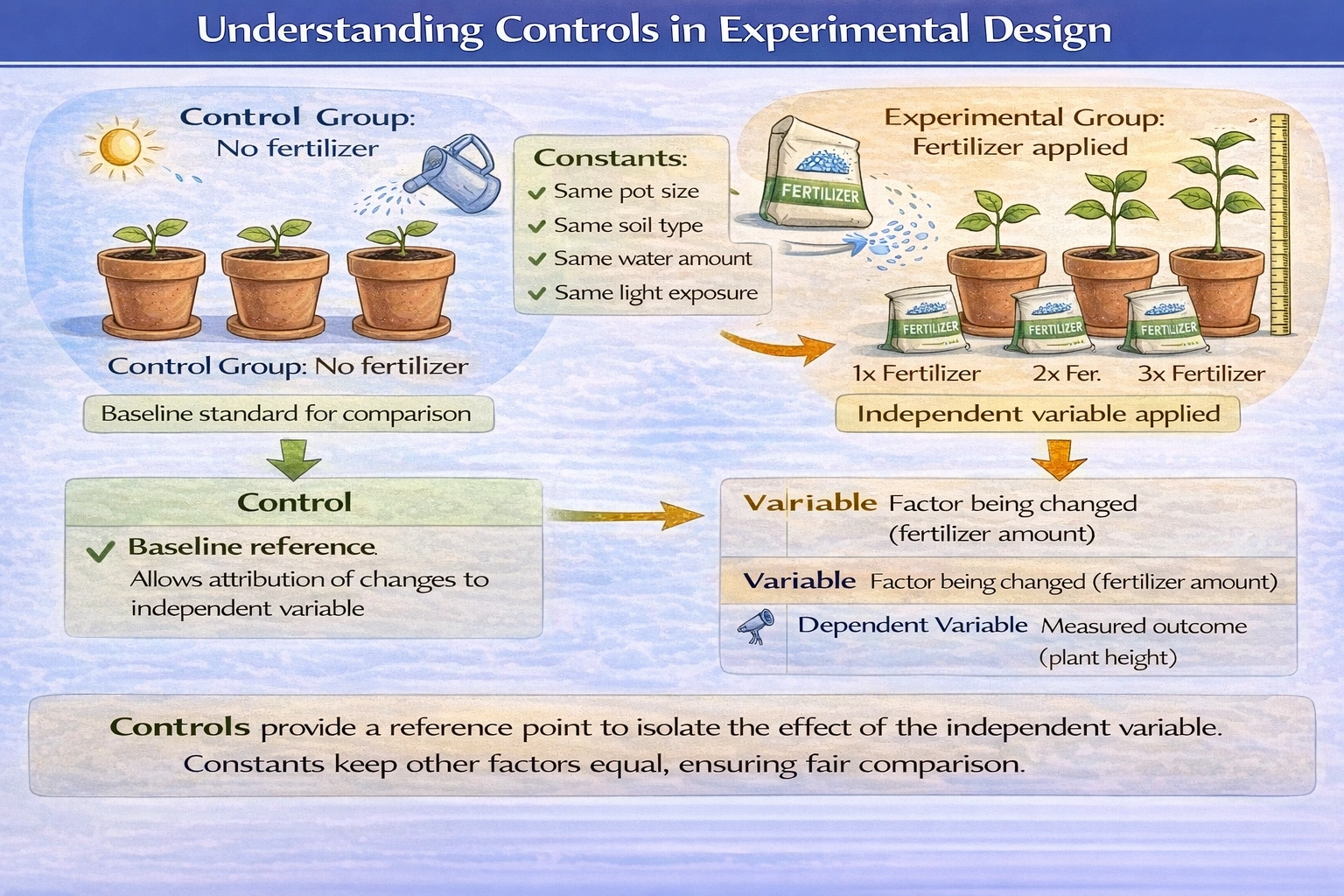
A control provides the baseline standard against which experimental results are compared to isolate the effect of the independent variable by eliminating alternative explanations for observed changes.
Controls establish reference conditions where the independent variable is absent or held at a standard level, enabling researchers to distinguish treatment effects from background variation, placebo responses, or environmental influences through comparative analysis.
A) A control
Controls serve as comparative baselines in experimental design. A negative control receives no treatment (e.g., placebo injection) to establish baseline response levels. A positive control receives a known effective treatment to verify experimental sensitivity. In plant growth experiments testing fertilizer effects, the control group receives identical conditions except fertilizer—allowing researchers to attribute growth differences specifically to fertilizer rather than soil quality, light exposure, or watering frequency. Without controls, researchers cannot determine whether observed effects stem from the manipulated variable or confounding factors.
B) A variable
Variables represent factors that change during experimentation—either deliberately manipulated (independent variables) or measured as outcomes (dependent variables). Variables constitute what researchers investigate, not standards for comparison. Confusing variables with controls would eliminate the reference point necessary for causal inference—researchers need stable baselines to interpret variable changes meaningfully.
C) A constant
Constants (controlled variables) are factors deliberately kept identical across all experimental groups to prevent confounding (e.g., temperature, light duration, container size). While essential for experimental validity, constants maintain uniformity rather than providing comparative standards. They prevent alternative explanations but don't serve as reference points against which results are measured—controls fulfill that comparative function.
D) Collected data
Data represents raw measurements obtained during experimentation—not standards for comparison. Data requires interpretation against controls to derive meaning; uninterpreted data lacks contextual reference. For instance, recording "plant height = 15 cm" provides no insight without comparison to control group heights under identical conditions except the tested variable.
Conclusion:
Experimental validity depends on comparative analysis against established baselines. Controls provide these essential reference standards by maintaining all conditions identical except the independent variable—enabling attribution of outcome differences specifically to the manipulated factor. While constants prevent confounding and variables represent investigated factors, only controls serve as comparative standards. Option A correctly identifies controls as the methodological cornerstone enabling causal inference through systematic comparison—without which experimental results remain uninterpretable against background variation.