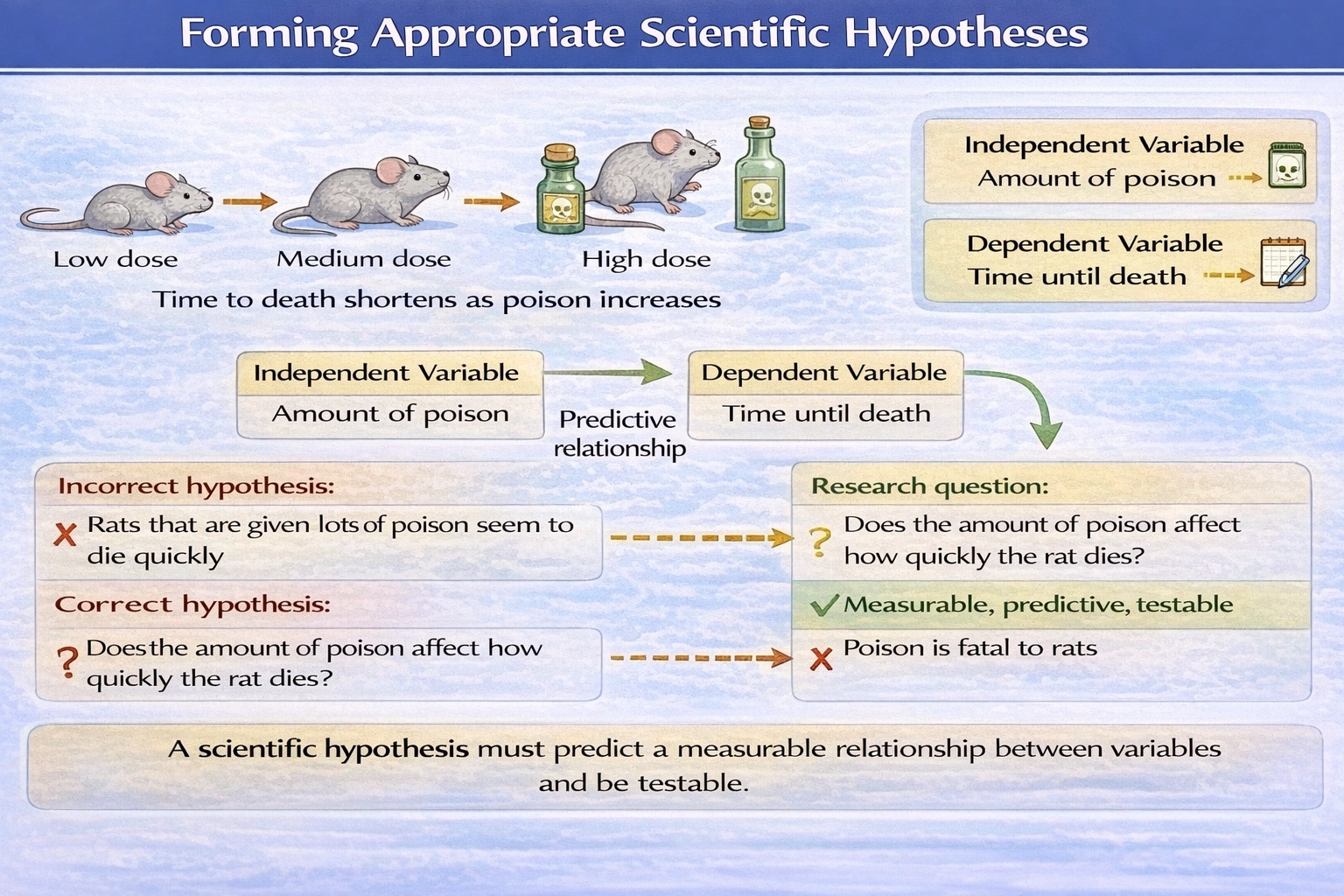
A scientist is trying to determine how much poison will kill a rat the fastest. Which of the following statements is an example of an appropriate hypothesis?
-
A
Rats that are given lots of poison seem to die quickly.
-
B
Does the amount of poison affect how quickly the rat dies?
-
C
The more poison a rat is given, the quicker it will die.
-
D
Poison is fatal to rats.
An appropriate hypothesis states a testable, predictive relationship between variables: "The more poison a rat is given, the quicker it will die."
A scientific hypothesis must be falsifiable, specific, and predictive—proposing a directional relationship between an independent variable (poison amount) and dependent variable (time to death) that can be empirically tested through controlled experimentation.
A) Rats that are given lots of poison seem to die quickly
This statement uses vague, non-quantitative language ("lots of poison," "seem to die") that lacks precision required for experimental testing. Scientific hypotheses require measurable variables—"lots" cannot be operationally defined for replication, and "seem" introduces subjective interpretation rather than objective prediction. Additionally, past-tense phrasing ("are given") describes observation rather than predicting future experimental outcomes.
B) Does the amount of poison affect how quickly the rat dies?
This is a research question, not a hypothesis. Questions identify areas for investigation but lack the predictive assertion required of hypotheses. A hypothesis must state an expected relationship ("will increase," "will decrease") rather than merely inquire about existence of a relationship. Research questions precede hypothesis formation in the scientific method but cannot substitute for testable predictions.
C) The more poison a rat is given, the quicker it will die
This statement presents a clear, directional, falsifiable prediction: as independent variable (poison dosage) increases, dependent variable (time to death) decreases. It specifies measurable variables (quantifiable poison amounts, time intervals until death) enabling experimental design with controlled dosages and timed observations. The prediction can be falsified if higher doses produce longer survival times or no change—meeting essential criteria for scientific hypotheses. This formulation aligns with dose-response relationship testing fundamental to toxicology.
D) Poison is fatal to rats
This statement describes a known fact rather than a testable prediction about variable relationships. While verifiable, it lacks specificity about the research question (speed of death relative to dosage) and cannot be falsified within the experimental context—researchers already know poison kills rats. Hypotheses must advance beyond established knowledge to propose novel, testable relationships between variables under investigation.
Conclusion:
Scientific hypotheses serve as predictive bridges between research questions and experimental design, requiring specificity, measurability, and falsifiability. Option C provides the only statement meeting these criteria—proposing a directional dose-response relationship that can be tested through controlled poison administration and timed mortality observations. Options A, B, and D fail as hypotheses due to vagueness, interrogative form, or description of established facts rather than novel predictions. Proper hypothesis formulation enables rigorous experimental testing and meaningful interpretation of results in toxicological research.