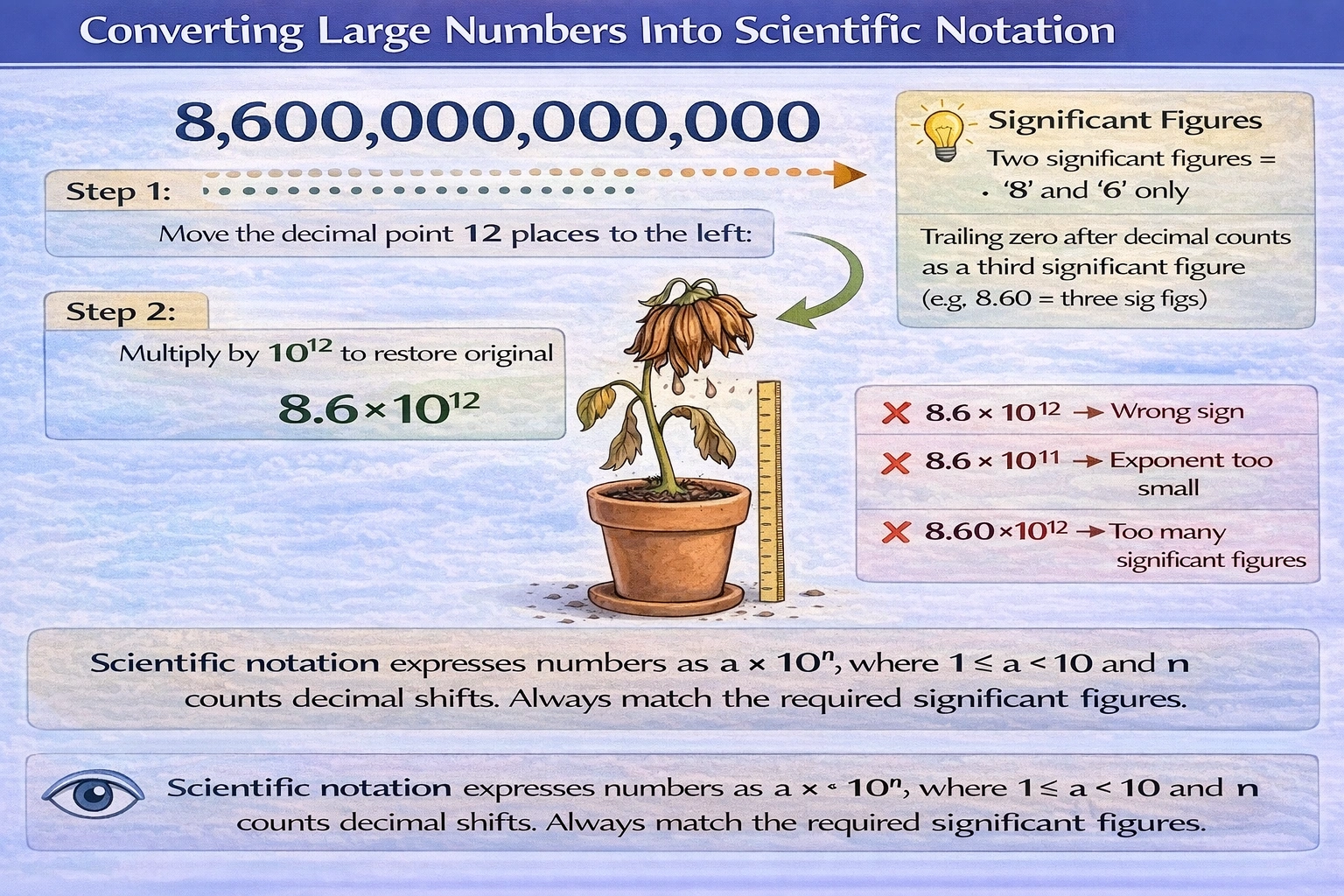
Which of the following correctly displays 8,600,000,000,000 in scientific notation (to two significant figures)?
-
A
8.6 × 10¹²
-
B
8.6 × 10⁻¹²
-
C
8.6 × 10¹¹
-
D
8.60 × 10¹²
Scientific notation follows the format a × 10ⁿ where 1 ≤ |a| < 10 and n is an integer; significant figures in the coefficient reflect measurement precision, with trailing zeros after a decimal point counting as significant while those before the decimal in whole numbers typically do not.
A) 8.6 × 10¹²
Moving the decimal point 12 places to the left converts 8,600,000,000,000 to 8.6, requiring multiplication by 10¹² to restore original value. The coefficient 8.6 contains exactly two significant figures (8 and 6), satisfying the precision requirement. Verification: 8.6 × 10¹² = 8.6 × 1,000,000,000,000 = 8,600,000,000,000. This representation correctly balances magnitude accuracy with specified precision.
B) 8.6 × 10⁻¹²
A negative exponent indicates a fractional value less than one: 8.6 × 10⁻¹² = 0.0000000000086, which is 10²⁴ times smaller than the target value. Negative exponents apply to values between 0 and 1, not large numbers exceeding 10. This option fundamentally misapplies exponent sign convention.
C) 8.6 × 10¹¹
This equals 8.6 × 100,000,000,000 = 860,000,000,000—only one-tenth of the target value (8.6 trillion vs. 860 billion). Counting decimal places: 8,600,000,000,000 requires 12 places moved left to reach 8.6 (not 11), making 10¹¹ insufficient by a factor of ten. Exponent errors commonly arise from miscounting zeros or decimal positions.
D) 8.60 × 10¹²
While numerically equivalent to the target value (8.60 × 10¹² = 8,600,000,000,000), the coefficient 8.60 contains three significant figures (8, 6, and the trailing zero after decimal). The question specifically requires two significant figures; the extra zero implies greater precision than warranted by the original value's representation. Scientific notation must reflect appropriate precision—8.60 suggests measurement to the nearest 10 billion, while 8.6 suggests measurement to the nearest 100 billion.
Conclusion:
Scientific notation requires both correct magnitude representation and appropriate significant figure precision. Option A achieves both: the exponent 12 correctly restores magnitude after decimal normalization, and the coefficient 8.6 contains exactly two significant figures as specified. Option D, while magnitude-correct, violates precision requirements by implying three significant figures. Options B and C fail magnitude requirements through sign error and exponent miscalculation respectively. Mastery of scientific notation conventions proves essential for communicating measurement precision in scientific contexts—from astronomical distances to molecular scales—where orders of magnitude and precision levels carry critical interpretive meaning.