Which of the following is a representation of a natural pattern or occurrence that's difficult or impossible to experience directly?
-
A
A theory
-
B
A model
-
C
A law
-
D
An observation
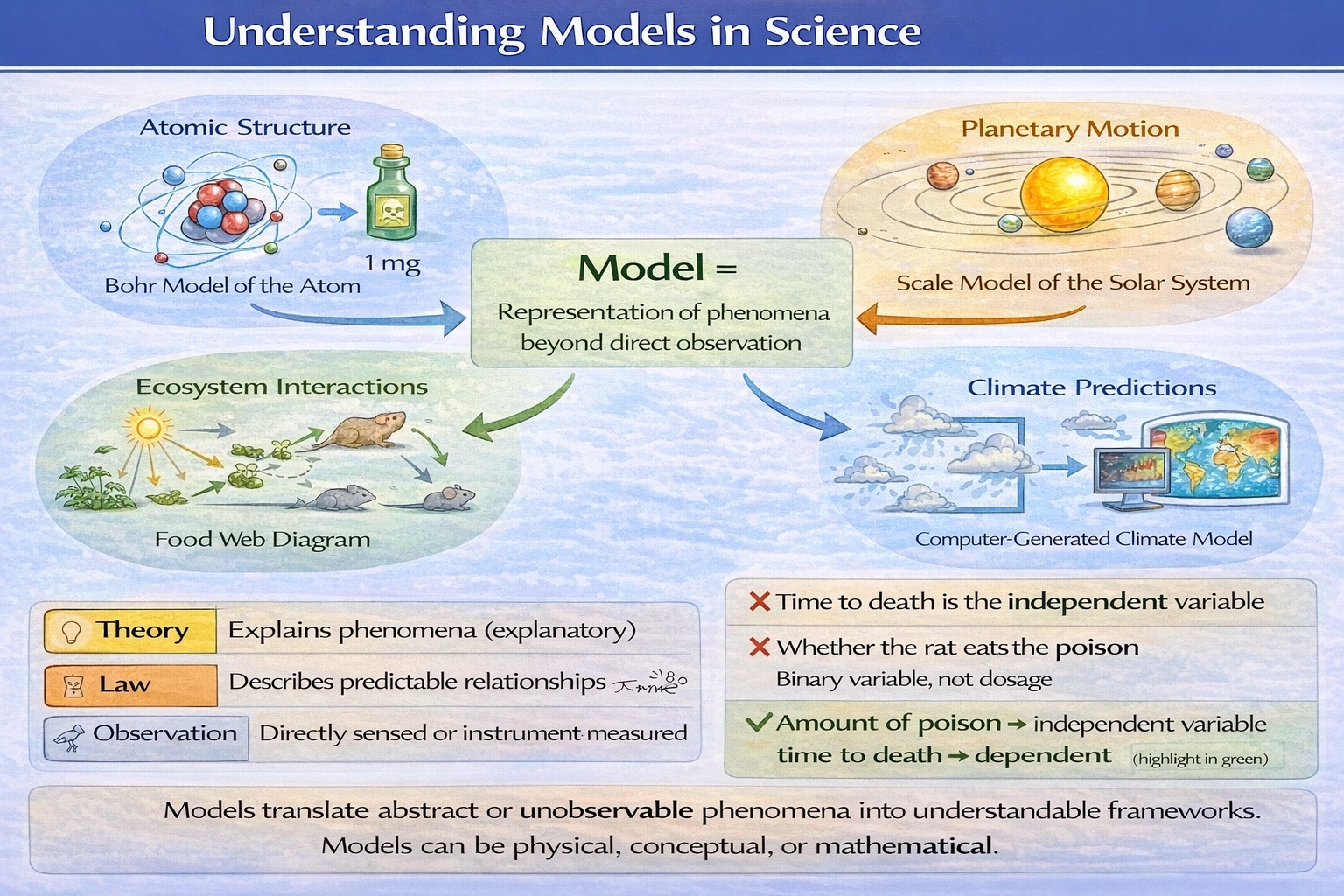
A model provides a simplified representation of complex natural phenomena that cannot be directly observed or experienced in their entirety, such as atomic structure, planetary motion, or ecosystem dynamics.
Models serve as conceptual, mathematical, or physical analogies that translate abstract or inaccessible phenomena into comprehensible frameworks for prediction, explanation, and experimental design—bridging observable data with unobservable mechanisms.
A) A theory
A theory constitutes a comprehensive, evidence-based explanation of natural phenomena supported by extensive testing and verification (e.g., germ theory, evolution). While theories explain patterns, they represent explanatory frameworks rather than representational tools. Theories integrate laws, models, and observations but are not themselves representations of inaccessible phenomena—they are explanatory constructs built from multiple lines of evidence.
B) A model
Models represent phenomena that resist direct observation through analogies, simulations, or mathematical abstractions. The Bohr model visualizes electron orbits around atomic nuclei despite electrons being fundamentally unobservable as discrete particles in fixed paths. Climate models simulate atmospheric interactions across centuries using computational algorithms. Scale models of DNA helices represent molecular structures millions of times larger than reality. Models intentionally simplify complexity to highlight essential features while acknowledging limitations—enabling prediction and conceptual understanding of otherwise inaccessible systems.
C) A law
A law describes consistent mathematical relationships observed in nature under specific conditions (e.g., Newton's law of universal gravitation, Boyle's law). Laws summarize what happens predictably but do not represent inaccessible phenomena—they describe observable patterns quantitatively without explaining underlying mechanisms or providing visual/conceptual representations.
D) An observation
Observations constitute direct sensory or instrumental data collection about phenomena (e.g., thermometer readings, microscope images). By definition, observations require direct or instrument-mediated experience of phenomena—they cannot represent what is impossible to experience directly. Observations form empirical foundations for models but are not representations themselves.
Conclusion:
Models uniquely function as representational tools for phenomena beyond direct human experience—translating abstract mathematical relationships, microscopic structures, or macroscopic systems into comprehensible forms. While theories explain, laws describe mathematically, and observations document directly, models specifically bridge the gap between observable data and unobservable reality through intentional simplification and analogy. Option B correctly identifies models as the representational mechanism enabling scientific understanding of inaccessible phenomena—from subatomic particles to galactic evolution—making them indispensable tools across scientific disciplines.