In testing how quickly a rat dies by the amount of poison it eats, which of the following is the independent variable and which is the dependent variable?
-
A
How quickly the rat dies is the independent variable; the amount of poison is the dependent variable.
-
B
The amount of poison is the independent variable; how quickly the rat dies is the dependent variable.
-
C
Whether the rat eats the poison is the independent variable; how quickly the rat dies is the dependent variable.
-
D
The cage the rat is kept in is the independent variable; the amount of poison is the dependent variable.
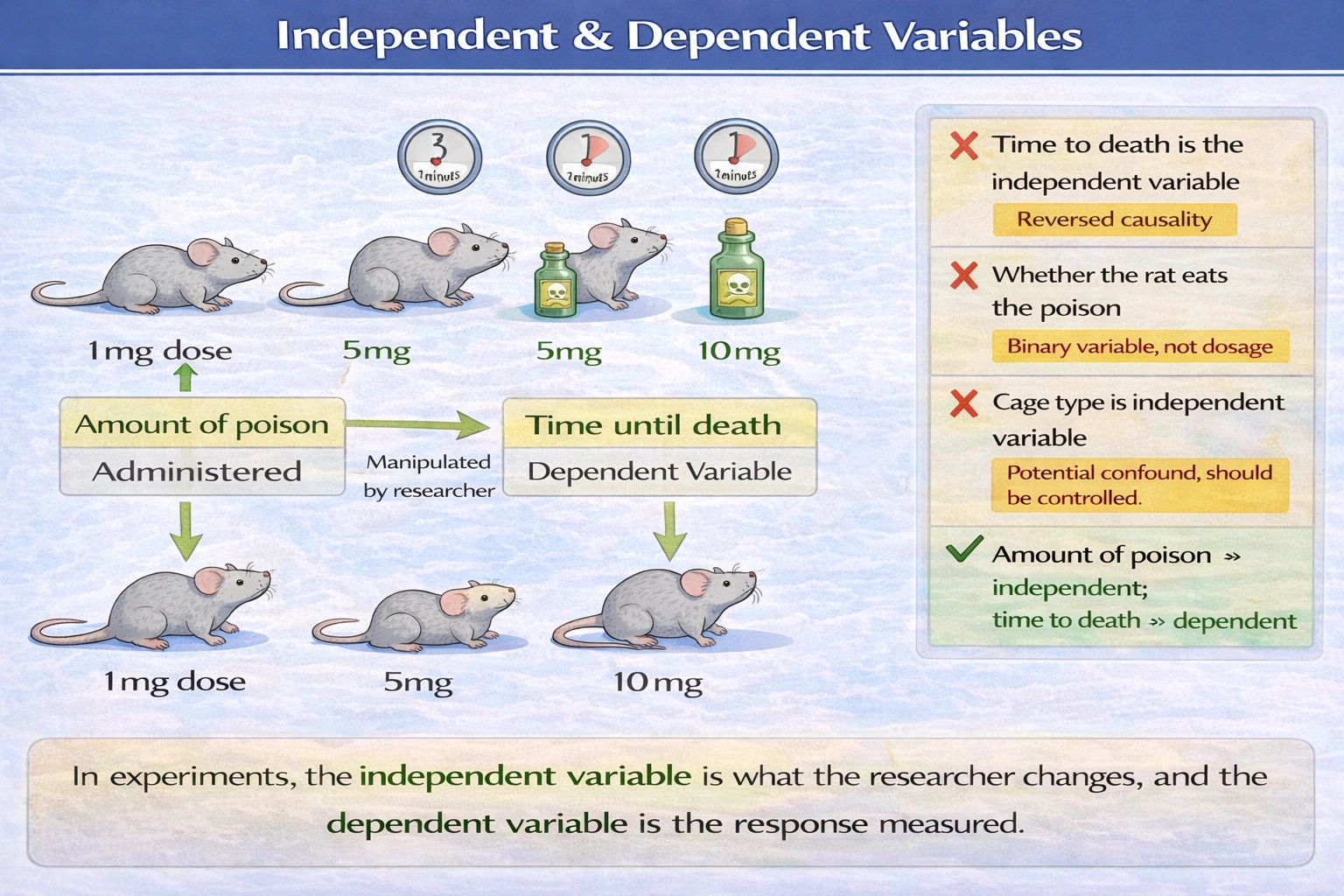
The amount of poison administered constitutes the independent variable that the researcher manipulates, while the time until death represents the dependent variable measured as the experimental outcome.
Independent variables are deliberately controlled or varied by researchers to observe their effects on dependent variables, which respond to these manipulations and are measured as outcomes—establishing cause-effect relationships essential for experimental validity.
A) How quickly the rat dies is the independent variable; the amount of poison is the dependent variable
This option reverses the causal relationship. Time to death cannot be manipulated to cause changes in poison dosage; rather, poison dosage influences time to death. Independent variables must be under researcher control—scientists administer specific poison amounts but cannot directly control precisely when death occurs. This inversion misrepresents experimental design fundamentals and would render causal inference impossible.
B) The amount of poison is the independent variable; how quickly the rat dies is the dependent variable
Researchers systematically vary poison dosages (e.g., 1mg, 5mg, 10mg) across experimental groups while holding other factors constant, then measure resulting time intervals until death. Poison amount represents the manipulated cause; time to death represents the measured effect. This causal direction aligns with toxicological dose-response principles where dosage determines physiological impact severity and speed. Statistical analysis examines whether variations in the independent variable significantly predict changes in the dependent variable.
C) Whether the rat eats the poison is the independent variable; how quickly the rat dies is the dependent variable
While poison consumption represents a binary condition (consumed/not consumed), the research question specifically investigates dosage effects ("how much poison"), not mere presence/absence. Binary variables lack the gradation necessary to test dose-response relationships. Additionally, researchers typically administer poison directly rather than relying on voluntary consumption to ensure precise dosage control and eliminate feeding behavior as a confounding variable.
D) The cage the rat is kept in is the independent variable; the amount of poison is the dependent variable
Cage characteristics represent potential confounding variables that should be held constant (controlled) across all experimental groups—not manipulated as independent variables. Varying cages would introduce uncontrolled environmental differences potentially affecting mortality rates independent of poison dosage. Poison amount must remain the deliberately manipulated variable; cage conditions should be standardized to isolate poison effects from environmental influences.
Conclusion:
Experimental design requires clear distinction between manipulated causes (independent variables) and measured effects (dependent variables) to establish valid causal relationships. In dose-response toxicology studies, administered dosage serves as the independent variable while physiological outcomes (time to death) function as dependent variables. Option B correctly identifies this relationship, enabling proper experimental setup where researchers control poison amounts to observe resulting mortality timing. Misidentification of variables (options A, C, D) would compromise experimental validity by confusing causation direction, eliminating dosage gradation, or introducing uncontrolled confounds—preventing accurate assessment of the poison's lethal kinetics.
