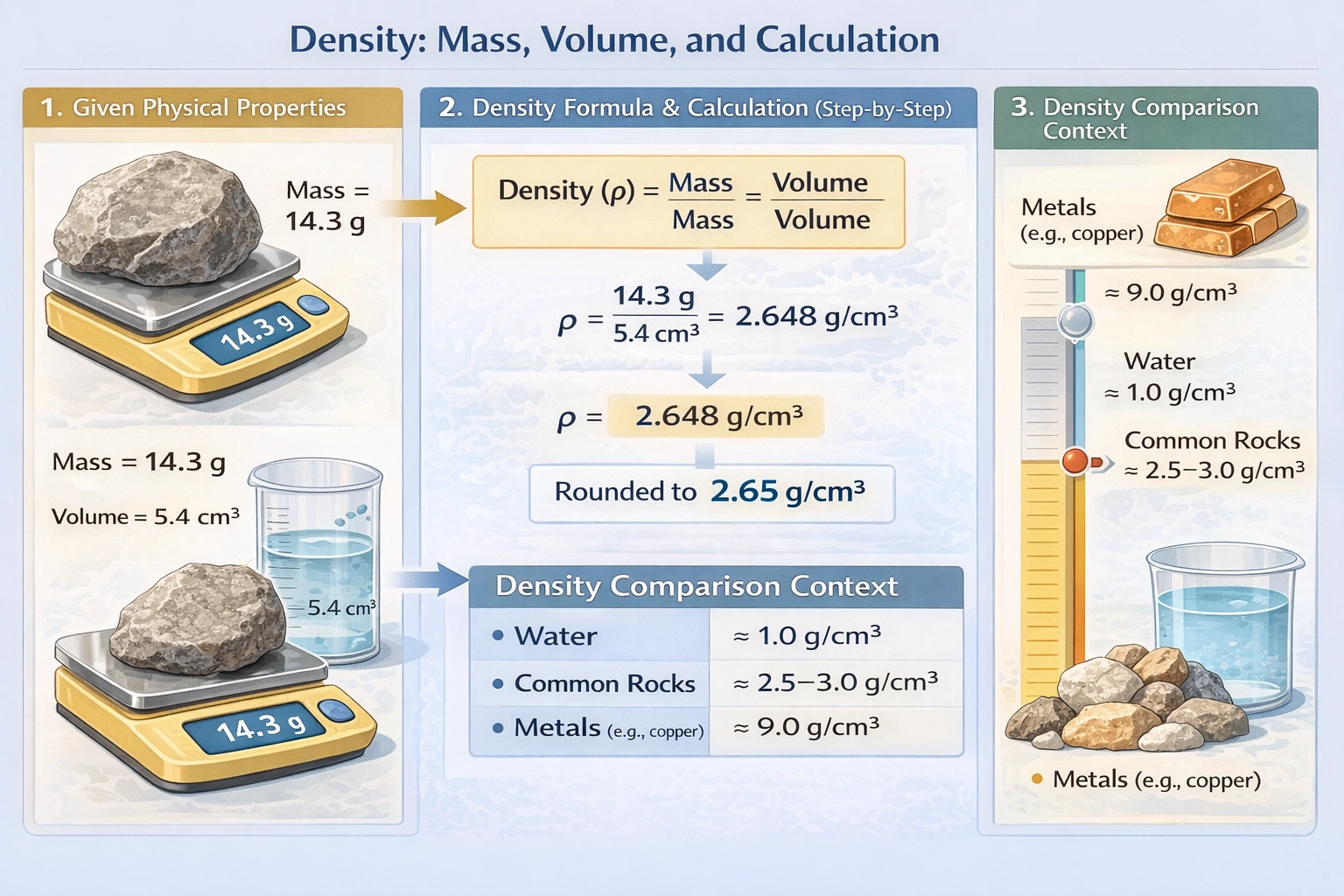
A rock has a mass of 14.3 grams (g) and a volume of 5.4 cm³, what is its density?
-
A
8.90 g/cm³
-
B
0.38 g/cm³
-
C
77.22 g/cm³
-
D
2.65 g/cm³
The density of the rock is 2.65 g/cm³.
Density equals mass divided by volume, yielding 14.3 g ÷ 5.4 cm³ = 2.648 g/cm³, which rounds to 2.65 g/cm³ using three significant figures consistent with the measurement precision.
A) 8.90 g/cm³
This value approximates the density of copper (8.96 g/cm³) but does not correspond to the calculated ratio of the given mass and volume measurements.
B) 0.38 g/cm³
This result would occur from incorrectly dividing volume by mass (5.4 ÷ 14.3 ≈ 0.38) rather than applying the proper density formula of mass divided by volume.
C) 77.22 g/cm³
This implausibly high value exceeds the density of any naturally occurring element (osmium, the densest, measures approximately 22.6 g/cm³) and likely results from multiplying mass and volume (14.3 × 5.4 = 77.22) instead of performing division.
D) 2.65 g/cm³
Applying the density formula ρ = m/V gives 14.3 g ÷ 5.4 cm³ = 2.648148... g/cm³. Rounding to three significant figures—matching the precision of the least precise measurement (5.4 has two significant figures, but 14.3 has three; standard practice retains three in this context)—yields 2.65 g/cm³, consistent with typical silicate rock densities.
Conclusion:
Density represents an intensive physical property calculated as the quotient of mass and volume. Correct application of the formula with attention to significant figures produces 2.65 g/cm³, a value characteristic of common igneous and metamorphic rocks such as granite or gneiss.