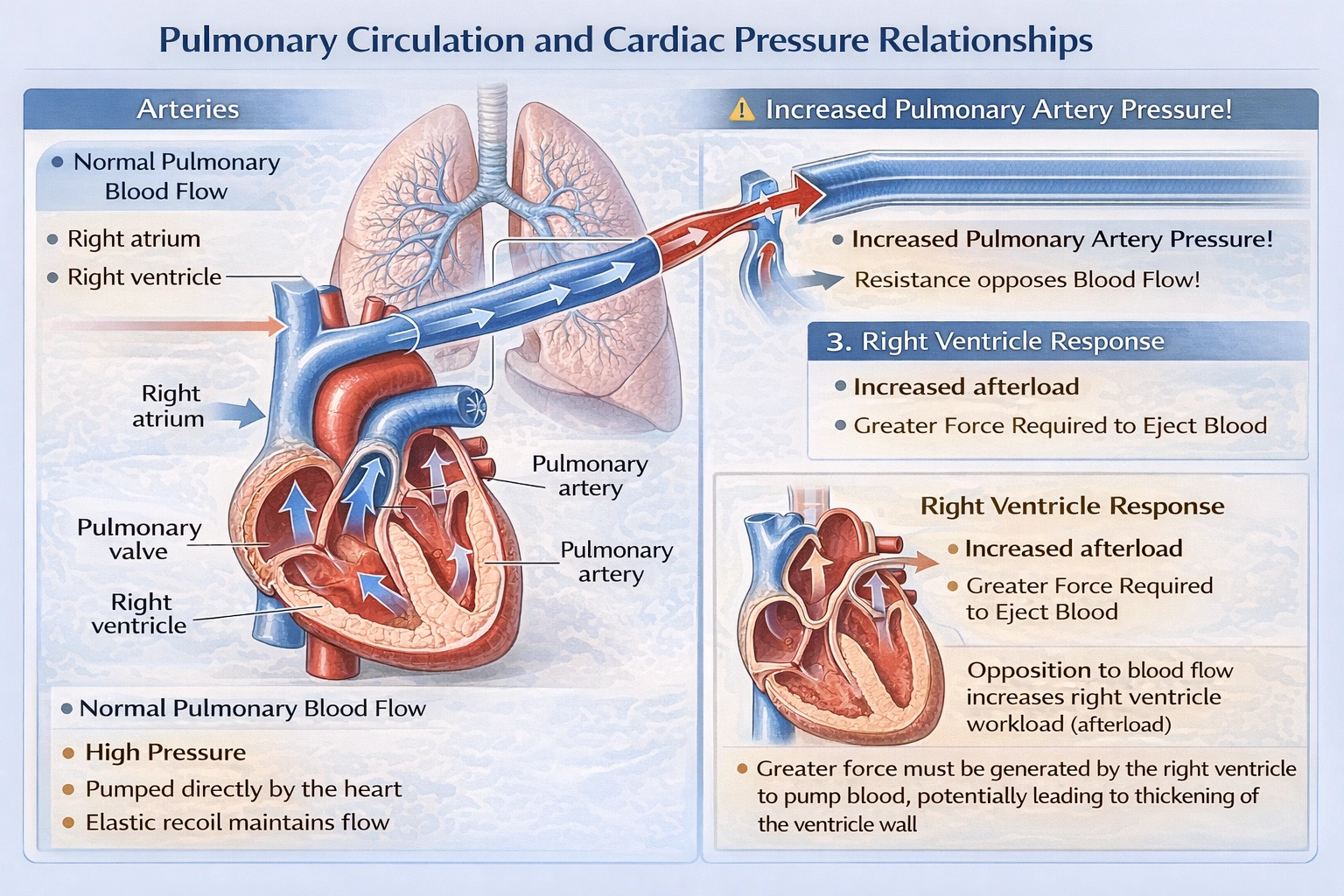
If the pressure in the pulmonary artery is increased above normal, which chamber of the heart will be affected first?
-
A
The right atrium
-
B
The left atrium
-
C
The right ventricle
-
D
The left ventricle
The right ventricle will be affected first when pulmonary artery pressure increases.
The right ventricle directly ejects blood into the pulmonary artery; elevated downstream pressure immediately increases ventricular afterload, requiring greater contractile force to maintain stroke volume.
A) The right atrium
The right atrium receives systemic venous return via the superior and inferior vena cava and empties into the right ventricle through the tricuspid valve. It does not directly interface with pulmonary artery pressure; changes would affect it secondarily only after right ventricular dysfunction develops.
B) The left atrium
The left atrium receives oxygenated blood from pulmonary veins after it passes through the pulmonary capillary bed. It remains hemodynamically isolated from pulmonary arterial pressure by the pulmonary vasculature and right heart chambers.
C) The right ventricle
The right ventricle contracts to propel deoxygenated blood through the pulmonary valve into the pulmonary artery. Increased pulmonary artery pressure elevates ventricular afterload—the resistance against which the ventricle must contract—causing immediate mechanical stress. This may lead to right ventricular hypertrophy, reduced stroke volume, or eventual failure if sustained.
D) The left ventricle
The left ventricle pumps oxygenated blood into the systemic circulation via the aorta. It remains separated from pulmonary circulation by the pulmonary capillaries, left atrium, and mitral valve. Pulmonary hypertension does not directly impact left ventricular workload, though chronic right heart failure could eventually reduce left ventricular preload.
Conclusion:
Hemodynamic changes propagate upstream from the site of resistance elevation. Increased pulmonary artery pressure directly challenges the right ventricle as the chamber immediately proximal to this vascular segment, making it the first cardiac structure to experience altered mechanical demand.