Which of the following describes a reflex arc?
-
A
The storage and recall of memory
-
B
The maintenance of visual and auditory acuity
-
C
The autoregulation of heart rate and blood pressure
-
D
A stimulus and response controlled by the spinal cord
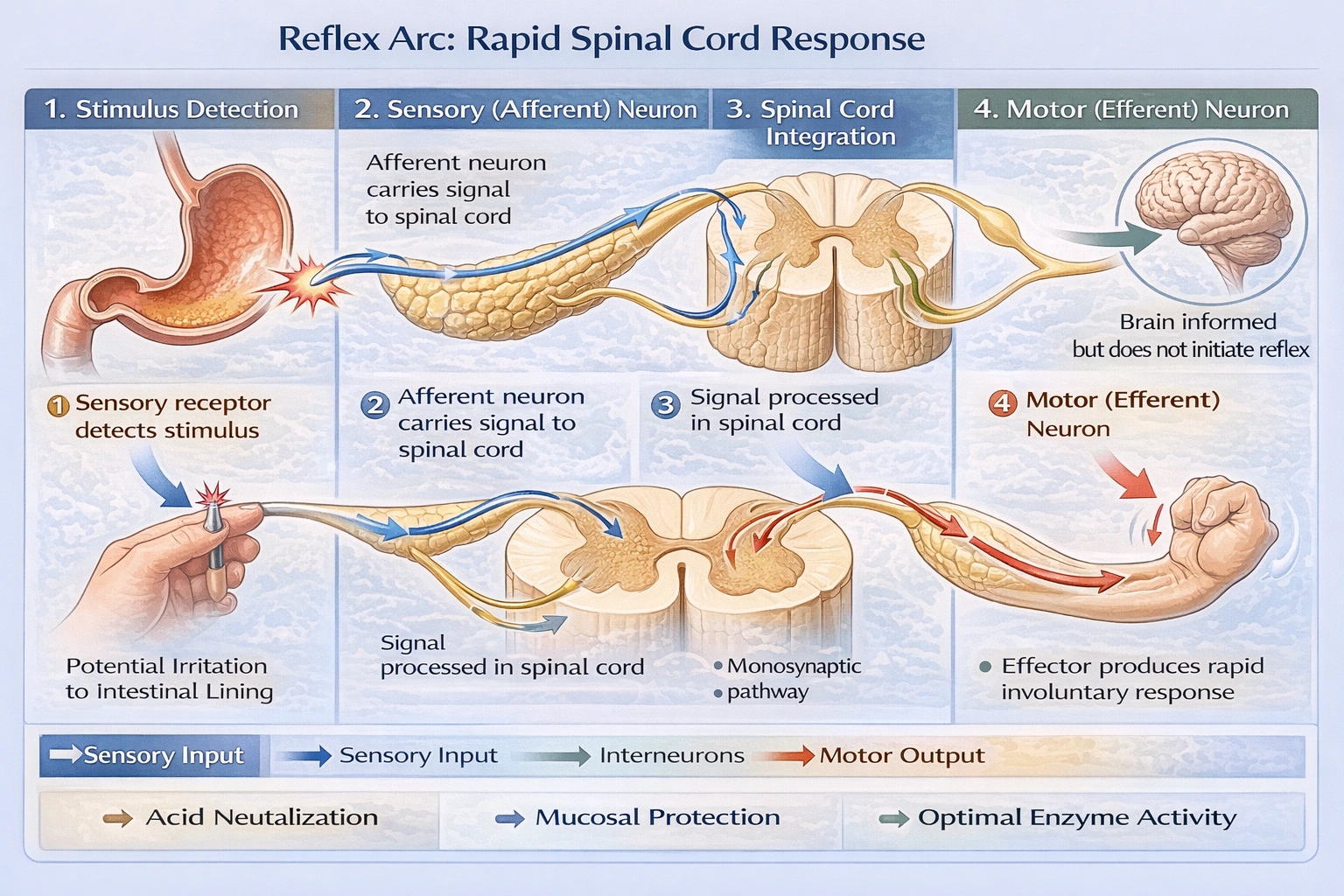
A reflex arc is a stimulus and response controlled by the spinal cord.
Reflex arcs constitute rapid, involuntary neural circuits where sensory input triggers motor output through spinal cord integration without requiring cerebral processing, enabling immediate protective responses.
A) The storage and recall of memory
Memory formation and retrieval involve complex synaptic plasticity within the hippocampus, cerebral cortex, and associated limbic structures. These processes require conscious or subconscious cortical engagement and extended neural networks, contrasting with the simple, rapid pathways of spinal reflexes.
B) The maintenance of visual and auditory acuity
Sensory acuity depends on receptor density, neural processing in specialized cortical areas (visual cortex, auditory cortex), and adaptive mechanisms like pupil constriction or middle ear muscle reflexes. While some auditory reflexes involve brainstem pathways, visual acuity maintenance does not constitute a classic spinal reflex arc.
C) The autoregulation of heart rate and blood pressure
Cardiovascular autoregulation occurs through baroreceptor reflexes involving the medulla oblongata's cardiovascular centers, not the spinal cord. Baroreceptors in the carotid sinus and aortic arch send signals via cranial nerves to the brainstem, which modulates autonomic output to the heart and vessels—a brain-mediated process distinct from spinal reflex arcs.
D) A stimulus and response controlled by the spinal cord
A reflex arc follows this sequence: sensory receptors detect a stimulus (e.g., pain from a sharp object), afferent neurons transmit signals to the spinal cord, interneurons (in polysynaptic reflexes) or direct synapses (in monosynaptic stretch reflexes) process the signal within the cord, and efferent neurons activate effectors (muscles or glands) to produce an immediate response (e.g., limb withdrawal). The brain may receive notification afterward but does not initiate the response, enabling reaction times faster than conscious processing allows.
Conclusion:
Reflex arcs exemplify the nervous system's capacity for rapid, protective responses through minimal neural circuitry confined to the spinal cord. This design prioritizes speed for survival-critical reactions such as withdrawing from harmful stimuli, distinguishing reflex arcs from higher-order cognitive or brainstem-mediated regulatory processes.
