Why do arteries have valves?
-
A
They have valves to maintain high blood pressure so that capillaries diffuse nutrients properly.
-
B
Their valves are designed to prevent backflow due to their low blood pressure.
-
C
They have valves due to a leftover trait from evolution that, like the appendix, are useless.
-
D
They do not have valves, but veins do.
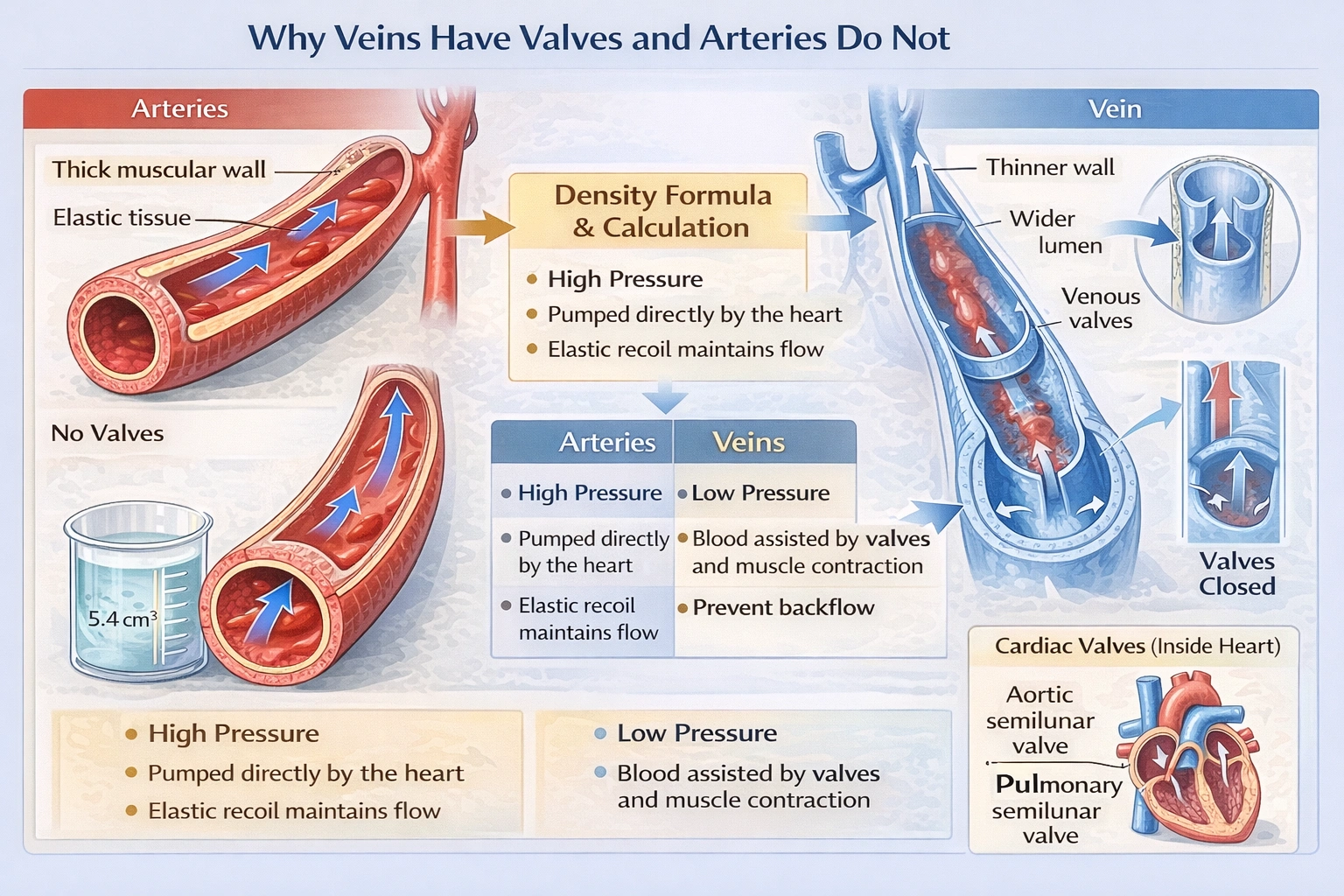
Arteries do not have valves, but veins do.
Systemic arteries transport blood under high pressure generated by ventricular contraction, creating unidirectional flow that eliminates the need for valvular structures to prevent backflow.
A) They have valves to maintain high blood pressure so that capillaries diffuse nutrients properly
Arterial pressure results from cardiac contractility, vascular resistance, and arterial elasticity—not valvular mechanisms. Arteries lack valves along their length (except semilunar valves at ventricular exits within the heart), and pressure maintenance occurs through smooth muscle tone and vessel compliance.
B) Their valves are designed to prevent backflow due to their low blood pressure
This description applies to veins, not arteries. Veins operate under low pressure and contain numerous bicuspid valves, especially in limbs, to prevent gravitational backflow and ensure unidirectional return to the heart. Arteries experience high pressure that naturally propels blood forward without requiring valves.
C) They have valves due to a leftover trait from evolution that, like the appendix, are useless
Arteries do not possess vestigial valves; they simply lack valves entirely beyond the heart's semilunar valves. This absence reflects functional adaptation rather than evolutionary remnant—high-pressure flow obviates the need for valvular prevention of backflow.
D) They do not have valves, but veins do
Systemic arteries contain no internal valves along their course. The pulmonary artery and aorta each have a semilunar valve at their origin from the heart's ventricles, but these are cardiac valves, not arterial structures. Veins, particularly in the extremities, contain multiple valves to assist low-pressure blood return against gravity.
Conclusion:
Cardiovascular anatomy aligns with hemodynamic requirements: high-pressure arterial flow requires no valves for unidirectional movement, while low-pressure venous return depends on valvular structures to prevent backflow. Arteries beyond the heart lack valves entirely.
