100% 4 Rated
Attempts 127

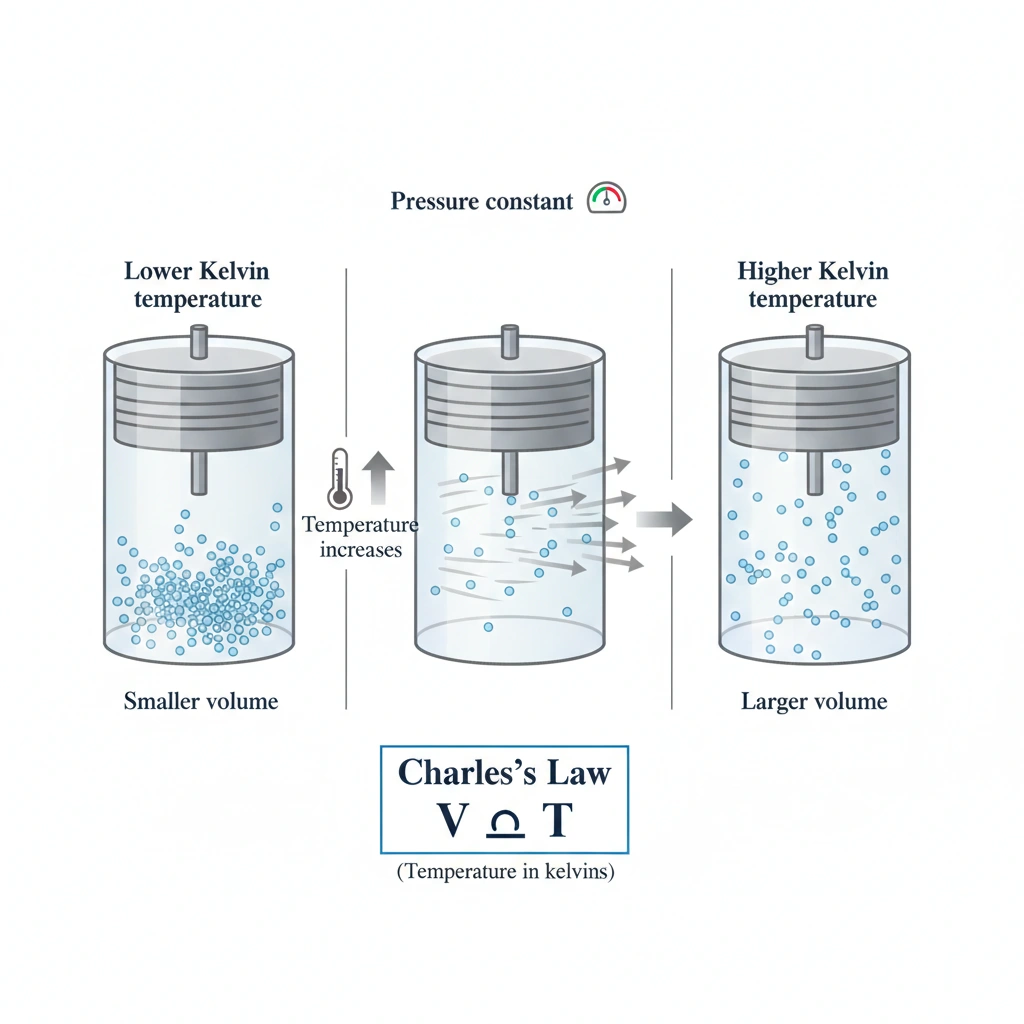
According to Charles’s Law, at constant pressure, Kelvin temperature is proportional to _______.

  1. A
    mass
  2. B
    volume
  3. C
    expansion
  4. D
    compression

Topic Flashcards

Click to Flip
Question

State Charles's Law in your own words. What condition (which variable is held constant) is required?

Answer

At constant pressure, the volume of a fixed amount of gas is directly proportional to its absolute temperature (in Kelvin).

Question

Write the mathematical expression for Charles's Law. What do the variables V and T represent?

Answer

V₁/T₁ = V₂/T₂, where V is volume and T is absolute temperature in Kelvin.

Question

Why is the Kelvin temperature scale (not Celsius) essential for using Charles's Law?

Answer

The direct proportionality (V ∝ T) is only valid for an absolute temperature scale where zero represents the theoretical point of zero volume. The Kelvin scale starts at absolute zero (0 K = -273.15 °C), making it the correct scale for gas laws.

Question

If a balloon has a volume of 2.0 L at 300 K, what will its volume be at 450 K if the pressure is constant?

Answer

Using V₁/T₁ = V₂/T₂: V₂ = V₁ * (T₂/T₁) = 2.0 L * (450 K / 300 K) = 3.0 L.

Question

Explain Charles's Law using the concepts of kinetic molecular theory (the behavior of gas particles).

Answer

Increasing the temperature increases the average kinetic energy of the gas particles. At constant pressure, the particles move faster and collide with the container walls more forcefully, causing the walls to expand until the pressure inside again equals the constant external pressure, resulting in a larger volume.

Mini Quiz

1 / 3
Does Charles's Law apply if the gas is in a rigid, sealed container (constant volume)?
Available Test Sets
Available FREE Test Sets