100% 4 Rated
Attempts 127

Longitudinal waves have vibrations that move _______.

  1. A
    at right angles to the wave direction
  2. B
    in a circular motion
  3. C
    in the same or opposite direction as the wave
  4. D
    in waves and troughs

Topic Flashcards

Click to Flip
Question

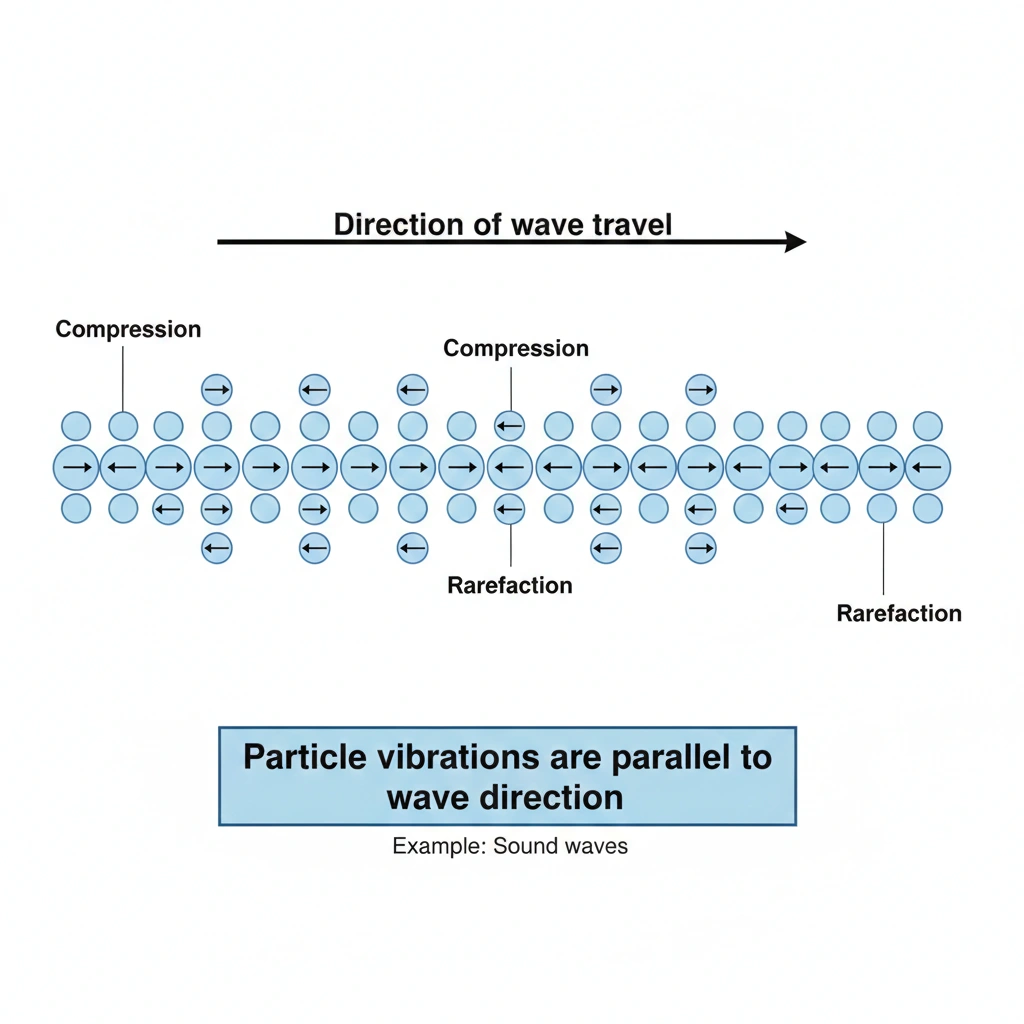
What is the definition of a longitudinal wave? Describe the direction of particle vibration relative to the wave's travel.

Answer

A longitudinal wave is a wave in which the particles of the medium vibrate parallel to (in the same line as) the direction the wave travels.

Question

How does the particle motion in a longitudinal wave differ from that in a transverse wave?

Answer

In a longitudinal wave, particles move parallel to wave travel (back-and-forth). In a transverse wave, particles move perpendicular (side-to-side or up-and-down) to wave travel.

Question

Name a common example of a longitudinal wave. What are the regions of high and low particle density in such a wave called?

Answer

Sound waves in air are longitudinal. The high-density regions are called compressions, and the low-density regions are called rarefactions.

Question

Why does a longitudinal wave require a medium (like air, water, or a solid) to travel?

Answer

Longitudinal waves are mechanical waves that transfer energy by causing particles in a medium to collide in a chain reaction. Without particles to transmit these collisions, the wave cannot propagate. (This is why sound cannot travel in a vacuum).

Question

Can longitudinal waves be polarized? Why or why not?

Answer

No. Polarization filters waves based on their vibration direction. Since longitudinal waves vibrate along their travel direction, rotating a filter does not block them—the vibration direction is always the same relative to the wave's path.

Mini Quiz

1 / 3
Do longitudinal waves, like sound, have crests and troughs?
Available Test Sets
Available FREE Test Sets