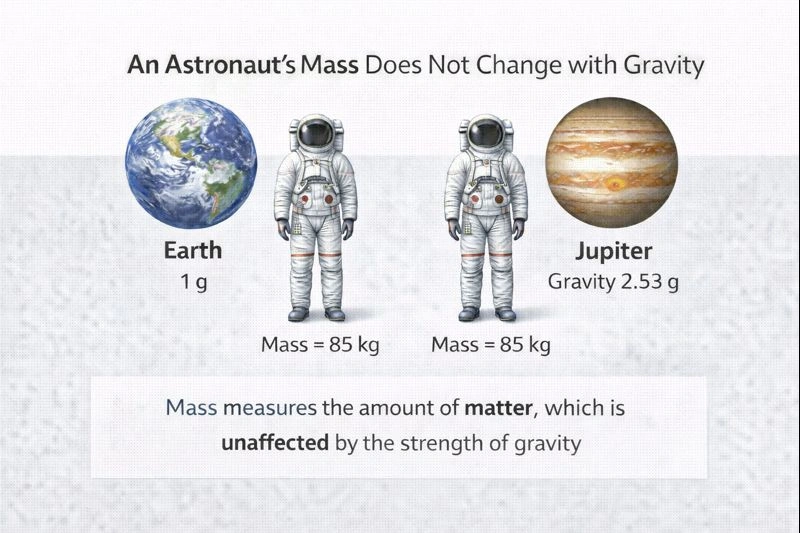
An astronaut’s mass on Earth is 85 kg. What is his mass on Jupiter, where gravity is 2.53 times Earth’s?
-
A
33.6 kg
-
B
85 kg
-
C
87.53 kg
-
D
215.05 kg
The astronaut’s mass on Jupiter is 85 kg.
Mass measures the amount of matter in an object and does not depend on gravity. Changing location from Earth to Jupiter changes the strength of the gravitational field and therefore the astronaut’s weight, but it does not change his mass. Even though Jupiter’s gravity is 2.53 times stronger than Earth’s, the astronaut still contains the same amount of matter.
A) 33.6 kg
This value comes from dividing the mass by 2.53, which reflects a misunderstanding between mass and weight. Dividing by gravitational strength would relate to force calculations, not mass. Mass is not reduced by weaker or stronger gravity.
B) 85 kg
Mass remains constant regardless of location. Whether on Earth, Jupiter, or in space, the astronaut’s mass stays the same because the quantity of matter does not change.
C) 87.53 kg
This option adds a numerical value related to gravity without any physical basis. Gravity does not add matter to an object, so it cannot increase mass.
D) 215.05 kg
This value results from multiplying the mass by 2.53, which would be appropriate when calculating weight (force) rather than mass. Weight depends on gravity; mass does not.
Conclusion
Gravity affects weight, not mass. Even though Jupiter’s gravity is much stronger than Earth’s, the astronaut’s mass remains 85 kg.

Topic Flashcards
Click to FlipDefine mass and weight and state which one changes with location (like on different planets).
Mass is the amount of matter in an object (kg). Weight is the gravitational force on that mass (N). Weight changes with location; mass does not.
What is the formula that relates weight (W), mass (m), and gravitational acceleration (g)?
W = m × g.
Calculate the astronaut's weight on Jupiter if his mass is 85 kg and Jupiter's gravity is 2.53 times Earth's (g_Earth ≈ 9.8 m/s²).
g_Jupiter = 2.53 × 9.8 m/s² ≈ 24.8 m/s². Weight (W) = 85 kg × 24.8 m/s² ≈ 2108 N
What would the astronaut's weight be in newtons if he were in deep space, far from any significant gravitational field?
Approximately 0 N (weightless). His mass, however, would still be 85 kg.
Why is the answer to the original question (85 kg) correct even though Jupiter's gravity is stronger?
Because mass is an intrinsic property of an object that measures its quantity of matter. It does not depend on the local strength of gravity.