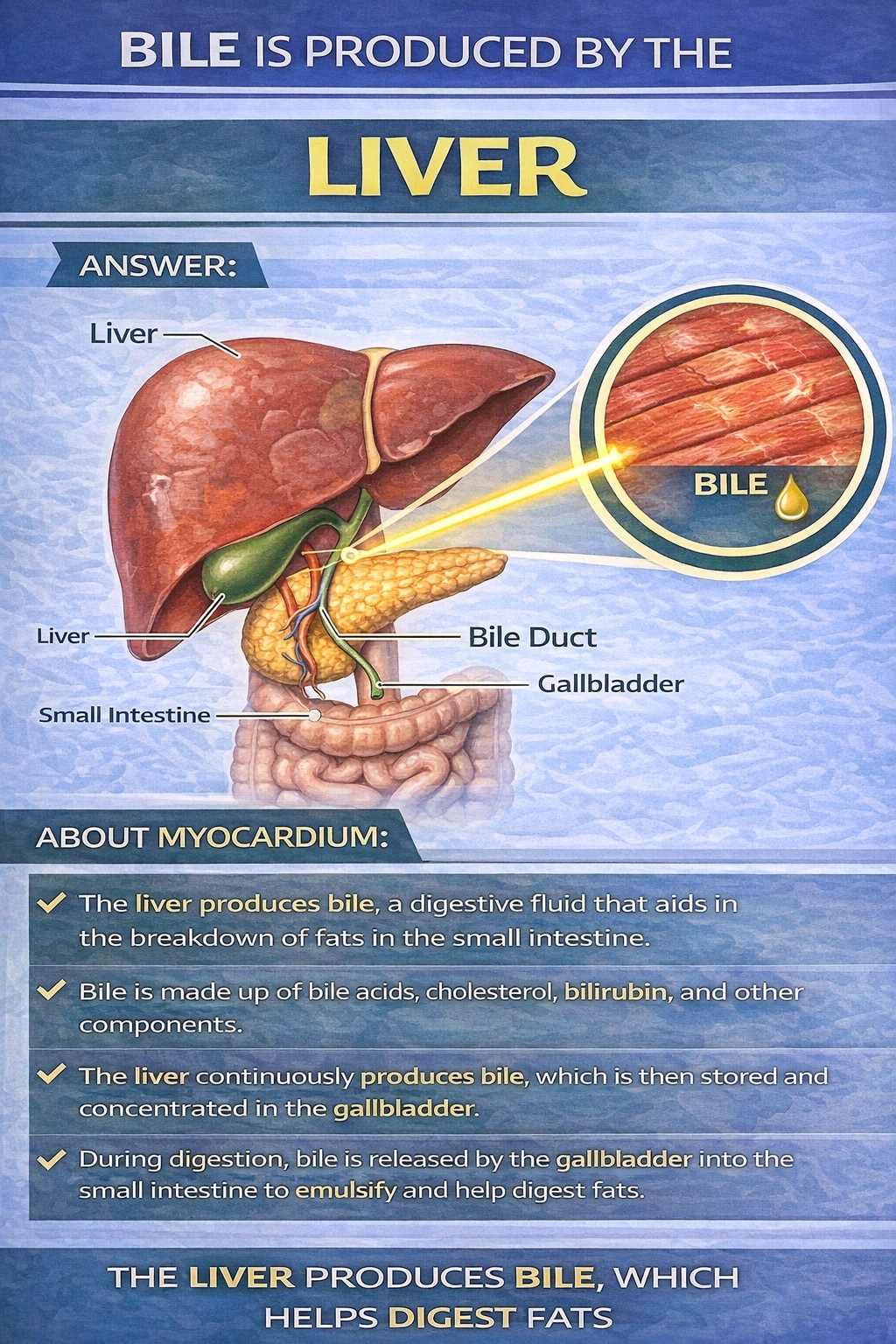
Bile is produced by the ____.
-
A
Liver
-
B
Spleen
-
C
gall bladder
-
D
Pancreas
Bile is produced by the liver.
Bile is a digestive fluid essential for the digestion and absorption of fats. It contains bile salts, cholesterol, bilirubin, water, and electrolytes, which work together to emulsify fats in the small intestine, increasing the surface area for enzyme action and facilitating nutrient absorption.
A) Liver
The liver continuously synthesizes bile as part of its normal metabolic and digestive functions.
Hepatocytes (liver cells) produce bile, which is then transported through bile ducts to the gall bladder for storage and concentration. During digestion, especially after fatty meals, bile is released into the duodenum to aid in fat digestion.
In addition to digestion, bile also serves as a route for eliminating waste products such as bilirubin and excess cholesterol from the body. Because bile is manufactured in the liver, this option is correct.
B) Spleen
The spleen is involved in filtering blood, recycling old red blood cells, storing platelets, and supporting immune function.
It does not participate in digestion and does not produce or store bile. Its physiological role is related to hematologic and immune processes, not digestive secretions.
Therefore, this option is incorrect.
C) Gall bladder
The gall bladder does not produce bile.
Instead, it stores and concentrates bile that has already been produced by the liver. When fatty food enters the small intestine, the gall bladder contracts and releases bile through the bile duct into the duodenum.
Because its function is storage and release rather than production, this option is incorrect.
D) Pancreas
The pancreas produces digestive enzymes such as amylase, lipase, and proteases, as well as bicarbonate to neutralize stomach acid.
Although it plays a major role in digestion, it does not produce bile. Pancreatic secretions and bile are separate digestive fluids with different compositions and functions.
Therefore, this option is incorrect.
Conclusion:
Bile is a digestive fluid synthesized by liver cells, stored in the gall bladder, and released into the small intestine to assist in fat digestion and waste elimination.
The spleen filters blood, the gall bladder stores bile, and the pancreas produces digestive enzymes, but only the liver produces bile.
Therefore, the correct answer is the liver.
Topic Flashcards
Click to FlipWhat are the two primary components of bile that aid in fat digestion?
Bile salts and phospholipids (which emulsify fats).
Which organ stores and concentrates bile after it is produced by the liver?
The gallbladder.
What is the name of the pigment in bile that is a breakdown product of hemoglobin and gives feces its brown color?
Bilirubin.
Through which duct does bile travel from the liver and gallbladder to the small intestine?
The common bile duct.
What condition can occur if bile flow is blocked, leading to yellowing of the skin and eyes?
Jaundice (or obstructive jaundice).